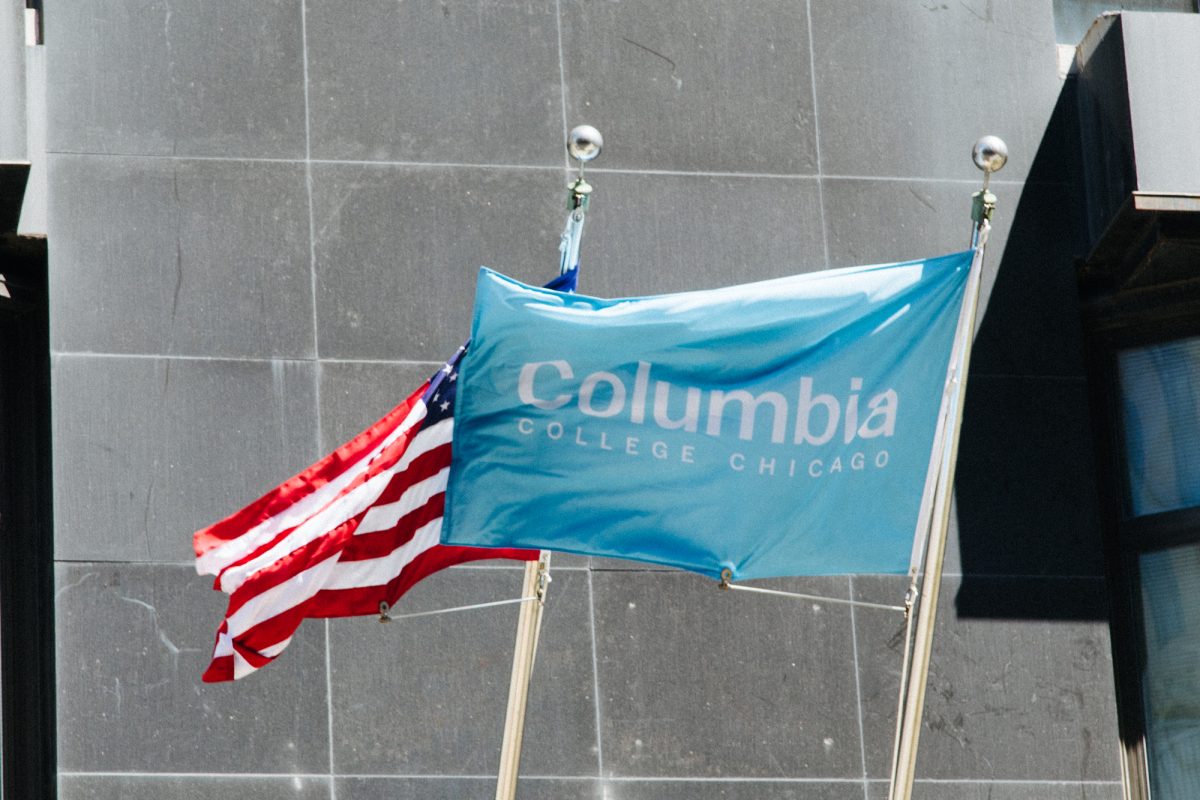

Columbia has been officially reclassified by the Carnegie Classification of Institutions of Higher Education as a “Special Focus: Arts, Music, and Design” institution, a category reserved for schools that award at least half of their degrees in one cluster of disciplines.
In Columbia’s case, that means the arts, media and design fields make up its core.
The Carnegie Classifications were updated in April this year to better reflect schools’ missions and concentrations. Columbia is now grouped with institutions whose academic offerings look more like its own, instead of being lumped in with broad-based universities. Other schools with the same classification in Chicago are the School of the Art Institute of Chicago and The American Academy of Art Chicago.
“This classification is a good thing, not only nationally, because it provides more nuance and accuracy in terms of how institutions are focused with their mission, but really within a broader higher education landscape,” said Luke Schalewski, the college’s executive director of the Office of Institutional Effectiveness.
He said the reclassification is not related to Columbia’s decision last year to reduce its core curriculum to give students more major-focused electives and to consolidate its academic offerings.
About half of the 43 full-time faculty who lost their jobs since the start of this year taught in the core, which encompassed traditional liberal arts courses.
“It’s really not due to Columbia changing,” Schalewski said. “It’s just due to Carnegie classification changes to be a bit more nuanced regarding the way they classify colleges.”
What the change means
Special Focus institutions are those that award at least 50% of their degrees in a specific academic field, area of study, or a set of related disciplines.
For Columbia, these degrees are in programs such as art, music, design, dance, graphics, and animation, as well as other forms of artistic expression and communication.
The 2025 Institutional Classification organizes U.S. colleges and universities using multiple factors instead of just the highest degree offered. The update reflects feedback from leaders and researchers to better group schools by program types, degree levels and size.
This change, which formally happened in spring 2025, could make it easier for prospective students to see Columbia as an option when they use college search tools.
“This is going to allow Columbia to pop up because those college search tools are using this Carnegie classification and before it would not happen,” Schalewski said. “It helps to distinguish us compared to our competition, like University of Illinois [at] Chicago, DePaul – those institutions have art, design and music programs, but Columbia as a whole, really has this discipline and expertise.”
When first-year Aliana Gonzalez was looking for colleges, she initially planned on going to UIC, but it did not offer the program she wanted, which was game design.
“They only have computer science,” she said. “Here, doing game design, I kind of get both computer science and then also the actual thing I want to do in the future.”
First-year music business major Therese Batano said that she has friends younger than her that are currently looking for colleges to apply to, and Columbia is one of their options.
“They were also mentioning how they think about Columbia, possibly applying here because of how focused it is in arts,” she said. “You’re surrounded by a lot of people who are also really creative and based around that.”
Karla Fuller, Faculty Senate president and a professor in the School of Film and Television, said the designation highlights what Columbia does best: nurturing creativity, artistry and innovation across disciplines.
But she said it also raises questions about how programs that don’t neatly fall under the new arts label fit within the designation.
She used Film and Television, the largest of the eight schools at the college, as an example.
“Film and television are deeply tied to the arts, of course, but they are also industries, technologies, and cultural forces,” she said. “Our students are not only creators; they are also preparing to work in fast-changing professional environments where critical thinking, adaptability and collaboration are key.”
A shifting identity
From 1973 to 1987, Columbia was classified as a Liberal Arts College II. This designation applied to institutions that emphasize undergraduate education but have less selective admissions and award a lower proportion of degrees in liberal arts fields compared to their “Liberal Arts I” counterparts.
The college has since been reclassified several times, moving from Baccalaureate Colleges II in 1994 to Master’s Colleges and Universities I in 2000, and then remaining in the master’s medium programs category from 2005 through 2021.
In 2022, the college met the eligibility requirement for a Hispanic Serving Institution with at least 25% of the student body identifying as Hispanic. With this new Carnegie reclassification, Columbia is the only institution in continental United States that is both an HSI and an institution with a special focus in arts, music and design.
Fuller acknowledged that there are real opportunities that come with the change. But she said the college needs to be intentional about ensuring programs outside the traditional “arts” framing aren’t overshadowed.
“This designation gives us the chance to emphasize that dual identity — to highlight how we stand at the intersection of art, media, and industry,” she said.
“We’re kind of the one that overlaps within both categories in the continental United States. So once again, speaks to how we distinguish ourselves compared to our competition, given our mission and values,” Schalewski said.
Copy edited by Matt Brady
Resumen en español
Columbia ha sido reclasificada como una universidad enfocada en el arte, música y el diseño, por el sistema Carnegie. El sistema fue actualizado en abril, con la meta de reflejar mejor las misiones de las universidades en el país. Como la universidad cumplió con los requisitos de ser una Institución al Servicio a los Hispanos en 2022, este cambio hace que la universidad sea la única de ISH con el enfoque en la arte en el país. Karla Fuller, la presidenta del senado de la facultad y una profesora en la escuela de la televisión y cine, dijo que este cambio destaca los valores y la misión de Columbia.
Resumen en español por Sofía Oyarzún
Resumen editado por Manuel Nocera