A year after Shantay Bolton introduced herself to Columbia faculty and staff as the college’s new president and CEO, she returned for a summit focused on student support, enrollment and retention as the college works to recover from declining enrollment and financial pressure.
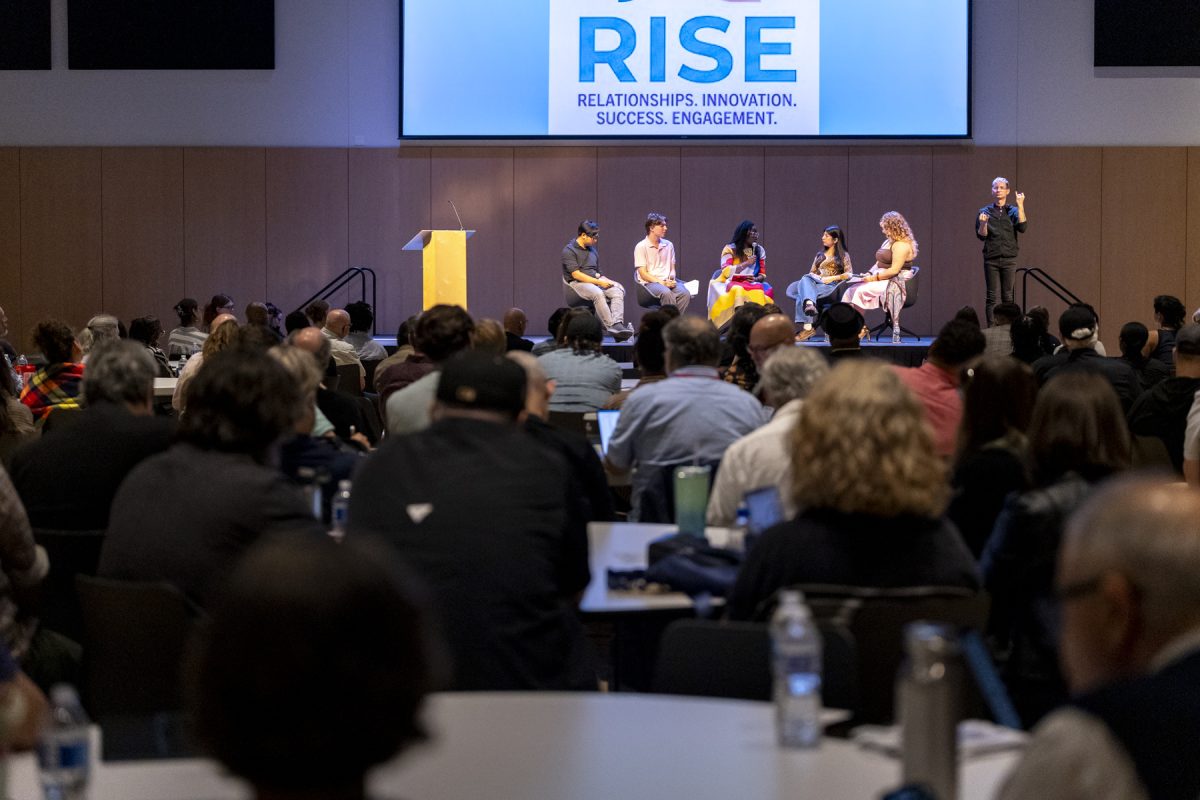
More than 200 faculty and staff attended the Fall 2026 summit at the Student Center on Tuesday, Aug. 18, the first campus gathering for faculty and staff ahead of the fall semester.
“As we enter this new year, I do want to say that our focus will shift from talking about possibilities as much as it will be around execution, execution on the ideas that you have put forth, the recommendations and suggestions,” said Bolton, who received enthusiastic applause from the audience when she started speaking. “We’re going to see those things come to life and to amplify it.”
Columbia reported an increase in incoming students for the fall semester, with a new class of about 1,100 new students compared with 632 first-time, first-year students last fall, according to Emmanuel Lalande, senior vice president of enrollment strategy and student success. Lalande also reported 316 new transfer students registered for fall classes, marking a 12% increase from last year’s 279 students.
Lalande said it was the first time in three years that Columbia was welcoming more than 1,000 new students in the fall.
The increase comes after Columbia experienced a 34% decline in enrollment over the past three years, with 3,958 students in Spring 2026, the lowest in nearly two decades.
Lalande cautioned that the college, which depends on tuition to cover its operating costs, has not yet fully recovered. After two years of significant enrollment declines, enrollment losses have slowed dramatically, he said, moving the college toward stabilization.
“We slowed the bleeding,” he said. “We didn’t stop the bleeding.”
Lalande said Columbia projects reaching 4,500 students by [Fall 2027] and 5,000 by Fall 2029. Final enrollment figures for this fall will not be official until the Sept. 22 census.
“We believe we’ll get to that 4,500 number,” Lalande said. “I know we project we will get there by 2028 to 2029, but I believe we’ll get there sooner because we have set the foundation for an opportunity for growth.”
Bolton urged faculty to move forward and “allow courage to catch up along the way.”
“None of this will happen without you,” Bolton said. “And it is because of you that we were able to think boldly, to lean into new ideas, to also give ourselves permission to be the greater version of ourselves that we could possibly imagine.”
Some faculty said they were encouraged by the message but wanted specific details about how Bolton would begin executing her strategic plan this fiscal year, as she said she intended to do in her second year leading the college.
She did not take questions.
Richard Zeid, associate professor in the School of Design, said he wished Bolton would have discussed her plans for bringing down the financial deficit, which was projected to be $40 million for FY2026, which does not end until Aug. 31. The college has said that number may rise.
“I’m not ignoring all of the successes that students have had, but as an institution, I don’t think we have a lot to celebrate right now,” he said. “I think we have a lot of hard work to address, and I don’t know how it’s being addressed. Makes me feel uneasy.”
Guy Villa, assistant professor in the School of Design, said that he keeps hearing about the problems without knowing the solution.
“I know we have lost a lot of faculty, we’ve lost a lot of staff, but the deficit still remains. So what’s being done about that?” he said. “Those are the things that I think are gonna help the school. I don’t need to be told how to do my job.”
Bolton, who came to Columbia from the Georgia Institute of Technology where she was executive vice president of administration and finance and chief business officer, told the Chronicle in an interview in early August that the financial pressures at Columbia were bigger than she had anticipated when she started in July 2025. The college’s deficit was about $40 million at the start of the Fall 2025 semester, nearly double from the year before.
The college has been cutting costs and eliminating faculty and staff positions in order to address the deficit, raising concerns about students.
According to the Fall 2025 student voice survey, 20% of students cite receiving poor service.
Associate Provost for Student Retention Initiatives Greg Foster-Rice spoke to the college’s renewed focus on improving student and advisor relations, implementing a new system of five standards that staff have been trained on over the summer and will be practicing over the upcoming semester.
“Those are data points that we’re using to help guide us to try to build this culture of care, and keep this number of trajectory and momentum going forward, so that we can change those students over,” said Foster-Rice, an associate professor in the School of Visual Arts.
Columbia’s current retention rate is 72%, according to the Student Success Task Force, up from 66%, a number that Bolton and other college leaders attributed to new student success initiatives.
Newly-appointed Assistant Provost for Faculty Affairs Chris Shaw, an associate professor in the School of Communication and Culture, said that Bolton’s focus on student retention has seemed successful.
“There’s an adage that retention is everyone’s job. And I think that’s something we’ve really been internalizing for the last few years,” Shaw said. “We, as faculty members and administrators and staff, have to be thinking about making sure that the student experience rewards the students who are putting in the time and effort to be here and be in class, and honors that by providing them with a good experience on our end.”
Student Government Association President Amelia Lutz, who was part of a student and alumni panel with Bolton in the afternoon, highlighted the focus on students and progress in enrollment.
“We have a lot of things going on the up for us, and I think there’s something so beautiful about being able to see it being implemented due to things that are happening,” she said.
Lutz found confidence in Bolton’s remarks regarding the college, emphasizing importance on student interests.
“I very much believe that President Bolton and her administration have continued to move forward with the students’ best interests at heart, and I think that’s something that is incredibly important for us as students to keep in mind,” she said.
Faculty Senate President David Gerding, associate professor in the School of Design, said he enjoyed the enthusiasm from the students in the panel and is ready to help faculty start working at a new pace during a transition period for higher education.
“I’m looking forward to helping the Faculty Senate be more agile in terms of being a real active department, in getting policies that we need to get done, done,” he told the Chronicle.
Diana Vallera, adjunct faculty in the School of Visual Arts and president of the Columbia Faculty Union, said she hoped to see students prioritized more than in years past.
“I would like to see some of that institutional discussions with all stakeholders, talking about ‘What are some of the barriers? What are some of the ways we can support each other?’ so that ultimately, we can support our students,” she said.
Vallera, who worked on the strategic planning committee, said Bolton is in a difficult position.
“I’d like to see her acknowledge that it’s gonna take all of us working together to really make Columbia what we all know it can be, right?”
Copy edited by Venus Tapang
This story has been updated to correct the college’s expected enrollment for Fall 2027. Emmanuel Lalande provided the wrong academic year at the Faculty and Staff Summit.