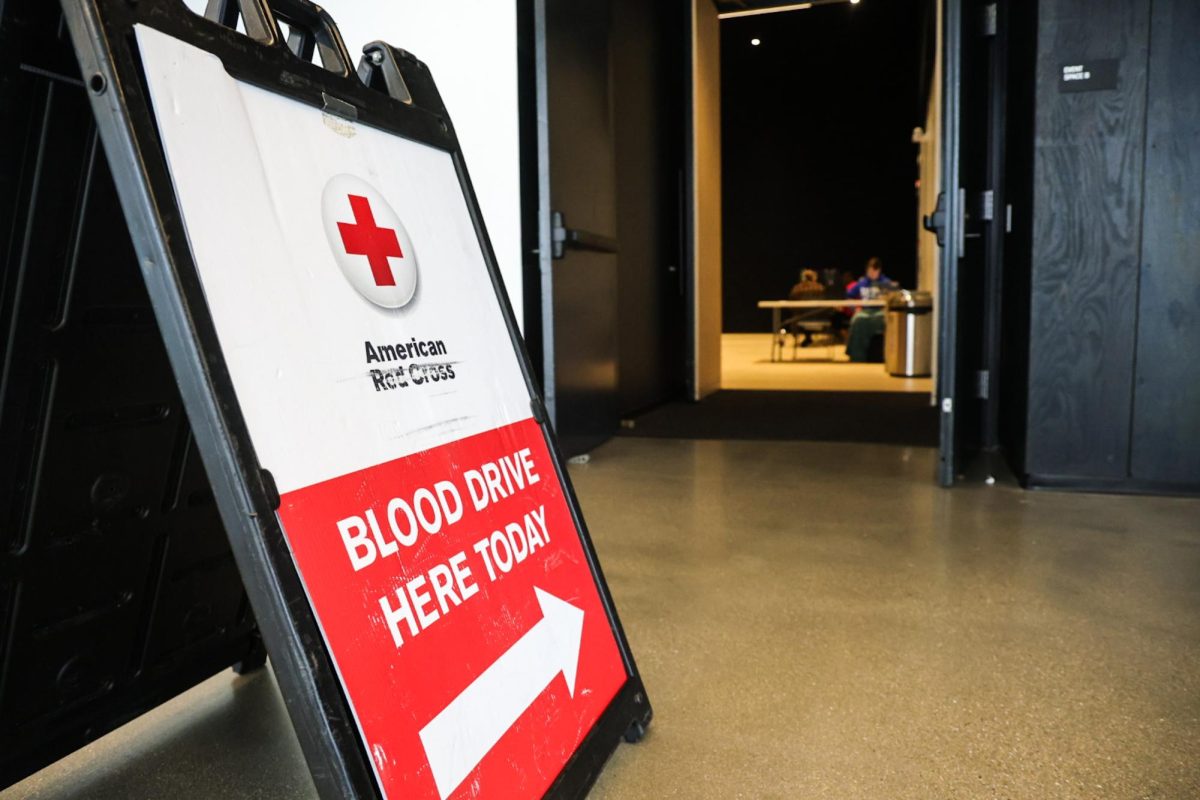
The Student Government Association hosted its biannual blood drive in partnership with the Red Cross on Thursday, Oct. 1, inviting members of the campus community to “be a villager.”
That’s how Mason Lawson, a senior film and television major and the student representative to the Board of Trustees, characterized what it means to donate blood. Lawson helped initiate the idea for the blood drive his first year at Columbia.
“Columbia has gotten many things from the city of Chicago, so finding ways to give back to our community whenever we can, even if it’s just as simple as coming and donating blood or volunteering to help is important,” said Lawson. “We always have the saying, ‘it takes a village,’ and it’s important to also be a villager.”
This was the third year that the SGA hosted the drive on campus, with the goal of collecting as many donations as people wanted to offer.
Donors received a $15 Amazon gift card.
First-year fine arts major Alia Martinez has donated blood seven times in the past when the Red Cross came to her high school and encouraged students to donate.
She has an O-negative blood type. According to the Red Cross, O-negative is used during transfusions when the blood type of a patient is unknown.
“It all benefits someone, so if you can help why not donate?” Martinez said.
Lucy Nemec, sophomore music business major, was trying to find a way to be involved at Columbia. With some encouragement from her mom, who has been a long-term donor, Lucy decided to volunteer for the first time.
She felt a little nervous, but knew how to approach those nerves.
“Be open to the people who are working here and communicate your feelings,” she said. “Read through all the materials and make sure to know what you’re getting yourself into and stay calm.”
Amelia Lutz, SGA president and senior film and television major, helped bring the first SGA blood drive to life. Lutz felt that there was a growing desire among students to help their community.
“We saw a need. A lot of students on campus really wanted to give back to their community, but they didn’t quite know how,” Lutz said. “And so we found that this was probably a really good way to help, especially during the national blood shortage going on.”
Lutz said donating is a small thing students can do to help make a positive impact.
“I think in the current day and age, there’s a lot of things that feel like it’s out of our control, and donating can be a way to help.”
Lawson said the biannual blood drive was a way to make sure donating blood is easily accessible to everyone at Columbia.
“As a college student, I always have a hard time going and donating blood,” Lawson said. “By having a blood drive that is accessible on campus, it means that students don’t have to find other drives, they can go between their classes if they have a little bit of downtime. That makes it more accessible to students.”
Additional reporting by Serenity Burgos
Copy edited by Isaac Russo