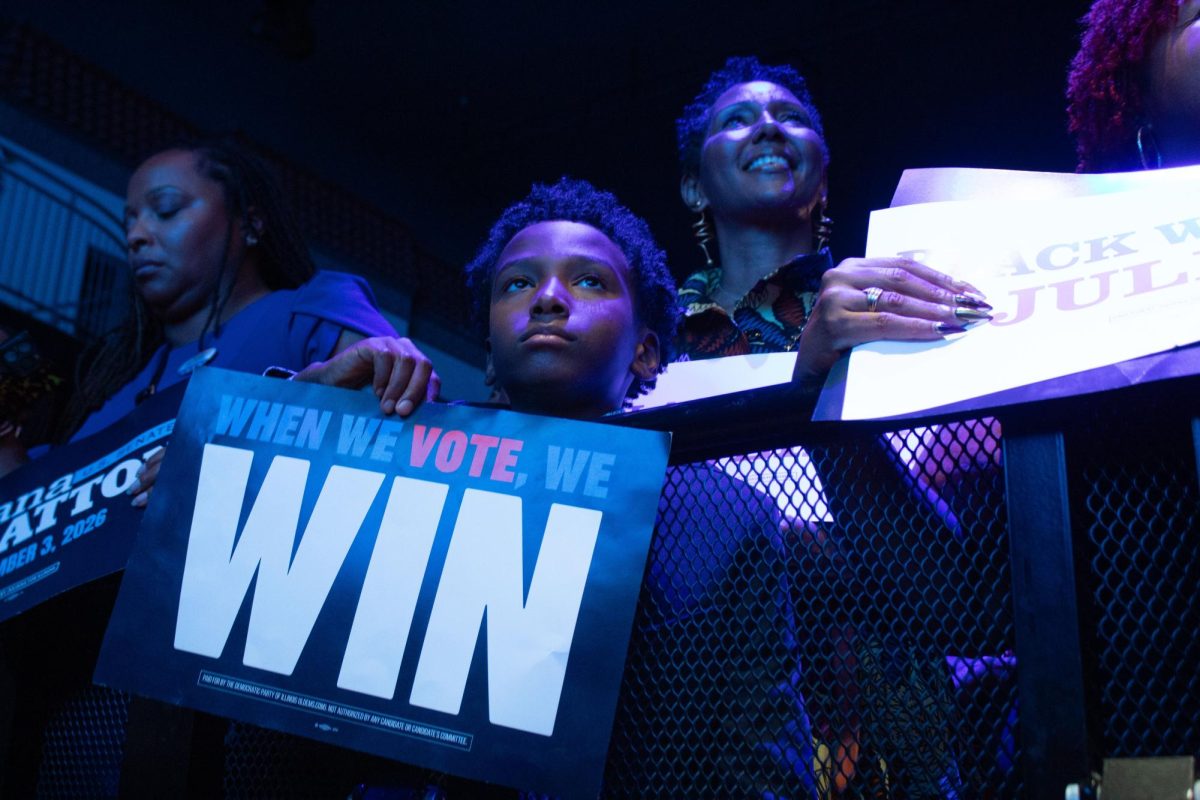

A group of about 16 students stood together in a line outside of the University Center at 525 S. State St. on Wednesday, Oct. 14, as one of them carried a sign that read “Columbia protects rapists” and announced through a megaphone that “Columbia College Chicago is protecting a rapist in this building.”
The protest was in response to allegations circulating on social media that claimed a residential assistant had allegedly sexually assaulted at least three women on campus. Protesters also raised concerns about how the college handled the allegations. An organizer declined to be interviewed.
The University Center is a residential dorm shared by students from Columbia, DePaul University and Roosevelt University. Several residents who walked out of the building during the protest commented “fuck men,” “oh my God” and “what’s going on?”
“I’m definitely scared,” said sophomore film and television major Isa Garza, who attended the protest with a sign that said “your reputation is not worth our safety.” “I don’t feel the same way as I did before about Columbia.”
The protestors also walked around campus down Wabash Ave. to the Student Center and made a loop to 623 S. Wabash Ave. where an organizer repeated, “Columbia College Chicago is housing a rapist.”
The Chronicle has confirmed that a student filed a Title IX complaint last spring involving the residential assistant, but the allegations circulating on social media have not been independently verified, and the RA has not been criminally charged.
A student who asked not to be identified because of privacy concerns told the Chronicle that she contacted the Title IX office, the Office of Equity Issues and the Center of Student Wellbeing after an incident in which she said the RA sexually assaulted her in her dorm room in Columbia-affiliated housing. The Chronicle reviewed an informal resolution proposal notice provided by the student to confirm that the complaint was filed.
In an email statement to the Chronicle sent from the Marketing and Communications office, the college said they hold all students and employees to standards of conduct and professionalism, and student employees must be in good standing with the college to be employed.
A significant conduct violation that results in a loss of good standing would make a student ineligible for employment, according to the statement. “We encourage students to speak up without fear of retaliation. Columbia College Chicago takes reports of retaliation seriously and is committed to ensuring that students have access to appropriate reporting channels and support.”
College students across the country have raised questions about campus safety following media coverage of a sexual assault allegation at Cornell University in New York.
The allegation at the Ivy League school centers on a woman who says she was gang-raped by a group of men at a fraternity house in 2024. The case has drawn scrutiny of how university officials, police and prosecutors handled the allegations.
The case gained wider public attention in September, when the woman filed a lawsuit against Cornell, the Chi Phi fraternity and other parties.
The Cornell case has renewed attention to how colleges handle sexual assault allegations and how students can seek help when misconduct is reported.
Compared with students who responded to surveys at other Chicago-area institutions, Columbia students reported lower levels of knowledge about where to report sexual misconduct, according to the Spring 2025 campus climate survey, which is required by Illinois law.
About 23% of Columbia student respondents agreed that they know where to report sexual misconduct, compared with 48% at the University of Chicago, 37% at DePaul University, 41% at the University of Illinois Chicago and 39% at School of the Art Institute of Chicago.
At least 43% of Columbia respondents said they felt safe from sexual assault or abuse, while 51% said they felt safe on campus. The survey does not represent how all Columbia students feel, given the low response rate.
Douglas Eck, dean of students, told the Chronicle that the survey’s low response rate means its findings may not accurately reflect how all students feel. Fewer than 4% of students responded to the survey in Spring 2025. 133 responded out of 3,958 students enrolled.
He said campus safety is a “shared responsibility,” and the college is committed to providing students with the resources and support they need.
“Students have several opportunities to become better informed about reporting sexual misconduct,” Eck said.
In a campus-wide email sent Monday, Oct. 12, Desirée Anderson, Columbia’s new director of Equity Issues and Title IX coordinator, explained to students how to report sexual misconduct, what happens when a student files a report and what they can expect through the process.
In the 2025 survey, about 71% of Columbia students disagreed or strongly disagreed that they know what the process is after a student reports sexual misconduct.
“You don’t have to navigate these situations alone or know exactly what you want to do before reaching out,” said Anderson, who started in the position on Monday. “Our role is to help you understand your options, connect you with support and make sure you know what to expect.”
If a student plans on reporting sexual misconduct to Title IX, they can choose to make a report, which notifies the college of potential misconduct, or they can make a formal complaint, which is a request to initiate a formal investigation under the college’s Title IX procedures.
The student who said she filed a complaint said she was told by Title IX that she did not have enough evidence to file a formal complaint, and advised her to file an informal resolution.
An informal resolution is a voluntary, non-adversarial process used to address complaints of sexual misconduct without going through a full formal investigation or hearing.
“They are probably not going to do anything if you continue to do the actual report,” the student recounted what she said she was told by an investigator in the Title IX office. “It’ll go and be investigated, it’ll go to the panel, but they probably won’t do anything.”
A student does not need to provide a specific amount of evidence nor establish a timeline to file a formal complaint, said Chaselyn Lewis, a Title IX investigator and the former interim director of the office.
Incidents that occur in campus-affiliated buildings can be reported to the Office of Equity Issues, and the applicable process is determined by the circumstances of the reported conduct.
“Our goal is to ensure that students understand their options, have access to appropriate support and are treated fairly throughout the process,” Lewis said in an email to the Chronicle. “Students are encouraged to contact the Office of Equity Issues with questions or concerns, even if they are unsure whether they wish to pursue a formal complaint.”
Serenity Teasley, a first-year film and television major, said she was disappointed the protest focused on the RA, whose name has been shared on social media.
She said that she initially called for a protest to focus on how the college handles sexual misconduct in campus housing.
“I really don’t like that they completely went a different direction than I was hoping for because I feel like protesting the action in general isn’t really going to help much if we aren’t targeting the administrators in charge of making the change,” said Teasley, who did not attend the protest outside the University Center.
This is a developing story.
Editor’s Note: The Chronicle is not naming the residential assistant because he has not been criminally charged.
Copy edited by Venus Tapang