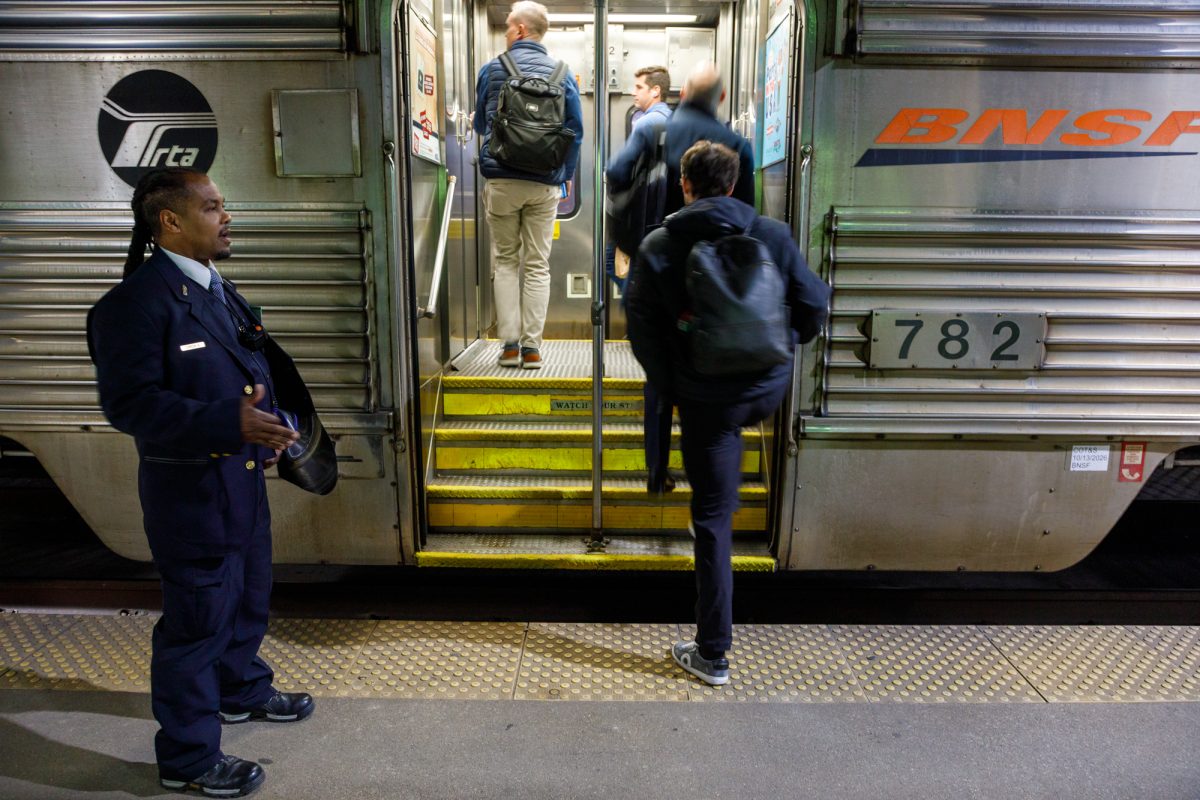
Columbia is in discussions with Metra about expanding its student transit pass to include unlimited rides on commuter trains, a change that could reduce transportation costs for students traveling to campus from the suburbs.
The proposed U-Pass + Metra option would add unlimited Metra rides to the college’s existing U-Pass, which provides unlimited access to CTA buses and trains. The expanded pass would exclude the South Shore Line, which connects Chicago with Indiana.
Emmanuel Lalande, Columbia’s senior vice president of Enrollment Strategy and Student Success, was the college’s primary contact for the negotiations when he left the college on Nov. 2.
In response to an email asking about the status of the talks, the college said in an email that discussions with Metra were continuing.
Metra’s discussions with Columbia about the program started over the summer, according to Martha Hill, Metra’s senior communications specialist.
After Lalande connected with her, Hill said Metra’s U-Pass+ marketing team talked to Miriam Nicholes, Columbia’s director of operational risk management, about a potential agreement.
Hill told the Chronicle this week that she did not know Lalande had left the college.
The college did not provide a timeline for a decision or respond to questions about whether it had asked Metra for a cost proposal, if the college would subsidize a portion of the cost and whether the pass would be optional. It also is not clear who will be the point person for the program now that Lalande has left.
Deana Wilson, the commuter senator for the Student Government Association, said offering the U-Pass+ would lessen the financial pressure for students who have to purchase Metra tickets out-of-pocket.
Wilson, who commutes from the suburbs. said she pays $135 a month for the 4 Zone monthly Metra pass, which after nine months, adds up to about $1,215 per school year.
“That’s a significant amount of money that could be allocated toward other college expenses, ” said Wilson, a first-year illustration major. “This may become a financial burden on commuters, which could be alleviated with a Metra U-Pass.”
About 93% of Columbia’s student body, or 3,949 students, currently participate in the standard U-Pass program. Students who opt in pay $153 per fall and spring semester and $115 for the summer semester.
The University of Illinois Chicago participated in the U-Pass + Metra pilot program in fiscal year 2024, with over 4,100 UIC students signing up.
During the pilot, Metra tracked participation in the program as well as the actual use of the reduced fare student passes, including the times of use and frequency. The pilot helped determine the cost of extending the pilot to additional schools and whether it would be financially sustainable.
Since the end of the one-year pilot, other downtown colleges, like Roosevelt University and Depaul University, have since signed up and offer the UPass+ to their students, Hill said, with prices for the add-on varying by university.
Roosevelt offers the optional Metra add-on with the standard U-Pass for $335.50 a semester, compared to $380 per semester at UIC and $263 per quarter at DePaul.
Alesandro Fajardo, a junior film and television major, usually commutes to campus from Hanover Park on Metra, about an hour-long train ride.
Fajardo said having the U-Pass + Metra plan would save money because he comes downtown nearly every day of the week.
A one-way ticket from Hanover Park to Chicago Union Station costs $6.75. The commute to and from downtown everyday costs $94.50 a week.
He does not currently get the monthly Metra pass because he finds it cheaper to switch between the Metra and the CTA Blue Line depending on where he is commuting from.
“A U-Pass+ plan would benefit me a ton because I have class four days a week,” he said. “This would cut down costs a lot, and would also make it one less thing to worry about when commuting.”
Altina Krasniqi, a senior journalism major, commutes from Arlington Heights, a 45-minute to one hour train ride to Union Station. She has paid for the monthly Metra pass since she started at Columbia.
She said she always builds her class schedule around her commute, so that she does not have to commute to campus everyday. She said spending over $100 a month was not ideal, but it was her only way of getting to campus.
“I feel like my journey here at Columbia hasn’t been inclusive of commuter students, despite there being a significant amount of them,” she said.
Copy edited by Venus Tapang