
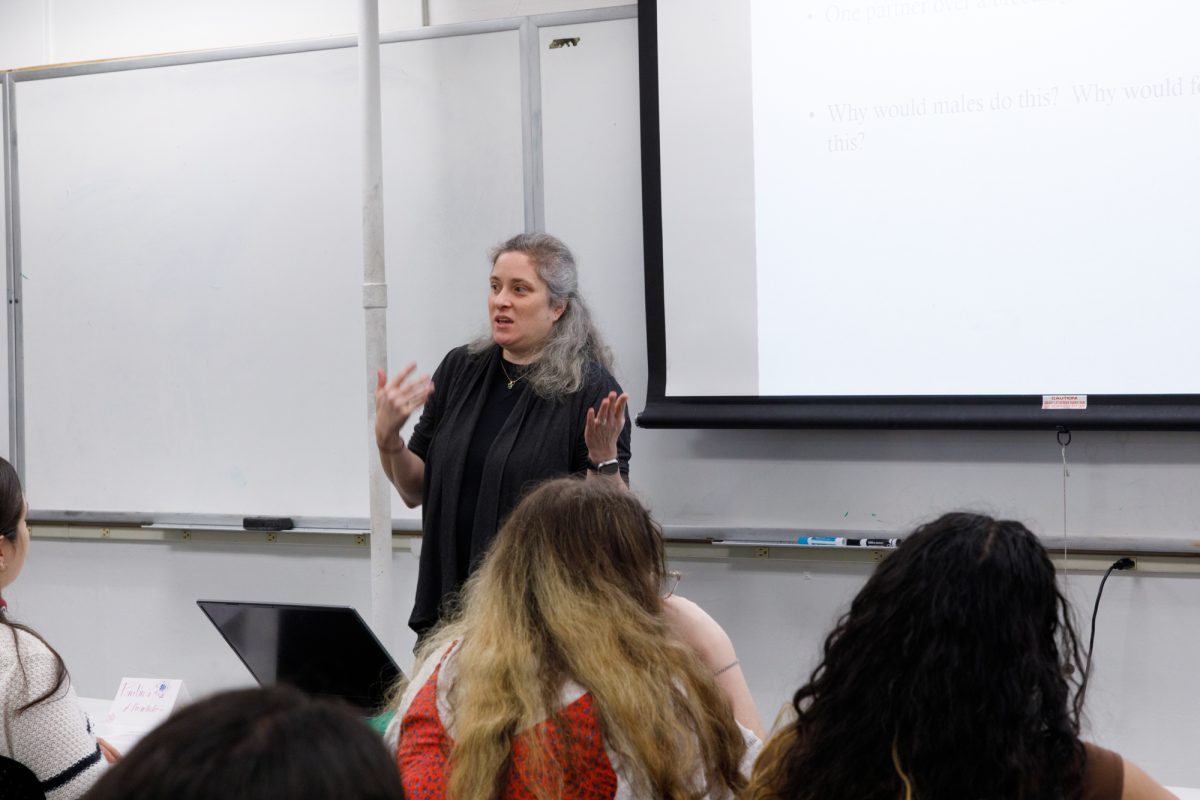
“Evolution of Sex” asks students to study the correlation between sexual behaviors in animals and humanity, and to see the different ways animals engage in sexual behavior.
The 200-level honors biology course discusses different ways animals engage in sexual behavior, focusing on behaviors that can be seen as unusual to humans as well as behaviors that closely resemble the human-made labels under the LGBTQ+ umbrella.
Elizabeth Davis-Berg, a professor of biology in the School of Communication and Culture, created the class 15 years ago. The class was initially created as a study of LGBTQ+ traits in the animal kingdom before being expanded into a broader class, including topics like gender and sexuality.
“It is a wonderful class. I’m having a fantastic time learning about animals and how sex shows up in the wild, how that affects evolution,” said Natan Mekonnen, a senior film and television major. “It’s been something I’m generally interested in. It’s been on my mind a lot, how sex shows up with humans, and having a scientific framework has been very interesting, very good to have exposure to.”
The course seeks to help students understand mating systems across the animal kingdom and how they differ from humans.
“There’s this assumption that sex is just ‘a male and female find each other, they have sex, life continues on,’” said Davis-Berg. “It’s often not that simple.”
One species that is taught about in the course is the New Mexico whiptail, or as they’re often colloquially called, the lesbian lizard: a female-only species that reproduces through parthenogenesis, an asexual method of reproduction that doesn’t require fertilization to reproduce. Despite this, the female-only species still engages in sexual behavior, thus creating its nickname.
“I try to remind everyone that the natural world has way more variation than even all the variation we have in the human world, and if anyone tells you something isn’t natural, that isn’t true,” Davis-Berg said.
Over the semester, students read textbooks by authors Olivia Judson, Marlene Zuk and Jerry A. Coyne. Judson’s book, “Dr. Tatiana’s Sex Advice to All Creation: The Definitive Guide to the Evolutionary Biology of Sex,” is a creative study of sexual behavior in the animal kingdom, and its advice column format directly inspires the final project of the class.
The final project is a sex advice column with questions coming from the perspective of various animals. Students pick a topic of their choice, write a question from the perspective of whatever animal they choose and then answer that question as a scientist.
“It is technically science writing, but it’s creative writing with scientific citations,” Davis-Berg said.
Grace Siegwald, a senior game design major, is writing about how female koalas in captivity often develop LGBTQ+ traits, finding attraction in other female koalas rather than males.
“When kept in captivity, a lot of female koalas prefer homosexual behavior over heterosexual behavior, statistically,” Siegwald said. “So I’m planning on doing an advice column for a female koala writing and being like, ‘am I gay?’ And I’ll tell her about how this has been observed in koalas in captivity.”
Eloise Park, a senior studying both environmental and sustainability studies and illustration, is writing about leopard slugs.
“These slugs will go to the top of a tree, create a line of mucus and dangle from the tree and create this sort of spinning spiral sex thing,” Park said. “It’s really kind of beautiful and gross at the same time.”
Park wants to find out why these slugs engage in this behavior, how they choose what tree to use for the sexual act and why the slugs have maintained this feature despite it leaving them open to predators.
The class is designed to be student-led, with students deciding what they want to learn rather than a traditional lecture class. Students declare what animals and systems they are interested in learning about, and Davis-Berg lectures on those topics.
“From the student perspective, you get to learn interesting things, but you also get to explore what you find most interesting about the topics in the class,” Davis-Berg said.
Students watch a variety of movies at the beginning of the semester so Davis-Berg can get an idea on what topics students are interested in.
“I don’t know what everyone wants to learn and I have no desire to tell people what to do their project on,” Davis-Berg said. “So we get all sorts of fun topics, which I guess is a challenge, because I never know what we’re going to learn about every semester.”
This structure allows students to engage with the content in a unique way, finding the next topic themselves and discussing it with Davis-Berg.
“She knows a lot, she knows about snails, she’s very knowledgeable and she’s very fun to talk to,” Siegwald said. “So, good thoughts all around.”
Students show an appreciation for having an academic setting to discuss the nature of sex, both biologically and socially.
“I love this class. I love the teacher. It’s a great class,” Park said. “I’ve had it recommended to me plenty of times. It was really foundational for a lot of people.”
Copy edited by Isaac Russo