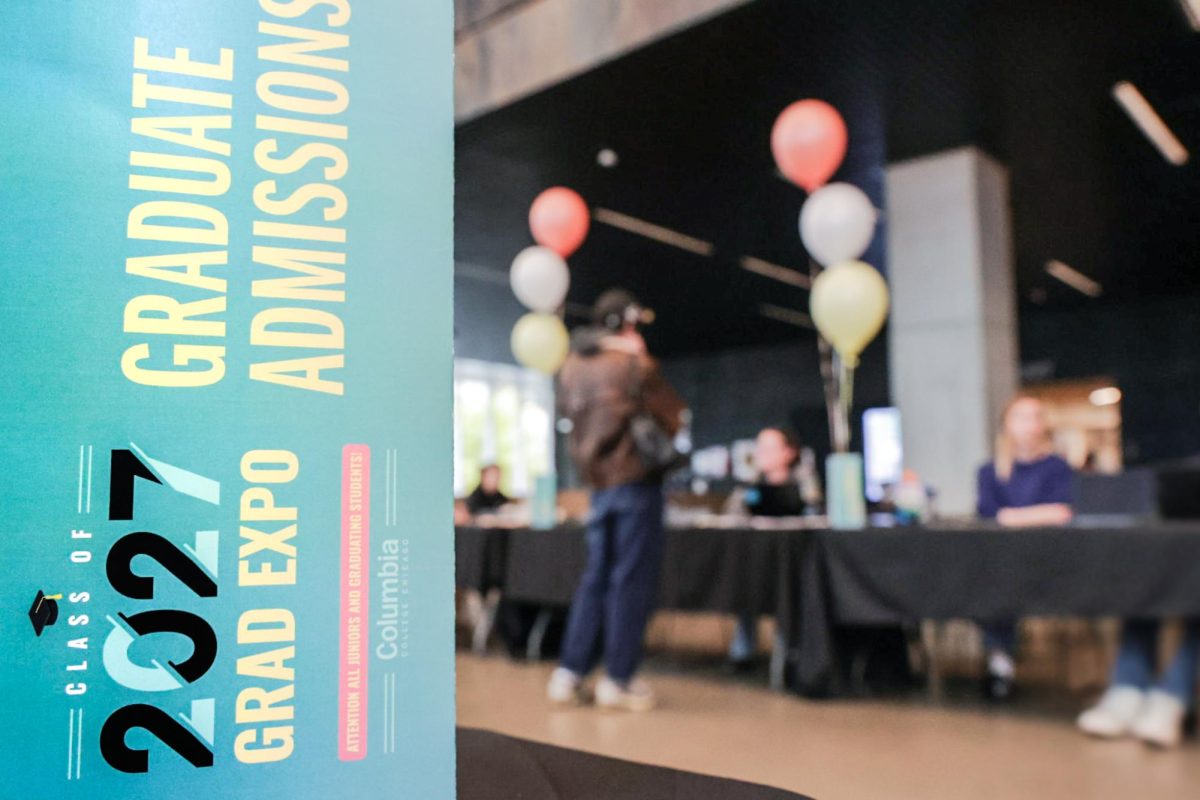
As graduation approaches, students at Columbia’s second annual Grad Expo had an opportunity to prepare for the transition from college to the next stage of their lives.
Held Thursday, Nov. 12, on the first floor of the Student Center, the expo offered students help with degree audits, information about commencement and graduation headshots.
For students preparing to enter the workforce, however, graduation also comes with questions about what awaits them in the job market.
The latest U.S. Bureau of Labor Statistics reported on Friday, Nov. 6 that the national unemployment rate has gone down to 4.1%.
“It’s good news compared to everything else that’s been going on in the world,” said senior illustration major Delia Burns.
Nay Williams, a senior fine arts major, currently works as a substitute teacher and is looking to become a secondary arts teacher. She said being in the arts helps people find work since there’s always some sort of work to be done, even if it’s outside of your speciality.
“If you’re an artist, there’s always a job for you,” Williams said. “It’s a business at the end of the day. Yes, you’re creating work, but if you’re making art and you can do things with your hands, you always have a job.”
Despite the flexibility, other students expressed concern over the job market because of the rise of generative AI.
The impact of AI in creative fields has been felt immensely in the past four years, with the US losing more than 200,000 jobs across different creative industries like film, TV, publishing and graphic design, with roughly 50,000 of those jobs being lost this last year.
Senior illustration major Belle Garcia said that with the continued use of generative AI to create media, she feels as though she has to push herself harder to be recognized.
“My teacher told me it’s not enough just to make art. You really have to push yourself, you have to be the — I wouldn’t say the best — but just the best at what you do,” Garcia said.
The worry of generative AI taking over jobs in creative industries also extends beyond the jobs themselves and into the current hiring process.
Devontae Anderson, a senior acting major, said that he had a general distrust of the hiring process because of companies using automation to conduct interviews and review resumes, potentially causing employment discrimination.
“It’s all just like one tap,” Anderson said. “And now AI is becoming more of a big thing too, and that’s being used when it comes to picking or choosing, but also for the application process because it’s online based. You probably get thousands of applications and it’s like, are people actually going through this or are they using some type of software?”
For many students, the Grad Expo was one of the last stepping stones for them before graduation and beginning their next chapter post-graduation. Despite some students’ worries over AI and how it will impact the future job market, they attempt to remain optimistic.
“It just makes me feel sad. But honestly, knowing that the job rates are getting a little bit better, it makes me a little happy, and I’m just trying to be as optimistic as I can,” Garcia said.
Copy edited by Isaac Russo