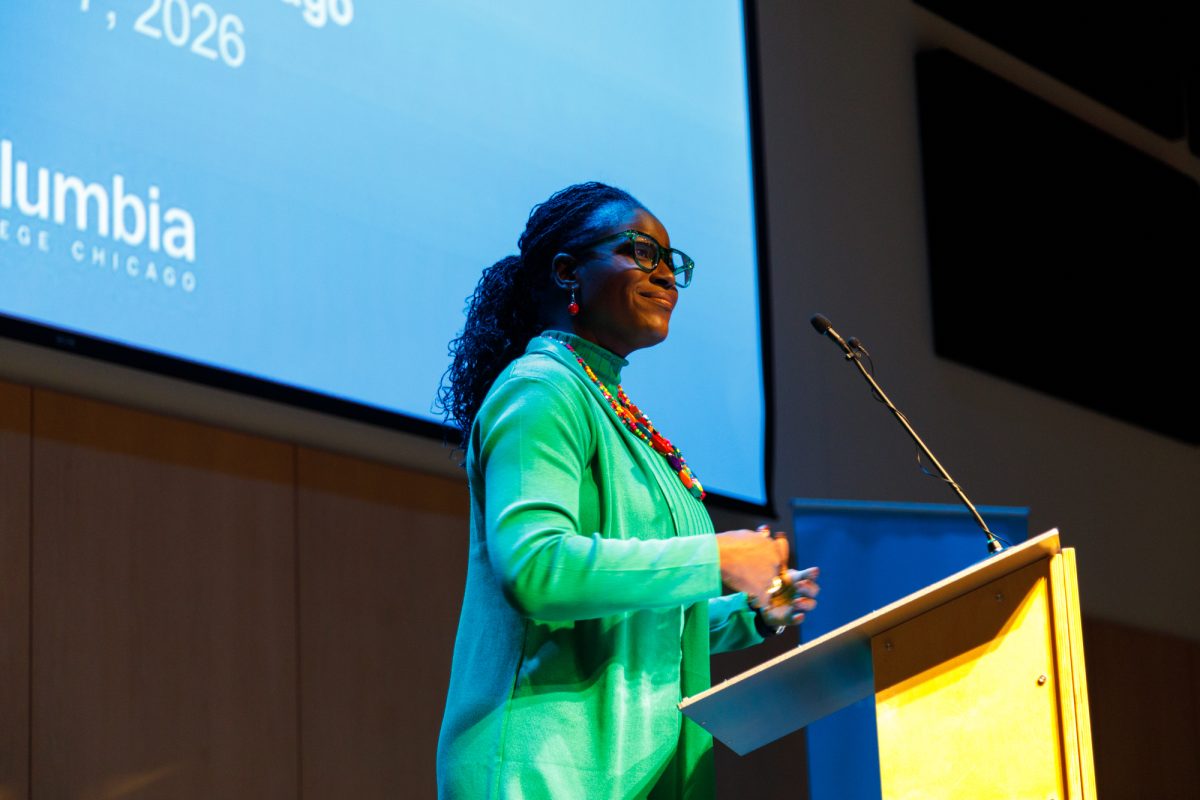
Columbia faculty raised concerns about teaching loads, compensation and the college’s recruitment strategies during a Faculty Senate meeting on Friday, Oct. 23, giving President and CEO Shantay Bolton an opportunity to address issues that went unanswered during the State of the College meeting earlier this month.
Bolton discussed the college’s financial constraints and recent progress, but cautioned that enrollment and retention gains have not resolved its underlying financial challenges.
“Our progress gives us a real reason to be optimistic. It is a real reason to be proud,” Bolton said. “But it does not, on any level, lessen the urgency of the work that we have in front of us, because you can not undo the structural challenges that we have in place in a year’s time.”
It was the first chance for faculty to question Bolton in a formal gathering since her State of the College address on Oct. 7. She did not take questions at that time.
“I believe the administration is working in good faith to be as even-handed as they can be,” said Lee Sanders, chair of the senate’s Faculty Affairs Committee and assistant professor in the School of Audio and Music. “They’re not making these decisions lightly. The cuts and compromises were, are, and will continue to be painful, but the process is working: It’s hard to argue that the momentum shift we’ve seen in just one year is anything other than a success story.”
Senators submitted questions to the Executive Committee to be read during the meeting. Bolton answered four out of six before time ran out, said Brendan Riley, Faculty Senate secretary and associate professor in the School of Communication and Culture. The others will be sent to her in writing.
Bolton was scheduled for 30 minutes and took questions for 20 of them.
A faculty member expressed concerns in a question about postponed sabbaticals, when the new 4:3 teaching load implemented this fall might return to 3:3 and about compensation.
For the second year in a row, Columbia did not grant sabbaticals, as the Chronicle previously reported.
This fall, tenured faculty shifted to a 4:3 teaching load, meaning four classes one semester, and three the other semester.
Botlon deferred questions about faculty workload to the Office of the Provost and academic leadership, but said a 4:4 teaching load is average across non-research institutions.
“That may be unusual for us because it is unfamiliar. Maybe not how we’ve done it in the past,” she said. “But we are a teaching-focused institution and we need to make sure that our first priority is supporting the students with the courses that we offer and the classes that they’re interested in taking and help them matriculate to graduation.”
Bolton acknowledged that faculty play a big role in student retention, though she said the college was not in a position to commit to salary increases, which was raised in one of the questions. “I am under no false pretense that the faculty play a huge role in the outcomes of what our students experience and their ability to matriculate to graduation,” she said.
The college projects that its budget deficit will fall to about $18 million this fiscal year, a reduction of more than 50% from the deficit budgeted for last year, according to Columbia’s Interim Chief Financial Officer Jeffrey Bethke.
Sanders said the administration has asked a lot of faculty as part of the process of addressing adverse circumstances. “I appreciate Dr. Bolton’s candor in acknowledging that,” he said in an email. “Faculty salaries are a large expense, but that money buys Columbia’s most important asset.”
Bolton reflected on what she covered in the State of the College address, speaking on the enrollment incline, higher retention rate and other milestones such as the Center for Student Success.
Columbia’s enrollment rebounded this fall after a historic drop last spring, when the number of students fell below 4,000 for the first time in more than two decades.
Total enrollment increased from 3,958 in Spring 2026 to 4,265 students for Fall 2026, according to figures presented at the State of the College address.
“I am operating with less revenue than with expenses,” she said. “It costs me more to operate the institution than what I’m able to bring in. The reason why we’re focused so much on enrollment is because the way our business model is structured.”
The one-year student retention rate, which measures the percentage of students who stayed from one year to the next, also reached 71.2%, the highest it’s been since 2018. That is above the national average of 69.1%, according to the National Student Clearinghouse Research Center.
The enrollment and retention gains come as Columbia continues to address the financial problems that led to significant cuts in staffing and other expenses last year.
“We can anchor ourselves in the reality that we know the work is not done, but where we can make improvements,” Bolton said. “We need to be committed to making those and where we still know we have serious financial concerns.”
Bolton said Friday that she’d like to meet with senators more often, something Sanders said faculty would welcome.
“I hope we can arrange these meetings on a regular basis,” he told the Chronicle.
Copy edited by Isaac Russo
Resumen en español
El viernes 23 de octubre, el senado de profesores se reunió para discutir problemas financieros persistentes, estrategias de reclutamiento y avances recientes de la universidad. Shantay Bolton, la presidenta y directora ejecutiva de Columbia, asistió a la reunión y ofreció a los otros miembros del senado la oportunidad de hacerle preguntas, tocando temas desde el aplazamiento de los sabáticos del profesorado, hasta los cambios recientes de la carga docente para los profesores.
Resumen por Sofía Oyarzún