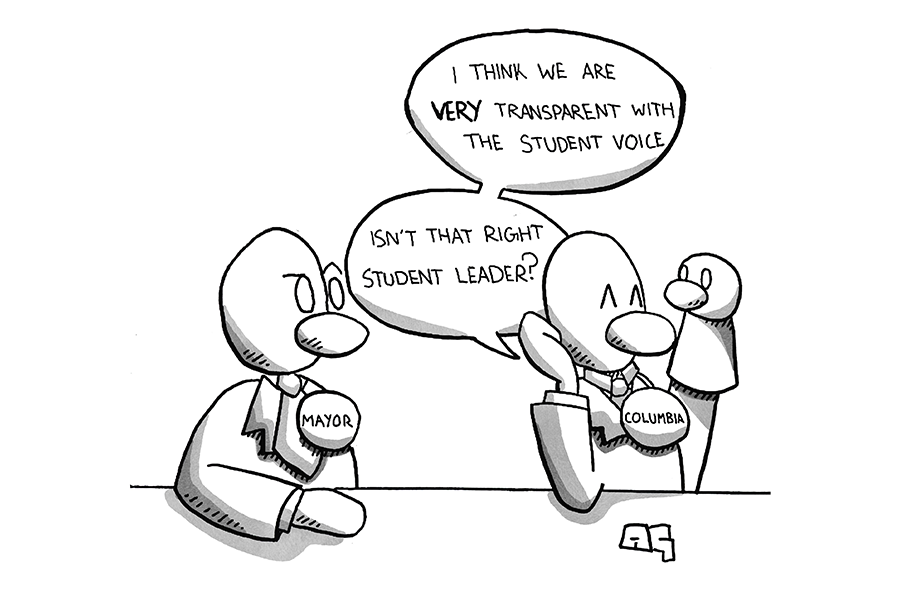
When Chicago Mayor Brandon Johnson visited Columbia last week, the administration had a chance to elevate student leadership and instead made a last-minute change that limited it.
Raymia Jones Fowler, president of the Black Student Union, was expected to moderate a conversation between Johnson and Columbia President and CEO Shantay Bolton. But less than 24 hours before the event, Fowler was notified she would no longer serve in that role.
The mayor’s visit had originally been scheduled for March 6 as part of Bolton’s investiture but was moved to Friday, April 24 so the mayor could attend the Rev. Jesse Jackson’s funeral.
Adriel Hilton, the college’s vice president of institutional strategy and chief of staff, told the Chronicle in an email that “it is always our goal to meaningfully include students in roles beyond attendance, particularly in high-profile events like this one.”
He said due to the rescheduling “aspects of the program were adjusted, including moderator roles.” But Fowler was unaware of any change until right before the event and still listed as the moderator in college promotions.
The decision sends the wrong message about how the institution values student voices.
In an interview with the Chronicle the night of the event, Fowler graciously conceded to Bolton, saying she did not have any personal feelings about the change. “It’s a privilege to be able to talk to the mayor and be here, period. So I was very honored and just happy.” she said.
But when Columbia creates a space where student engagement is supposed to be at the forefront of the event, it has a responsibility to ensure students are centered, not limited to the margins.
The event produced a meaningful conversation. Johnson spoke about plans to convert vacant office spaces into affordable housing, expand arts programming in public schools and increase job opportunities for young Chicagoans. He spoke about artists as workers deserving fair pay and described a vision for public art rooted in community identity.
Bolton handled the conversation well, and the argument can be made that she should have been at the center of a conversation that originally was part of her investiture programming. Institutional events of this scale carry logistical and reputational considerations that administrators must make.
But it’s more than who was sitting on stage with the mayor.
Only half of the 40-minute conversation was dedicated to questions from students, two read aloud by Fowler from a pre-collected online form and one taken from the audience directly.
Fowler said she appreciated the chance to ask two of the student questions but wished there had been more time spent on their concerns. “Honestly, I wish there was a lot more time for that because it is for us,” she said.
Fowler was prepared to lead the event and found herself hoping from the sidelines that more of her peers would get to speak.
South Loop TV, the college’s student-run broadcast network, also was barred from covering the event, though it’s not clear if that was the college’s decision or the mayor’s team.
Columbia does a lot right when it comes to student involvement. But a commitment to the student voice cannot live only in mission statements; it has to show up in the room.
Copy Edited by Samantha Mosquera