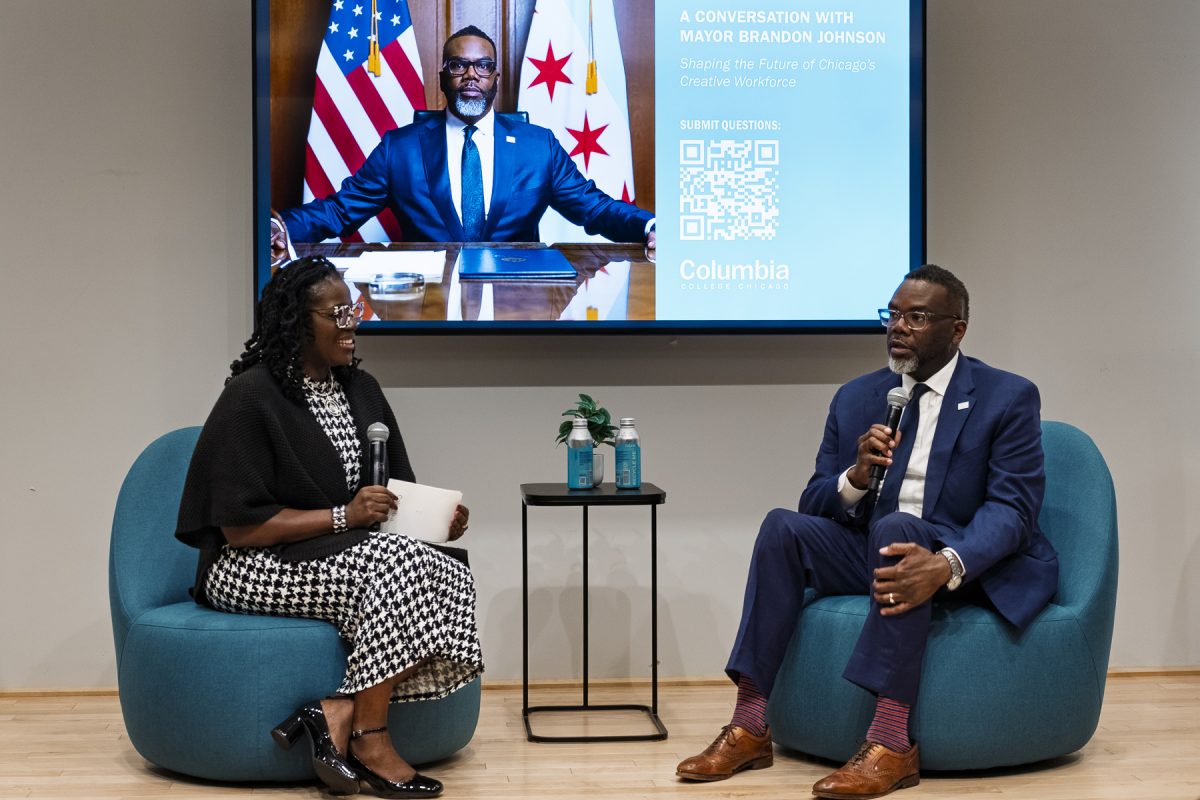
Chicago Mayor Brandon Johnson focused on expanding arts programs and increasing affordable housing during a 40-minute conversation at Columbia on Friday, April 24, though some students said the format limited direct engagement.
President and CEO Shantay Bolton moderated the discussion, held at The Hive as part of her investiture programming.
The event, a lakeside chat originally scheduled for last month, brought together students, faculty and administrators for a conversation that largely centered on arts funding, public programs and economic development.
In an interview with the Chronicle, Johnson addressed concerns about affordable living in downtown Chicago, sharing his plans to convert vacant office spaces into housing.
“In fact, we should be cutting the ribbon on one of our first investments of an office space being converted into housing, of which again, 30% is going to be affordable,” he said. “That’s something that I’m really, really focused on, and we’re going to work to do more of that at scale.”
Much of the conversation between Bolton and Johnson centered on incorporating art into the city, which has been a large focus of the president’s “Renaissance Rising” strategic plan. Johnson says he is willing to look into an “institutionalized operation” that allows artists to tag buildings.
“I’m gonna sound like the real OG — I don’t want y’all tagging my whole city everywhere. However, I do believe that there’s a role for public art to demonstrate who we are as a city. I think there’s a lot of beauty in that. The way even tagging exists and the messaging and the motivation behind it, there’s real history connected there.”
During the conversation, Johnson pointed to how art could be incorporated into public school programs and already has through his mental health programs.
“So, we actually have artists that are part of our mental and behavioral health care outreach, where they are providing support services for individuals who are coming out of domestic violence, individuals who have lived through trauma. Art as an economic driver for the city of Chicago. That’s the ultimate goal.”
SGA Vice President and junior film and television student Amelia Lutz said the conversation went “pretty good,” and was glad the topic of art and mental health was discussed.
“I feel like there was a lot of focus on how art is beneficial for mental health, which I think is a detrimental conversation to be having right now with the politics that are happening in the world,” she said. “I feel like hearing how our art can create a positive impact on the world is so important right now, so that students can feel like they’re doing something.”
However, Lutz said more attention should have been given to Columbia’s housing challenges after the college ended leases with two apartment buildings, The Arc and Dwight Lofts. Though administrators have said all students on the waitlist will be accommodated, as the Chronicle previously reported, rising rents in the South Loop — where the average apartment costs about $2,700 per month — have made it increasingly difficult for students to find affordable off-campus housing.
“With students feeling a lot of housing insecurity as a whole, with the state of the world and with housing at Columbia, I do wish that they had touched a little bit more on that and more on the ways in which students can access those resources,” Lutz said. “I was hoping to ask about that.”
The discussion was initially set to be moderated by Black Student Union President Raymia Jones Fowler, a junior film and television major, but she said she was notified before the event that she would no longer serve in that role.
“I was just glad to be here, honestly privileged just to do what I did anyway, to be able to facilitate our Q&As,” she said.
Bolton asked the majority of the questions during the conversation. About 20 minutes were dedicated to three student questions, which were collected through a digital form and read aloud during the event.
Fowler said she appreciated the opportunity but wished more student voices had been included.
“Honestly, I wish there was a lot more time for that because it is for us,” Fowler said. “I definitely advocate for us being heard, so I wish we got a chance to hear more student questions.”
Johnson said his primary goal as mayor is to make Chicago an “equitable city” that is “safe and affordable for everybody.”
He plans to do this by raising wages, pushing residents to use public transportation by reducing the requirement for parking spaces that businesses have to build, “revolving loans” for building affordable housing where the revenue from the development goes back into the loan and, for students, creating more job opportunities in public school programs.
“Look, I believe artists should be paid for their work. I mean, they are workers, right? And so that’s why investing in our public education system to expand our arts programs,” said Johnson.
Senior creative writing major Kennedy Person said she was happy that much of the conversation focused on public school programs and offering opportunities for teens, something she worried about when she was younger.
She said “teen takeovers” of downtown spaces are a sign that “the kids are looking for something to be involved in and to do, and especially wanting to be around each other.”
Caitlyn Brunner, a part-time instructor for the School of Design, said she looks forward to the potential public art programs students can be a part of, giving students a chance to create substantial portfolio pieces without having to find work within corporations.
“I think it will be really helpful for students who maybe aren’t going to go the corporate route,” she said.
Copy edited by Venus Tapang
Resumen en español
El alcalde de Chicago, Brandon Johnson, se centró en ampliar los programas artísticos y aumentar la oferta de vivienda asequible durante una conversación de 40 minutos en Columbia el viernes 24 de abril, aunque algunos estudiantes señalaron que el formato limitó la interacción directa.
La presidenta y directora ejecutiva, Shantay Bolton, moderó la discusión que tuvo lugar en “The Hive” como parte de la programación de su ceremonia de investidura
En una entrevista con el Chronicle, Johnson abordó las inquietudes sobre el costo de vida en el centro de Chicago, compartiendo sus planes para convertir espacios de oficinas vacíos en viviendas.
“De hecho, pronto estaremos cortando la cinta inaugural de una de nuestras primeras inversiones: un espacio de oficinas transformado en viviendas, de las cuales insistió el 30% será asequible”, dijo. “Es un objetivo en el que estoy sumamente concentrado, y trabajaremos para replicar este modelo a gran escala”.
Gran parte de la conversación entre Bolton y Johnson giró en torno a la incorporación del arte en la ciudad, un aspecto que ha sido un pilar fundamental del plan estratégico de la presidenta, titulado “Renaissance Rising”. Johnson manifestó su disposición a estudiar la implementación de un “mecanismo institucionalizado” que permita a los artistas realizar grafitis en los edificios.
“Voy a sonar como un auténtico veterano de la vieja escuela: no quiero que vayan por ahí pintarrajeando toda mi ciudad por donde quieran. Sin embargo, creo firmemente que el arte público desempeña un papel esencial para reflejar nuestra identidad como ciudad. Considero que hay mucha belleza en ello. Incluso en la propia existencia del grafiti en su mensaje y en la motivación que lo impulsa, existe una conexión con una historia real”.
Johnson dijo que su objetivo primordial como alcalde es transformar a Chicago en una “ciudad equitativa”, que sea “segura y asequible para todos”.
Caitlyn Brunner, instructora de tiempo parcial de la Escuela de Diseño, comentó que espera con interés los posibles programas de arte público en los que los estudiantes podrán participar brindándoles la oportunidad de crear piezas sustanciales para su portafolio sin tener que buscar trabajo en el ámbito corporativo.
“Creo que será de gran ayuda para aquellos estudiantes que, tal vez, no vayan a seguir la vía corporativa”, dijo.
Resumen por Anthony Hernandez
Editado por Brandon Anaya