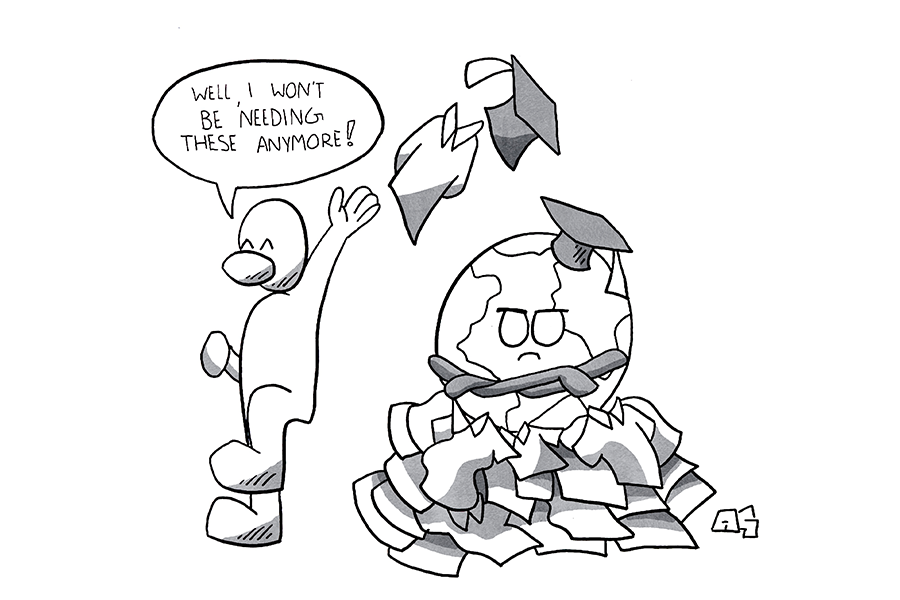
Every spring, Columbia students cross the graduation stage in polyester gowns they will likely never wear again. Within months, most will end up in a landfill. The college has acknowledged the environmental problem but has not yet committed to fixing it.
Columbia must switch to a reusable rental model.
The infrastructure already exists. Columbia’s vendor, Herff Jones, already offers a rental program called EarthGrad. The University of California, Berkeley, committed to a 10-year EarthGrad partnership beginning in Spring 2026, with projected student costs comparable to what Columbia already pays for commencement regalia.
Columbia also already operates a rental model for faculty regalia, demonstrating that collection and redistribution systems are manageable at commencement scale.
The question is no longer whether a reusable system is possible. It is whether Columbia is willing to prioritize it.
More than 5 million polyester graduation gowns enter U.S. landfills every year. Columbia’s gowns are made from polyethylene terephthalate, or PET, the same plastic used in water bottles. The material is nonbiodegradable.
Polyester is also cheap, wrinkle-resistant and easy to produce on a large scale. Columbia currently covers commencement regalia through student fees of roughly $45 for undergraduates and $78 for graduate students
Switching to recycled polyester gowns would reduce some environmental impact, but it would not solve the larger problem: the gowns are still designed to be worn once and discarded.
Transitional costs are legitimate. Sourcing new gowns, building out logistics and managing a rental return process all require real administrative investment. The college has confirmed it is in conversation with Herff Jones about sustainable options, which suggests that a change may be coming.
The college should announce a reusable rental program for commencement by 2028, giving administrators time to plan the transition.
Columbia has the vendor, the infrastructure and the model for a reusable system. Now it must act.
Copy edited by Venus Tapang