Illinois voters went to the polls on Tuesday, March 17 for one of the most important primary elections in decades, with an open U.S. Senate seat and five vacant congressional seats reshaping the state’s political landscape.
Moments like this are rare. They are also when civic engagement matters most.
At Columbia, students who were already paying attention had ways to participate. Columbia Votes organized registration efforts, tabled in the Student Center and helped guide students through early voting options.
A high-stakes election is more than a test for engaged voters. It indicates how well institutions reach students who are not already engaged.
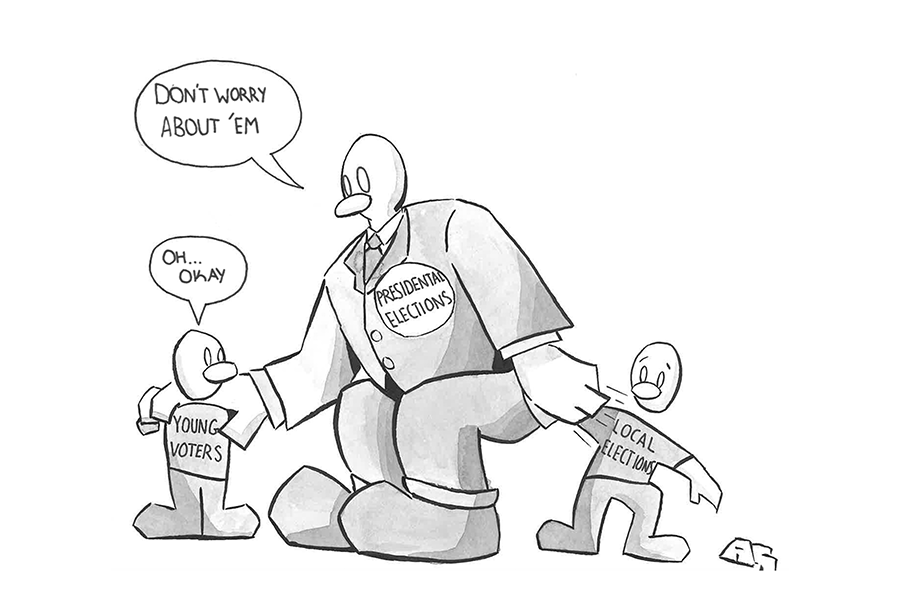
Student disengagement from local and state elections is the result of a political environment that has left young people feeling surveilled, targeted and expendable.
Some say that low primary turnout is inevitable — that students are busy, primaries can seem complicated and presidential elections hold more obvious stakes. Columbia Votes co-organizer Saoirse Adams acknowledged that students tend to overlook local elections in favor of national ones.
Columbia Votes, created by former professor Sharon Bloyd-Peshkin, tabled at the Student Center, organized early voting trips and showed up for students. That work matters. Columbia Votes helped raise the voting rate at the college from 56% in 2016 to 72% in 2020.
But student groups cannot carry the full weight of civic engagement alone. Their efforts are most effective when reinforced by the institution itself.
Political burnout among young people, particularly LGBTQ+ students and other marginalized groups who witness legislation targeting them in real time, is an understandable reaction to feeling unheard and overwhelmed.
Local and state elections are especially important because they shape students’ lives. Arts funding, affordable housing, labor protections for freelance workers and public transit are all affected by local midterm races.
Local issues that students encounter every day are decided by aldermen, state legislators and other candidates who appeared on Tuesday’s ballot. For students at Columbia living throughout the Chicago area, the elected official with the most immediate power over their neighborhood is their alderman. Many students are not aware of this, and that is a civic infrastructure issue, one that Columbia cannot ignore.
Research shows that when young voters register to vote, 86% of them turn out to vote. The barrier is access and awareness of election cycles, and as an institution Columbia is positioned to provide those resources.
The college needs to fund civic engagement as an institutional priority. This can look like coordinated, campuswide emails at key political moments including registration deadlines, early voting windows and Election Day. It means putting up signs across campus with clear voting information and having Canvas reminders and ballot education built into new student orientation.
This primary election has passed, but the opportunity Columbia has to do more for its students extends to the general election this fall and all future elections.
Copy Edited by Samantha Mosquera