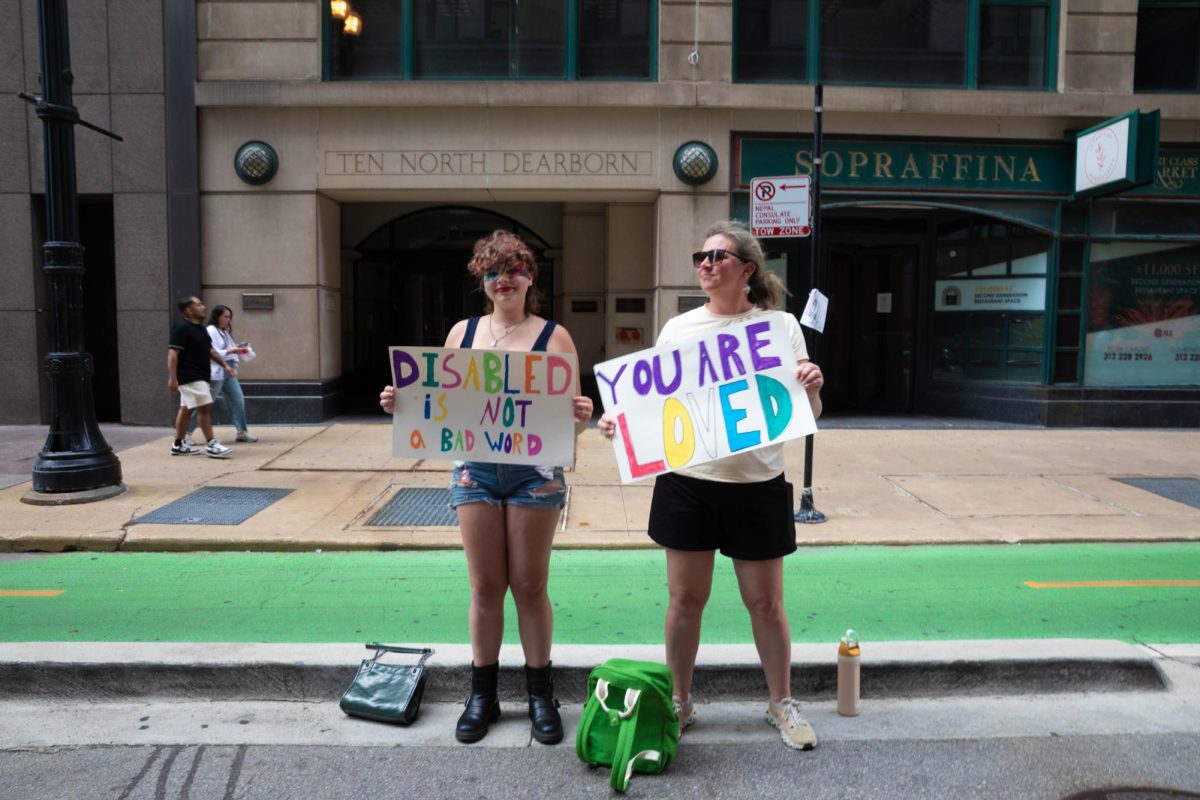
Balloons, bubbles and streamers filled the air in Plymouth Court near campus on Saturday, July 25 as participants gathered for Chicago’s 23rd annual Disability Pride Parade.
The parade began near Harold Washington Library and ended at Daley Plaza, where there was live music and organizations with informational booths.
One of these booths was the Great Lakes ADA Center, one of ten centers across the country that provides information on the Americans with Disabilities Act, serving six states in the Midwest.
Claudia Diaz, a representative with the booth, has been participating in the event for eight years.
“You get to meet the actual people in the community and the organizations that are actually providing services,” Diaz said.
Diaz said the Great Lakes ADA Center helps connect people with resources and guide them to other organizations in their community.
“When people call us for information, we’re like, ‘I know this organization that actually can help you and address those other issues,’” Diaz said.
Disability Pride began in July 1990, when the Americans with Disabilities Act was signed into law by former President George H.W. Bush. The first Disability Pride Parade was held in Boston, Massachusetts. Chicago held its first Disability Pride Parade in July of 2004.
Chicago Mayor Brandon Johnson formally recognized July as Disability Pride Month this year, aiming to celebrate the achievements and cultures of those with disabilities.
People with and without disabilities marched in the parade, representing their chosen organizations.
Michelle Remedi and Cindy Cajecka were spectators at last year’s Disability Pride Parade. This year, they were marching with Community Support Services, a non-profit organization that seeks to provide support for people with intellectual and developmental disabilities.
Remedi and Cajecka felt encouraged to advocate for the community and raise awareness instead of watching from the sidelines.
“I’m looking forward to seeing all the other organizations that are participating today,” Cajecka said.
Olivia Asuncion and Rachel Wiesbrock, both wheelchair users, participated in the march with the Mayor’s Office for People with Disabilities.
“They’ve done a lot of great efforts throughout the years to make it more accessible and welcoming to everyone,” Wiesbrock said. “It’s really great to see everyone come together and celebrate.”
Asuncion added, “To me, disability visibility is very important. To have us be here all together and celebrating pride,”
Mayor Johnson took a photo with those representing the Mayor’s Office for People with Disabilities, alongside parade Grand Marshal Kelsey LeFavour.
LeFavour is the manager of the Adaptive Sports Program at Shirley Ryan AbilityLab. The program provides year-round accessible sports for those with physical disabilities.
Each organization highlighted different resources for the community.
Matthew Gorski marched with Special Children’s Charities, a local charity that benefits people with disabilities by partnering with other local charities to fund athletic and educational programs for those with developmental disabilities.
“It’s a charity that benefits people with disabilities like myself,” Gorski said. “They give people with disabilities chances to grow and to learn and to build new things,”
Maureen Perez, the program manager of Special Children’s Charities marched alongside Gorski.
Perez said her favorite part of the event was celebrating the disabled community.
“It makes me feel really proud to show your pride and show what you’re made of,” Gorski said. “It makes the city proud.”
Copy edited by Katie Peters