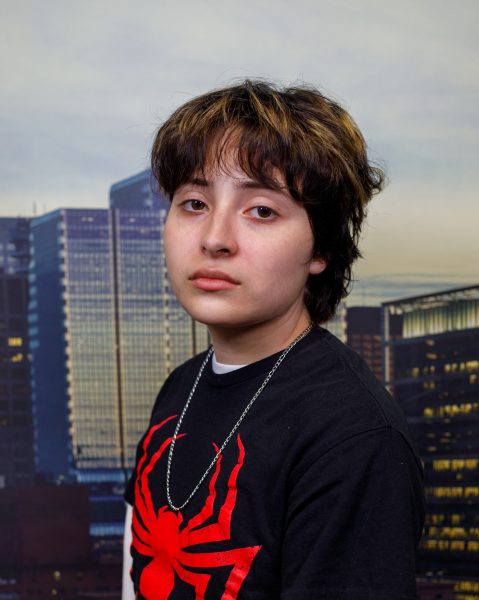
After keeping her film “A Field, a Body, an Angel” private until submitting it to film festivals, Noah Alvarez, a Columbia alum, screened her film on Oct. 1 at the Eyewash Station venue. The film was rooted in surrealism, something Alvarez features in all her films.
Alvarez is one of many transgender filmmakers based in Chicago who are part of an ever-growing rise in DIY, low-budget films in a new wave of cinema that some trans filmmakers have called “Trans New Weird.”
“I feel like there’s not one culture of filmmaking, and that’s partly what allows for the rise of trans filmmakers and other filmmakers of marginalized backgrounds,” filmmaker Henry Hanson said. “At the very least, there are subcultures of filmmaking that look very different from the mainstream.”
Alvarez’s film was given an honorable mention at both the LA Underground Film Festival and the Washington Underground Film Festival.
“I think for trans underground cinema right now, it’s really doing great,” she said.
Chicago filmmaker Henry Hanson said the variety of indie subcultures in filmmaking allows for trans filmmakers to have opportunities beyond mainstream cinema.
Hanson had his film “Dog Movie” featured by the Criterion Channel, and he said that was the first time the people around him recognized it as a massive achievement, especially considering that the film only had a budget of $1,000.
Another Chicago-based filmmaker, Dante Dammit, was particularly inspired by Hanson’s film and the success it had and urged them to get back into filmmaking.
Dammit, a film and television alum, had previously made a short film called “Taste Like Pork” along with senior theatre major Aurora Lowther. It centers on a trans woman who gives her genitalia to a cannibalistic cisgender woman.
For Dammit, the rise in trans-centered films that focus on taboo themes of gore and sexuality are a sign of a return to making transgressive films for the sake of creating.
“There’s more trans people being honest, telling their stories through authentic transgression, and I just think that’s so awesome to see and it’s making me want to get back into film,” Dammit said.
Lowther echoed a similar opinion, saying these films are a response to the rise in purity culture and conservatism in the dominant culture, especially when it comes to trans people’s bodies.
“We’re moving more in the direction of people being okay with transsexuals in film, but like, explicit nudity in sex, people are so puritan now,” Lowther said. “That’s why I’m making the thing I’m doing, that’s why it’s so explicit, that’s why it’s hard to look at, because you gotta put everything on camera.”
Alvarez said that because of how tight-knit these film communities are, it builds stronger production teams, which can be lost on bigger productions.
“I really agree with the importance of this movement being made with people in your inner circle or in your direct outside community, like bringing the community back to filmmaking,” she said.
For senior film and television major Jackson Romer, he has found it very empowering to be coming into a world where trans and queer-centered films are going to be received well and won’t impair his ability of making it in the field.
“We want queer voices. We want something different than whatever streaming service is pushing out next,” Romer said. “That is so validating, especially in the current economy which I am graduating in.”
Former film and television student Imogen Gurthie said that there are cisgender people who are becoming more receptive to trans films, leading to the opportunity for these trans filmmakers to have their work screened at large venues.
“It’s very cool that we’re able to carve out our own distinct style and have it and have our work shown at large venues like the Music Box or Facets–all these larger theaters that cis people go to all the time,” Gurthie said. “I think that within our generation, cis people are a lot more accepting of trans art and willing to be challenged by it.”
Copy Edited by Mia Smith