The question of what freedom means and how Americans interpret these ideals today is at the center of “Free and Independent,” a new exhibition at the Newberry Library that coincides with the nation’s 250th anniversary this year.
The exhibition brings together rare documents from the Revolutionary era, including an early printed broadside of the Declaration of Independence and Thomas Jefferson’s personal copy of the Federalist Papers.
For Jill Austin, vice president for public engagement at the Newberry, the exhibition is less about celebrating a finished story and more about creating a space for reflection.
“I think it’s important for cultural institutions to provide a place within the community to explore this history, think about what it means, where are we at the 250, and hopefully generate dialogue and reflection on the part of individuals and community members,” Austin said.
The exhibition, which opened Friday, June 5, intentionally presents both the promises and the contradictions embedded in the nation’s founding. Alongside documents celebrating independence are materials highlighting the experiences of Indigenous communities, enslaved people and women who were excluded from many of the rights articulated in the Declaration.
“We’re not telling people what to think, but giving people tools for reflection and helping them learn about the history through these authentic original documents,” Austin said. “All of those documents were touched and created by people who lived through it.”
Scott Stephenson, president and CEO of the Museum of the American Revolution in Philadelphia, said growing political and social divisions have prompted many Americans to revisit the nation’s origins.
“People are really saying, ‘wow, I don’t know enough about the background of how the country came about,’” Stephenson said. “Ordinary visitors are showing up and saying that they want to better understand the roots of the nation.”
For Stephenson, understanding the Revolution is not simply an exercise in studying the past.
“You have to understand this history if we’re going to get ourselves through another moment of division,” he said.
Rather than offering definitive answers, Stephenson said museums should encourage visitors to think like historians.
“A core value in our museum is that we ask a lot of questions, but we don’t feel obligated to answer them,” he said. “You, as the visitor, should answer them.”
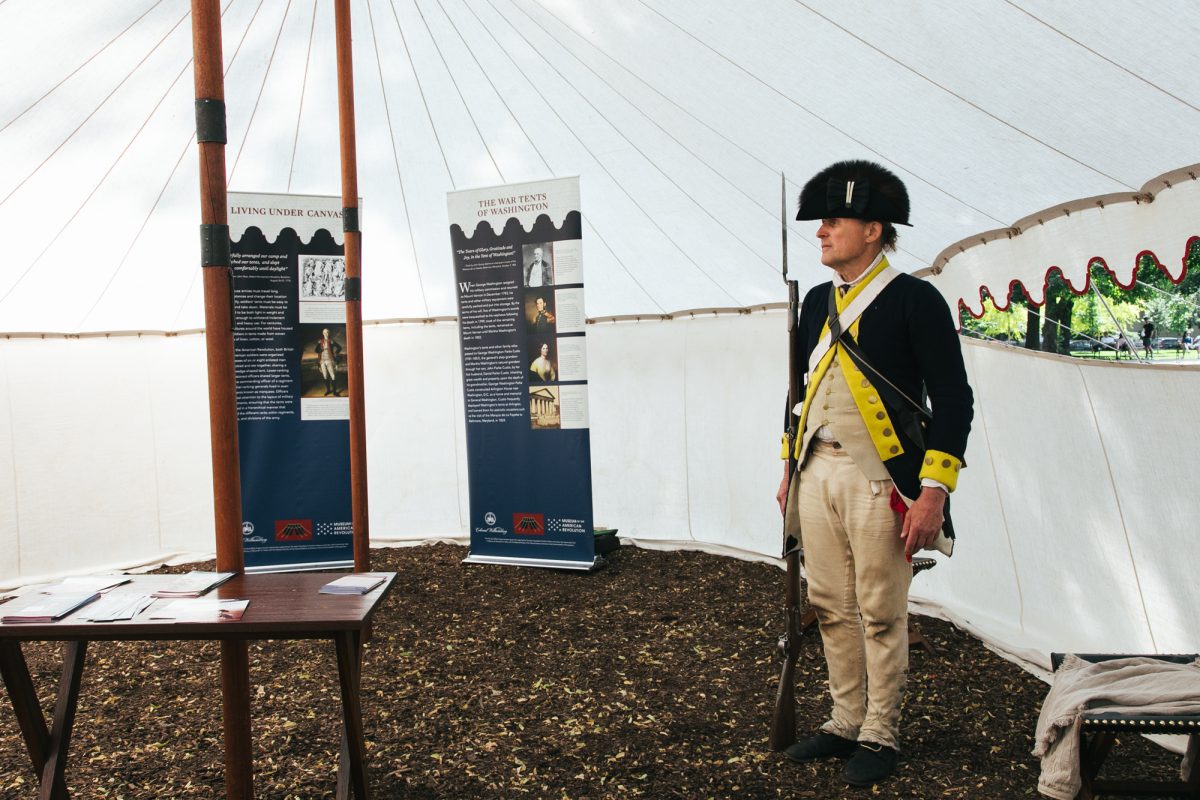
At the Newberry, visitors could walk among recreated tents and replicas of what it would have looked like to be present during the 1776 conversations about citizenship, freedom and democracy.
Eleanor Alexander, a visitor and Chicago copywriter, said the Revolution’s heritage remains relevant because democracy itself remains unfinished.
“Democracy and the revolution in general is an ongoing experiment,” Alexander said. “And I feel like especially in today’s world, where we’re very divided, kind of like we were 250 years ago, that just feels very true.”
Alexander said the nation’s founding ideals cannot simply be transplanted into the present without some sort of adaptation.
“I think we have to adapt to the times that we’re living in,” she said. “And I think that, generally speaking for me, it’s just having a world where me and my friends and family and loved ones can all be safe and live happily and cohesively together is kind of what we’re all working towards.”
Jean SmilingCoyote, a native Chicago resident who visited the library last week, said the exhibition demonstrates why studying history remains important as the country approaches its 250th anniversary.
For her, conversations about freedom require acknowledging the complicated realities behind our nation’s growth.
“In the case of the United States, there’s a lot of freedoms that immigrants and Native Americans got, which have been at the expense of Native Americans,” SmilingCoyote said.
The exhibition does not try to resolve those tensions. Instead, through rare documents, public conversations and competing perspectives, it asks audiences to wrestle with them for themselves.
While the exhibition focuses on documents from the past, Austin said its main questions are rooted in the present.
“We are still a young nation. We are only 250 years old,” Austin said. “It’s up to us to do our part. Whether you are a Republican, or a Democrat, or whatever your position is, we all have a role to play in being active, engaged, educated citizens who know our history, who can learn from the past, and hopefully look forward to continuing to contribute to the common good.”
“Free and Independent: The Declaration of Independence and the Words that Made the United States” will remain on display in the Hanson Gallery at the Newberry Library through July 18. Admission is free, though visitors are encouraged to reserve tickets in advance through the Newberry Library’s website.
Copy edited by Antonio Chaves