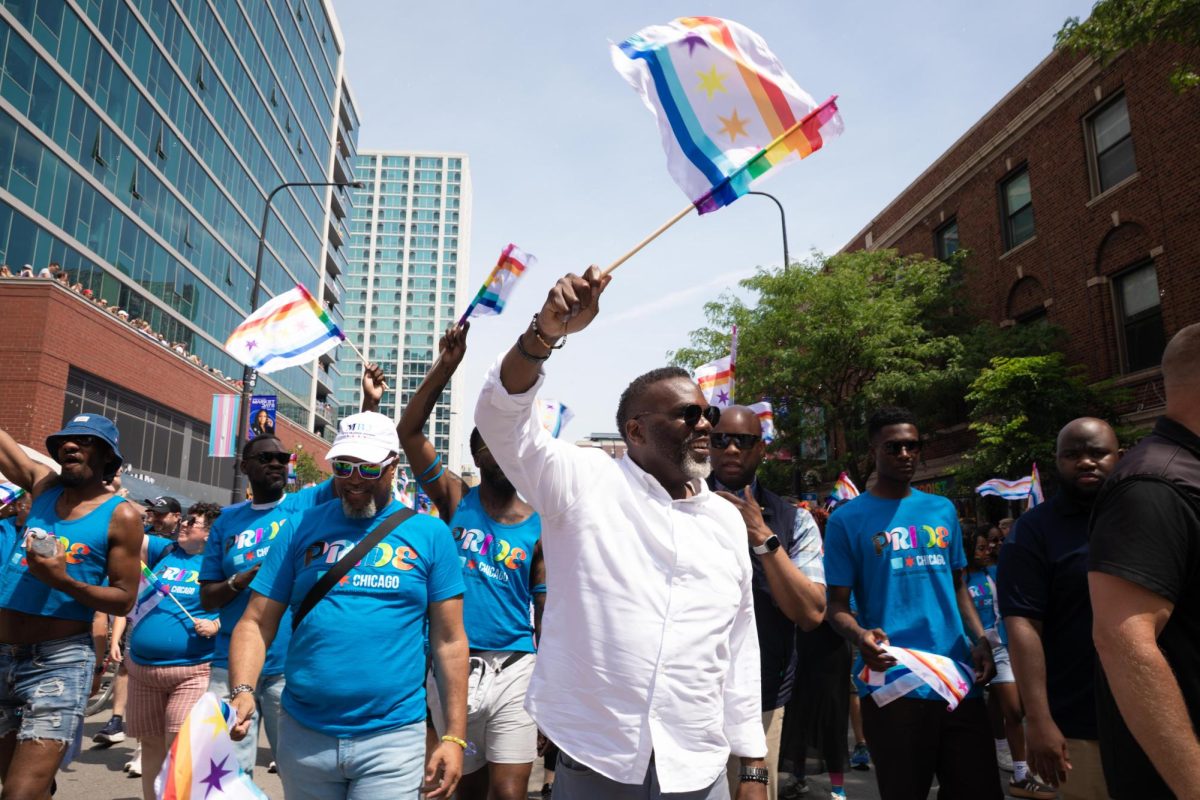
A transgender pride flag flew high, held by a group of queer Illinois politicians, as a horn and the revving of the “Dykes on Bikes” motorcycle club signaled the beginning of Chicago’s 55th annual Pride Parade.
The parade stepped off on Sunday morning, June 28 at the intersection of West Sheridan and Broadway in the Northhalsted neighborhood. While many facets of queer life were celebrated, from African American LGBTQ+ residents to queer scouts in the “Every Scout is Equal” program, there was a notable focus on the transgender community.
PRIDEChicago chose “Free to Be Proud” as the theme for the 2026 parade, celebrating LGBTQ+ joy while pushing back against efforts to restrict transgender rights.
In Iowa, for example, Gov. Kim Reynolds signed HF 571 into law on May 19, allowing health care providers to decline to participate in certain services that conflict with their religious, moral or ethical beliefs. In Illinois, state leaders have positioned the state as a refuge for transgender residents, and organizers said the theme also reflected a commitment to visibility and inclusion.
“Pride has always been about visibility, dignity, resilience and the right to exist safely and authentically. The theme serves as a reminder that freedom is still not equally experienced, and that true liberation is collective — no one is truly free until everyone is free to be,” said PRIDEChicago Board Chair Steve Long.
Iowa is only one of 18 states that have signed a total of 54 laws that target the LGBTQ+ community so far in 2026. Many specifically target transgender individuals and their access to healthcare.
Asher McMaher, founder and executive director of Trans Up Front, a non-profit and state-wide organization that supports trans youth and their families through advocacy services, described the importance of pride as a moment to celebrate joy amidst the battle for the rights of queer youth.
“We’re having this amazing pride parade so that people in Kansas or Iowa can see that there are still people fighting for them. I think that celebrating joy is just as important as hitting the streets and demanding our rights, because they can’t take our joy and our resilience from us,” McMaher said.
The organization’s presence in the parade was a bus full of trans youth waving and welcoming the streets of Northalsted, as on-lookers cheered them on and waved back.
Kayden McCall, a trans man, originally lived in southern Illinois before moving into the city. Now in Chicago, he feels much more supported and comfortable to be himself.
“It means that I can express myself how I want and let other people know that I’m proud of who I am, and that nobody can judge me for that,” he said.
Along with celebrating genderqueer voices, Long said a focus of this year’s Chicago Pride Parade was a celebration of history, especially as the current administration erased references of transgender people from the Stonewall monument website in February, 2025.
A part of this celebration was making Chicago journalist and Windy City Times Co-founder Tracy Baim a Grand Marshal of this year’s parade, recognizing her work in documenting queer Chicago history for the last 42 years by making her the star of her own float.
“In a time when parts of that history are being erased or at risk of being overlooked, her contributions underscore the importance of preservation and visibility,” Long said.
Baim, whose friends joked about her “finally wearing some color” to pride as she usually dresses in black, spoke to the importance of featuring all walks of queer life.
Baim shared anecdotes about her times reporting on the HIV and AIDS crisis, and how differences were made, not just by featuring the doom-and-gloom stories that focus on the current administration, but the everyday queer experience.
“It can’t always be about tragedy and policy. But then the other stuff that we need to cover is the harder news,” Baim said. “The violence and the pushback of the arc of the moral universe. They’re trying to bend it and break it backwards. So we have to do both parts, but we can’t do one without the other. We have to humanize this issue.”
Baim attended her first Pride Parade in 1984, and said that the main thing that has changed, just like her outfit, is the amount of color.
“Everything about pride is just so much bigger, which gives us the support we need as we fight the things that are trying to push things backwards. This genie is out of the bottle and it’s millions and millions of people. You can’t push all of that back into the closet. It’s way too strong,” she said.
Mayor Brandon Johnson and Governor J.B. Pritzker both walked in the parade, waving and shaking the hands of residents. Many parade-goers said they felt supported by the current Illinois political leaders.
Kait Wilbur, a bisexual central Illinois resident who used to live in Indiana, spoke to the importance of Illinois as a sanctuary state for genderqueer people, as she has seen many of her friends take the brunt of discrimination in her home state.
“I have friends who were getting very very scared — my trans friends especially — of legislation passing and for the community overall. Illinois has always felt like a pretty safe haven for queer people,” Wilbur said.
While many parade-goers voiced their fears about the current U.S. administration — including Tony Norman, a gay man in his 50s who attended with his partner and noted his concerns about federal walk back on healthcare — other on-lookers were just concerned about celebrating the day.
“I don’t know what the future holds, I just kind of live for today,” said Eva Skye, a nonbinary person in their 60s who wore an all-rainbow outfit while holding two fluffy rainbow wands.
As a youth cheer squad cartwheeled while wearing pride-themed skirts and a person in a fursuit passed out trans pride flags to smiling on-lookers, anxieties seemed to subside with the excitement of strangers celebrating.
Nick Colosimo, a volunteer with the Human Rights Campaign for the past 15 years, wore clown-like makeup inspired by horror movies for pride. He said that pride, especially this year, is a space for people to forget their issues for a while.
“There’s just so much unnecessary hatred in the world and there’s no need for that. And I feel, being here, you can just push that all beside, even for a couple hours. Surrounding yourself with so much love and support really makes you feel like it’s where you need to be and should be,” Colosimo said.
Baim said all queer people right now need to be together, not just to celebrate, but to fight for their genderqueer community members.
“We have to, as a community, really wrap our hands around each other,” Baim said. “For those queer people that really are not great at understanding that gender diversity, they need to take a back seat if they don’t understand it and let folks who do understand it fight for our folks within our community.”
Additional reporting from Nico Waugh
Copy edited by Venus Tapang