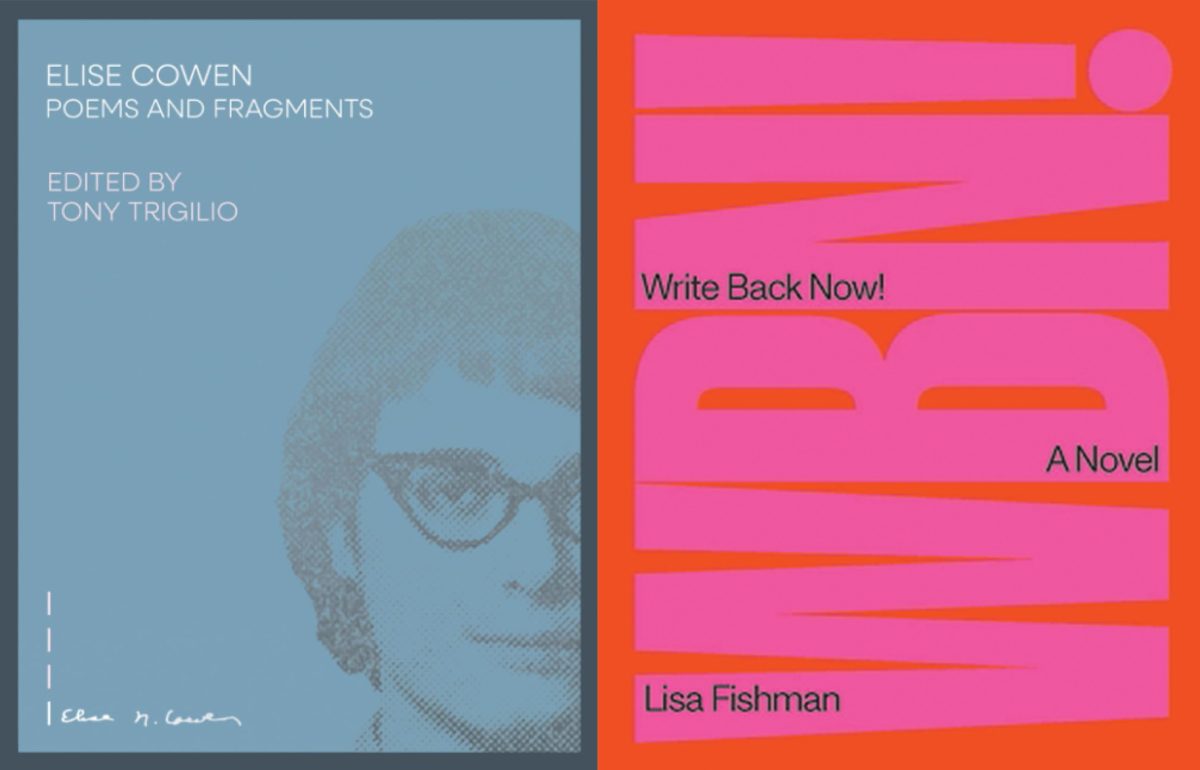
Two faculty members in Columbia’s School of Communication and Culture recently released books that explore storytelling, memory and literary history through different forms of writing.
Professor Lisa Fishman published “Write Back Now!,” a novel centered on memory and emotional openness, and professor Tony Trigilio edited “Elise Cowen: Poems and Fragments,” a collection revisiting the work of the late Beat poet.
For Fishman, writing is less about following strict rules and more about remaining emotionally and artistically open.
“It’s a very delicate and, it will sound, paradoxical balance between an attention to craft,” Fishman said. “And getting out of the way of what needs to emerge and unfold.”
That openness to uncertainty and experimentation carries throughout “Write Back Now!,” a work that drifts between memory, observation and lyrical reflection rather than following a conventional narrative arc.
“The novel goes backward in time, subsequently with each chapter, until the final one or two chapters, when it comes back to the present and then, in fact, goes a bit forward,” Fishman said.
Fishman said she has always been interested in the ways language can mirror emotional experience rather than simply describe it.
This is something students said defines her teaching style as well. Rather than encouraging students to imitate existing structures, Fishman pushes them to discover voices and styles that feel personal to them.
“The way that it deviates from form has to do with the way that it tries to prove that time itself is a deviation,” said Charly Heber-Spates, a 2025 alum who majored in creative writing. “Through her classes, she just encouraged her students, really, to experiment.”
Trigilio’s work similarly emphasized authenticity over perfection in the classroom. His recently released collection revives the voice of Beat poet Elise Cowen, a writer associated with the Beat Generation, a postwar literary movement known for rejecting traditional social norms and experimenting with freeform, whose work had long remained fragmented and overlooked in literary spaces, despite her generational influence.
“I want her poems to give them permission to disrupt traditional forms,” Trigilio said. “I want the poems to give them permission to experiment politically, experiment thematically, experiment structurally.”
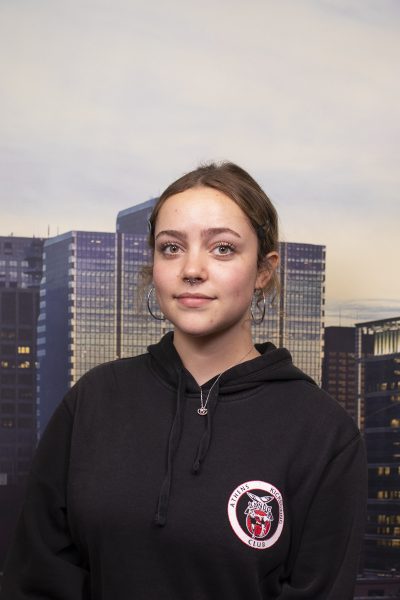
Natalie Hernandez, a creative writing major who graduated on Sunday, May 17, said professors like Fishman and Trigilio helped her rethink what poetry could look like.
“There’s so many different things you can do with poetry,” Hernandez said. “I do enjoy using my connections with fiction to almost freestyle prose in my poems, rather than following a specific structure.”
Jake Whalen, a creative writing major who also graduated last weekend, said having professors who are authors offers reassurance that careers in writing can exist outside of abstraction or fantasy.
“I think it’s good to have a professor who’s practicing what they preach,” Whalen said. “It just gives you something to aspire to.”
That visibility matters deeply within a field that can often feel uncertain to emerging writers. Students described seeing faculty members not only teaching literature, but also actively contributing to it through published books and editorial work.
“They’ve done such a good job of treating their students like peers,” Hernandez said. “It makes me really excited for the future and for expanding my own career.”
Copy edited by Venus Tapang