Narissa Duncan, a first-year acting major, never had many Filipino friends growing up.
On Wednesday, Oct. 14, she had a chance to attend a Columbia event with other Filipinos and to explore her culture.
“When I found out there was an event held for Filipinos, I thought it was such an amazing feeling to be represented,” Duncan said. “I feel like we have a lot of pride in being Filipino.”
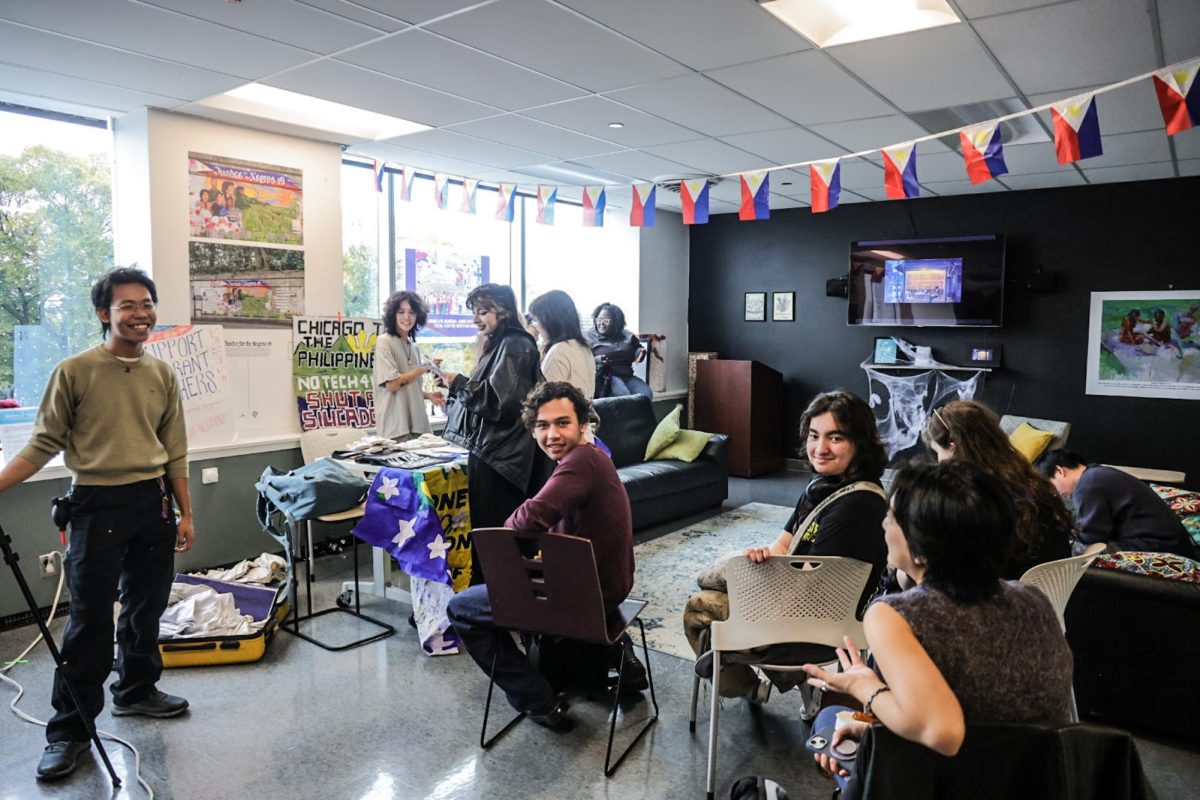
Student Belonging and Persistence hosted the Sampaguita Celebration, bringing about 20 students to celebrate Filipino culture during Filipino American History Month.
An estimated 4.6 million people in the United States identified as Filipino in 2023, according to the U.S. Census Bureau. Filipino Americans are the third-largest Asian origin population living in the U.S., accounting for approximately 19% of the Asian population.
The Columbia event was named for the sampaguita, a sweet-scented flower in the Philippines that is a small, star-shaped blossom which opens at dusk and closes at dawn. It holds many cultural meanings such as purity, simplicity and strength. Honoring the sampaguita, the country’s national flower, is important to Filipino culture and its celebrations.
Dillon Poblador, a first-year photography major, attended the event because growing up in Chicago, he didn’t see a lot of Filipino representation.
Only about 1.4% of Chicago’s population is Filipino, according to the U.S. Census Bureau’s American Community Survey.
“Overall, Filipinos, I feel like we’re perceived pretty good when it comes to personality and being nice,” Poblador said.
The celebration featured lumpia, a traditional Filipino dish filled with pork or beef, minced vegetables and seasonings, wrapped in a thin pastry and fried.
Rae Ruiz, a senior theatre major, attended the celebration as a way to communicate with fellow Filipino students.
“A lot of our history is very sad, and it is still right now, so it’s important to acknowledge all the good parts of our culture as well,” Ruiz said.
Students were able to use a photobooth and try on traditional Filipino clothes at the celebration. Amy Hernandez, a senior film and television major and a part of the Student Belonging and Persistence office, provided the clothes from her own family.
Most of the clothing was made from piña fibers from the pineapple plant, an indigenous plant in the Philippines.
The Philippines were under Spanish colonization for over 300 years, and during that time, the Spaniards banned any coloring or designs on Filipino clothing as a way to oppress them.
“What Filipinos did in response to right against that power was they started embroidery,” Hernandez said.
Students also had a chance to respond to prompts about what makes them feel connected and what growth they could see related to their culture.
Poblador said he enjoyed “being able to talk and connect to people and find out about other Filipino events.”
Copy Edited by Mia Smith