
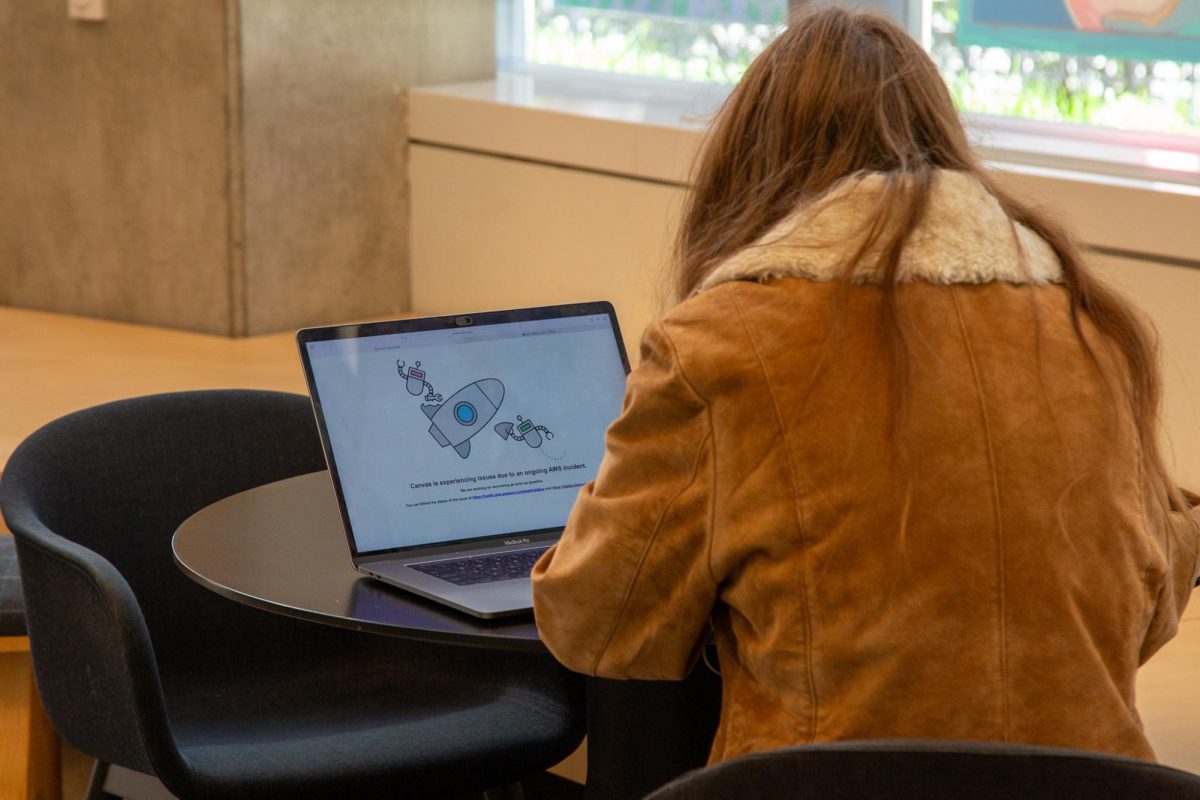
A global outage of Amazon Web Services early on Monday, Oct. 20 knocked out multiple sites, including Canvas, disrupting classes, assignments and tutoring sessions across the college.
As one of the world’s largest cloud-computing providers, AWS powers thousands of websites and apps, including Venmo, Snapchat and DoorDash.
At Columbia, students and faculty use Canvas for assignments, quizzes and tests, discussion boards and to share resources and other course materials, including syllabi. Half the colleges and universities in North America use Canvas as their learning management system.
Nina Domanus, a senior sound design major who works at Columbia’s Student TechBar, said they haven’t had a lot of people come into the TechBar because faculty are communicating with students about the outage. The new Student Information System was not impacted.
“The outage is affecting everything from Canvas to even just sending messages on social media and stuff like that, as well as ordering food,” she said. “I know a couple of us here, we’re trying to order our lunch and all of the ordering services are down.”
Domanus said that there hasn’t been a lot of communication between them and the college’s Information Technology department.
“It’s pretty understood that it’s an issue that we can’t do much about,” she said. “They’re just making sure that there’s a clear communication to students about the fact that it’s not a Columbia issue. It is a nationwide issue.”
Kathie Koch, associate vice president and head of Columbia’s technology, said several of the college’s third-party systems like Canvas and Panopto are hosted on AWS.
Cloud computing allows companies to store data, software and services on remote internet servers instead of local machines. Providers such as Amazon Web Services, Google Cloud and Microsoft Azure host platforms like Canvas, handling requests through vast data centers that deliver files, grades and assignments to users almost instantly. When one of these providers fails, it can disrupt access nationwide.
“As a customer of these vendors, we have limited control over their infrastructure decisions, including which cloud providers they use,” she said. “While we can’t prevent outages at the cloud provider level, our focus is on resilience, communication and continuity to support our students, faculty, and staff as effectively as possible.”
The college sent an email about the outage at 1:41 p.m. Zoom, MailChimp and parts of Adobe also were impacted, according to the college.
Feihong Guo, a senior arts management major who works as a math tutor at the Academic Center for Tutoring, said he initially thought the issue was with his student’s phone when they couldn’t access Canvas during their session this morning.
“I also have a midterm test this Thursday,” he said. “Now I can’t access anything from the assignments due today to the midterm study questions.”
Aside from his coursework, Guo uses Canvas for tutoring classes and assignments required for his job.
“I talked to my tutoring advisor to see if I could move my assignment to next week,” he said. “She agreed and told me to take advantage of the Canvas outage.”
When students and faculty tried to access Canvas this morning, they saw a message that Canvas was down, with no estimated recovery time. The outage was first detected around 2 in the morning.
Lauren Downing Peters, an associate professor in the School of Fashion, said her initial reaction was a sense of empathy for her students. “I can only imagine what a huge source of stress and anxiety this is.”
Peters said she could not send emails through Canvas or post announcements to classes. “Vital communications in addition to assignments are inaccessible right now.”
Sophomore fashion studies major Evelyn Perez said she was struggling to access the readings she needs to do for class.
“I just feel like I’m wasting time waiting and I feel as though I could be doing so much,” she said. “I had a whole idea set and plan set for what I was going to do today, but because Canvas is down, I can’t really do all of those things that I had initially set and planned ahead for.”
Peters urged the college to have a backup for what to do in these instances, and maybe start making shifts towards more analog methods of teaching and delivering content.
“It’s just made me very, very aware of how dependent we are on Canvas and how dependent we are on technology,” Peters said. “We only realize that when things kind of fall apart or break.”
This story has been updated.
Additional reporting from Angel Cal
Copy edited by Matt Brady