THE BACK-TO-SCHOOL ISSUE
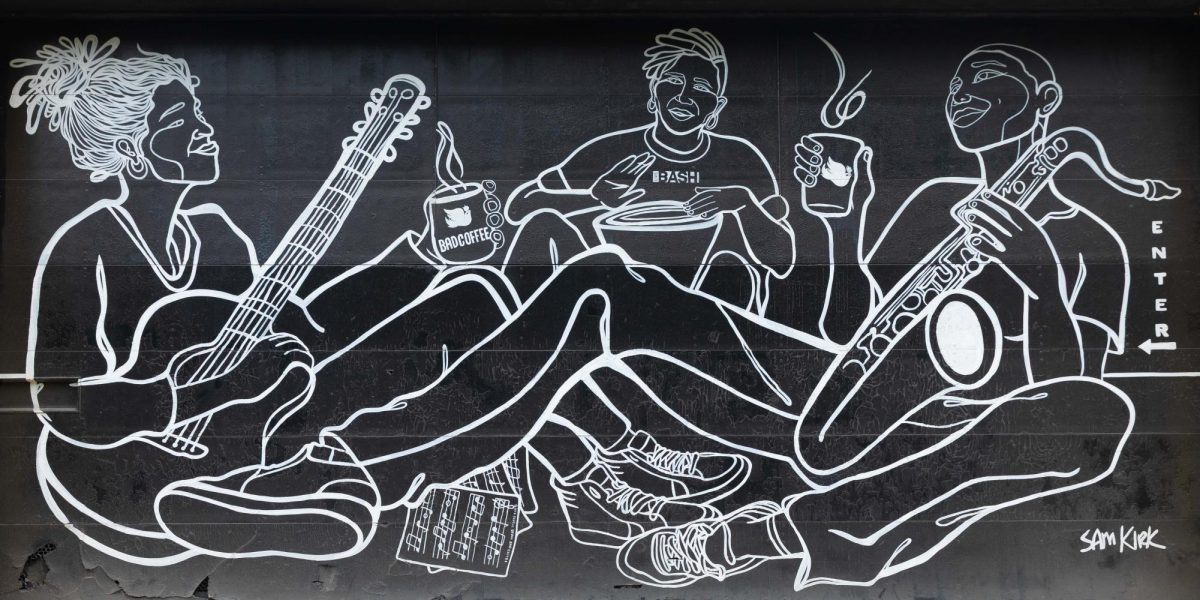
“Art becomes protest the moment it publicly shares an idea that inspires people to imagine a different way of living,” said Chicago artist Sam Kirk, who grew up on Chicago’s South Side.
Kirk, who has work permanently displayed in the Obama Presidential Center and Smithsonian National Museum of Mexican Art, tries to select locations for her art that will make a significant impact, sometimes placing murals in neighborhoods that have discriminated against the people portrayed or that have been historically ignored.
She said claiming that physical space is a powerful statement.
Kirk focuses on creating layered visual environments that invite reflection, recognition and connection in her work. One of her most recent murals, in collaboration with artist Dorian Sylvain, is permanently displayed in Home Court at the Obama Presidential Center. The mural, “Pass it Forward,” embodies the spirit of connections to the past while reimagining the future through the eyes of the next generation.
The new generation of Chicago artists is using art as a platform to express viewpoints on social topics such as racism, women’s rights and LGBTQ+ discrimination, which mirrors how activists used protest art to challenge mainstream culture of the past.
Currently featured at the Chicago History Museum is “Aquí en Chicago,” an exhibition inspired by students from Instituto Justice and Leadership Academy in Pilsen who protested the museum for the lack of Latino representation in 2019.
The students created posters and shared them on social media to create a mass movement of images to promote their movement.
Elena Gonzales, curator of civic engagement and social justice at the Chicago History Museum and co-curator of the exhibit, said that protest art remains important because it is able to introduce topics in a more intimate way compared to traditional protests like marches, rallies and speeches.
“It feels like everyone is ready to be offended. Everyone is ready for an argument and everyone sort of already knows their piece that they want to say in that argument,” Gonzales said.
She said that using art instead of spoken or written words can eliminate flash points and triggers.
“Especially in the case of visual art or performing art or something that’s not explicitly text based. You are able to come right into the topic without using those words first,” Gonzales said. “A lot of times, artists can bring us into a topic in a way that doesn’t necessarily start out with those words that get everyone fired up, but, instead, gets us thinking about the deeper issues at play.”
Artists have long used reproducible images to spread political ideas, like printmakers who were known for their mass movement of images.
José Guadalupe Posada, who was famous for his figure of “La Calavera Catrina,” distributed prints of his art and fueled the mission of the Mexican Revolution from 1910 to 1920.
Taking inspiration from Posada, Carlos Cortéz, a Chicago artist and printmaker, fueled protest art with his prints for the industrial workers of the world and the labor movement of the 1970s and ‘80s.
“The youngest generation of all is really using social media to move images in a mass way, the same way that these printmakers have,” Gonzales said.
As protest art evolves with the political climate, artists continue to find ways to spread the messages behind their work.
Paint the City, a nonprofit organization whose mission is to support the equality of all people through paintings and murals around the city, was started in 2020 following the Black Lives Matter protests.
Barrett Keithley, a Chicago artist and co-founder of Paint the City, currently features his work in the Chicago History Museum in the “US at 250” exhibit, a rotating gallery focusing on the history of civic action in Chicago.
His mural “The People, We Are: Democracy, Justice, a More Perfect Union” explores the impact of the U.S. Constitution while also reflecting on the ongoing struggle for equality and justice. Keithley’s work gives viewers the message that democracy is an evolving and collective effort.
Keithley has worked with many local artists and businesses to spread awareness to unrepresented communities in the Chicago area, and continues to do so with his own art.
“If you tell someone something, you’re just telling them. They’re being told, and they’re being instructed,” Keithley said. “If someone sees something, they feel inspired by it, or it connects them deeply. It gives them a visceral feeling. Now we’re talking true power.”
Copy edited by Katie Peters
This story also appears in the Chronicle’s back-to-school issue, available Sept. 1.