
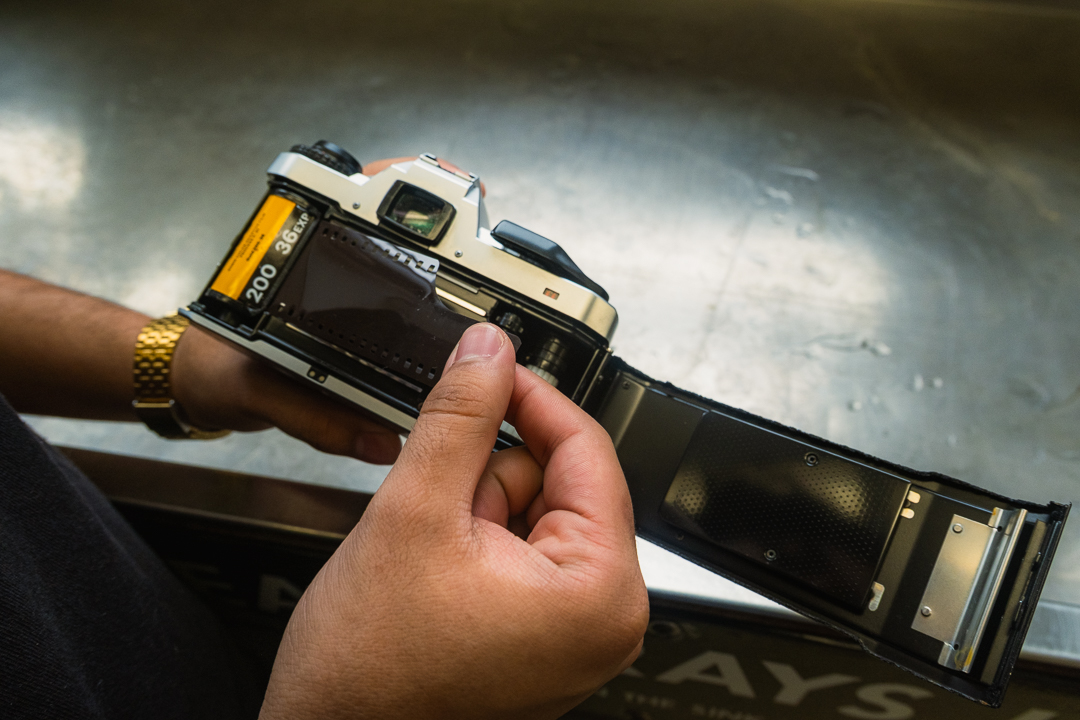
When Neyman Canelo-Garcia first got interested in photography, he learned to use disposable cameras and polaroids before moving onto digital photography. After suddenly losing four years of digital work out of the blue however, he made a return to analog photography.
“I was like, well, I still have my camera,” said the senior photography major.
Other Columbia faculty and photography majors like Canelo-Garcia said they still actively work in analog photography, specifically film, because of its physicality and permanence, among other things that make it unique from digital.
Krista Wortendyke, assistant professor of instruction in the School of Visual Arts, said that part of what makes photographers work in film photography is because of the assurance that it will still be around for years to come.
“I feel like we’ve gotten to a place in the world where we don’t own anything anymore, everything’s subscription-based,” Wortendyke said. “You’re making photographs and they’re on a screen and they are in a cloud, and if that company goes broke, your history is gone.”
Wortendyke recalled the transition from film to digital photography at the college and how difficult of a switch it was for photography students and faculty.
Many photography facilities, like the darkroom, were suddenly not in use anymore.
Robert Linkiewicz, assistant director of digital facilities, said that when he first started working at the college 27 years ago, the 10th floor of 600 S. Michigan Ave., where the darkrooms are located, was “busier than O’Hare Airport on Thanksgiving.”
Despite the drop in large use of the darkrooms, Linkiewicz said that more and more students have become drawn to film photography, causing an increase in how many students have signed up for darkroom courses.
In Spring 2026, the college initially offered two “Darkroom Dynamics” classes, which served as an introductory course to analog photography.
Now this semester, four of these classes are being offered.
He said that with the darkrooms, people are more likely to create a sense of community because of everyone using the shared space.
“Just meeting people up there, it’s a very special kind of way of creating,” Linkiewicz said.
This sense of community created through film photography doesn’t just stop in the darkroom. Camera stores like Central Camera Company in the South Loop help to keep film photography alive by providing a space to learn more about the kinds of materials used to produce it.
Customer service sales representative Joseph Real had been going to the store for around seven years before landing a position at Central Camera Company. He said because of the store, he’s been able to meet new people and get to know the regulars while offering recommendations.
“Communities form around interests,” Real said. “And having stores like ours where a lot of people congregate in a single place to even just pick up film, helps build that and helps create a weave of people that we know.”
However, where film photography differs from digital is accessibility.
With film photography, a 35mm camera and buying film is needed. Then the photographer has to develop it in a darkroom, which requires several chemicals, whereas smartphones or DSLR cameras can be more readily available.
John Morrison, adjunct professor of instruction in the School of Visual Arts, mentioned how, despite film always being pricey, the cost could be too much for some people and might turn them away from learning how to do film photography.
“Film and paper are very expensive. There was a cost involved and you were very conscious of the fact that every time you took a picture – even 40 years ago,” Morrison said. “Things [are] particularly hard for people financially now. It makes it more difficult for people to work in film, and I think that’s unfortunate.”
Most of all, photographers at Columbia shared the same sentiment of finding the process of creating film photography exciting and fulfilling in a unique way from digital.
For junior photography major Alice Bortel, she sees the process of working with film photography as a science.
“Photography in general, but more so film, is a big science experiment,” Bortel said. “You go in with a hypothesis, you write your ‘if, then, and because,’ and then you just go out and try it out. It’s really fun to see what happens.”
Junior photography major Aren Burman said that knowing film has helped him become more aware of certain settings without relying on a digital camera to tell him.
“When you’ve been doing it for long enough, you kind of know ‘these are the settings I need in the aperture, the shutter speed’ without even relying on a digital meter,” Burman said.
For Canelo-Garcia, since returning back to film photography, it has helped him be more meticulous with what he takes photos of and lets him see the world through a different lens.
“I called it ‘the disease,’ you just don’t stop photographing, even without a camera,” he said. “It’s like there’s a tiny photographer in my head and he never shuts up.”
Copy edited by Isaac Russo