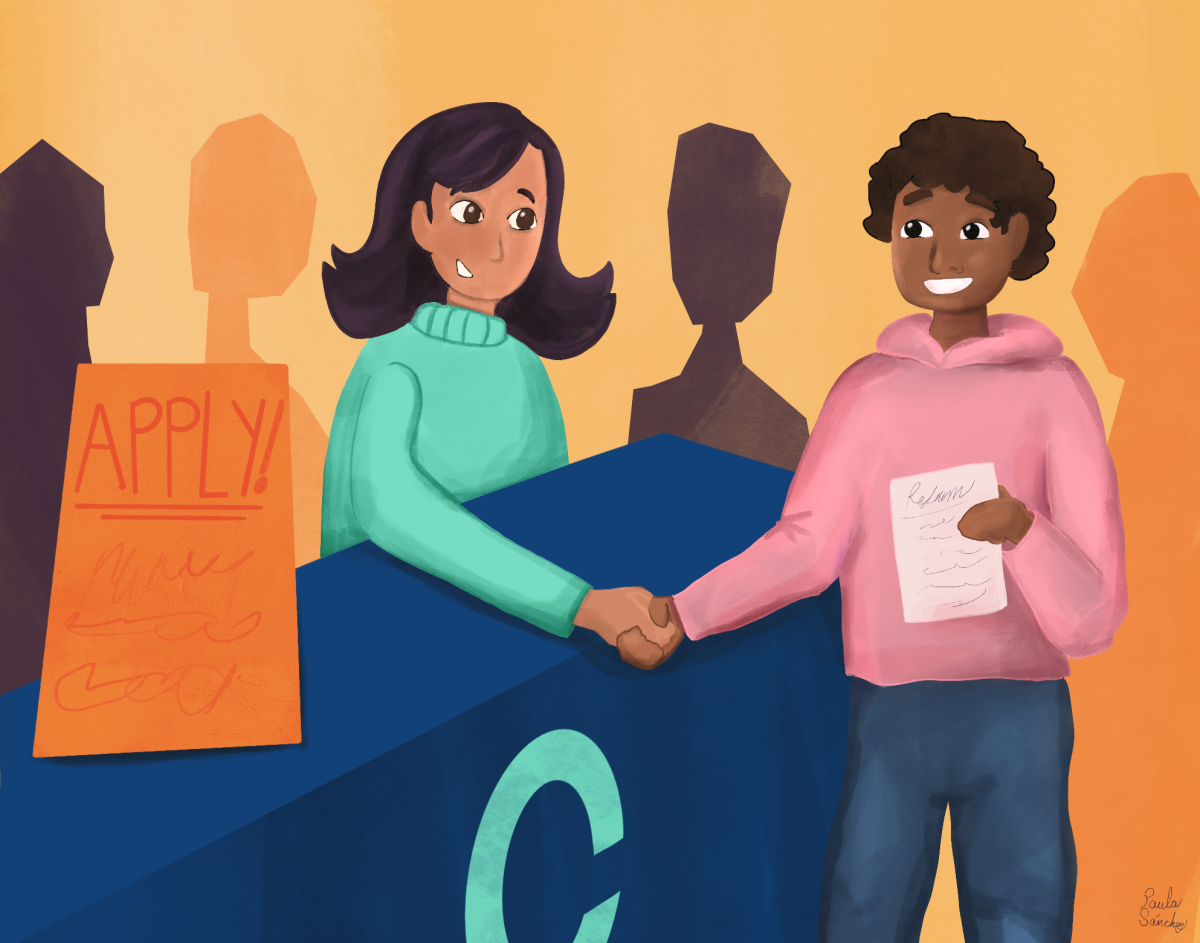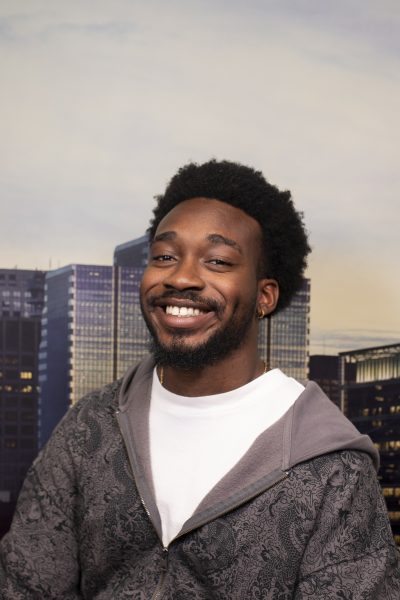

Tanika Lewis Johnson brings Columbia students face to face with Chicago’s history of segregation through her Folded Map Project.
TRANSCRIPT
0:07: Welcome back to Chronversations.
0:08: I’m your host, Cameron Johnson.
0:11: The beautiful city of Chicago is a melting pot of many different cultures.
0:15: Diversity is very prominent here, however, the diversity doesn’t excuse the mass segregation of the city.
0:22: For change to effectively happen, many hands will need to be on deck.
0:26: That’s why Tanika Lewis Johnson, a photographer, social justice artist, and 2003 Columbia College alumni, developed the Folding Map Project, which was used to bring together people from the opposite sides of Chicago to discuss the uncomfortable differences and ultimately bridge the gap.
0:43: A folded map, debuted to the largest Chicago public as an art exhibit in 2018.
0:52: An art exhibit at Loyola University Museum of Art.
0:56: And so, of course, a couple of years after it debuted as an art exhibit, the pandemic happened.
1:01: After the pandemic, I definitely wanted the project to still have some relevance, so I did a lot of, I used all of my artistic tools to make sure that the project would transfer well to virtual and online engagement.
1:17: She came this past Wednesday in the 1104 building and spoke with the film students about her project to combat Chicago’s segregation and subliminal racism.
1:27: The film she presented showcased her life growing up on the South Side of Chicago and Englewood, going up north in high school and seeing all the different cultures come together, and her more in-depth outlook on the division of cities and communities in Chicago, including her own, upon being an adult and her aim for a solution.
1:42: After presenting her film, she coordinated an interactive activity with the students.
1:47: After Folded Math, I really wanted to expand the project to help
1:52: people kind of understand the ways that we perpetuate segregation and sadly redlining.
2:00: And so I did my project called Don’t Go.
2:03: And to give you an idea of what that project is about, I’m just gonna ask you all some questions so you can raise your hand and, and participate, all right.
2:12: So I would like for you to raise your hand if you aren’t from Chicago.
2:18: Raise them high.
2:20: Now I would like you to raise your hand if you aren’t from Illinois.
2:26: Now, I would like you to raise your hand if you are from Chicago.
2:32: OK.
2:33: Hey, me too.
2:35: Now this is where it gets real.
2:37: I would like for you to raise your hand if when you were planning to come to Columbia College,
2:44: and told your family and told somebody, did you hear someone say the Chicago South Side or West Side was dangerous and you don’t go.
2:57: Raise your hand if you did.
2:58: Raise them high, raise them high.
3:00: Chicagoans, can you see?
3:02: This is what they’re telling our people.
3:04: That advice that you all were given, whether you heard it or somebody told it to you, that is how you perpetuate segregation and that sadness is how redlining is continued.
3:16: Afterwards, I spoke to a few students about their overall experience.
3:20: My name is Zoey Hockin.
3:21: I’m a film and television major and my pronouns are she/her.
3:24: My name is Maurice Lorenzo Jones Jr.
3:27: My major is music, business, and entrepreneurship, and my pronouns are he/him/his.
3:32: My name is Jamira Conrad.
3:33: My major is illustration, and my pronouns are she/her.
3:36: So what was your favorite part about the overall film that Tanika showed?
3:40: I think my favorite part was when she started introducing the Map Twins.
3:44: I thought it was really cool to see how they were so similar, but the reasons they were living in their specific neighborhoods were so different.
3:50: Like the first Map Twins, I can’t remember, oh, I think her name was Nanette.
3:56: She said the reason that she lived in Englewood was simply just because that’s what they could afford, and then I can’t remember the name of the couple, but they basically just said that they really liked the neighborhood that they were living in the community there, and so it was like one was out of necessity
4:11: and one was out of enjoyment.
4:13: My favorite part of the film was when she explained how she would go to high school, on the north side of the city coming from Inglewood and how her commute consisted of her looking out the windows and seeing the neighborhoods change because that is something that I really relate to.
4:34: When the Map Twins had interacted with each other,
4:38: I feel like socialism and interaction is very powerful, since us as human beings, we are very social and we are very, I would say, adventurous or intrigued to interact with one another, especially because we are all similar and we all have experienced relatable personal experiences.
5:04: So where are you originally from?
5:06: I’m from Maywood, Illinois, so it’s just the suburbs, like 20 minutes out from Chicago.
5:10: I am from the South Side of Chicago.
5:14: I live in Roseland and I’ve been living there my whole life.
5:18: I live in Mount Greenwood and I went to school.
5:20: I went to a selective enrollment school in Pullman.
5:22: Around the end when she was trying to make it more personal for everyone else, was there a part that resonated with you about, you know, the gentrification that was happening, any part of her story that might have related with you?
5:33: I really related a lot to what she was talking about when in high school,
5:38: she said she went to selective enrollment school,
5:39: I did too.
5:40: It wasn’t as far away, but I met a lot of people that were in neighborhoods that I never really went to often.
5:48: I also related to what she said she saw in her neighborhoods, like a lot of empty lots, storefront churches, lots of beauty supply stores.
5:55: I really resonated with that.
5:57: And then going to neighborhoods that like my friends grew up in, it was significantly nicer.
6:03: Going from west to east, I had the same experience where I would start in a very white neighborhood, and very like developed neighborhood, and then as I drove to school every day, I would see the neighborhoods change, especially at about Vincennes, it would seem to shift and you could see the lack of money and investment put into the more like black neighborhoods on the far south side of the city.
6:36: So that was something that really resonated with me because I had the same experience.
6:40: What resonated with me were
6:43: the differences between the neighborhoods, because every day I have to travel, I have to travel like 15 to 30 minutes just to go to a restaurant or just to go to a store and I have to travel an hour to come here to school.
6:59: So, in the midst of commuting like what she had mentioned, what Tanika had mentioned in the video, it is very different because where I live at there are vacant lots, people, it’s predominantly black folks.
7:12: They don’t interact with each other and it’s not even that dangerous.
7:17: Like where I live, that’s specifically my neighborhood,
7:21: I mean, yes, crime happens, but it’s not every day to where it’s like how they picture it where gang members are just running around, causing havoc on the streets.
7:31: New insights and outlooks were definitely brought about that evening.
7:39: Make sure to stay up to date with campus and Metro News at columbiachronicle.com.
7:44: I’m Cameron Johnson.
7:45: Thanks for listening.
7:46: And until next time.
Copied by Mia Smith