

THE SUSTAINABILITY ISSUE
As graduation season approaches, millions of college students across the U.S. will wear polyester gowns that are used once and often discarded, raising questions about sustainability and cost in higher education ceremonies.
At Columbia, where caps and gowns are included in tuition, students say the tradition comes with trade-offs that don’t always align with their environmental values.
Carter Pham, a senior social media and digital strategy major, said he tries to be mindful when purchasing clothes in order to reduce overconsumption and waste. As a result, his personal wardrobe consists of items mostly made from natural fibers.
However, his graduation gown provided by Columbia is an outlier.
“It doesn’t surprise me, but it doesn’t necessarily align with my code of ethics,” Pham said. “I wish that I had a greater purpose for it, but I think realistically, it’s probably going to sit in my closet.”
The current gowns offered by the college are made from polyester, a non-biodegradable synthetic fabric constructed out of polyethylene terephthalate, the same chemical compound used to make plastic water bottles.
This reflects the broader issue in the U.S. where more than 5 million high school and college graduation gowns made from polyester enter landfills each year.
Faculty regalia, by contrast, is typically rented and reused across ceremonies, a longstanding practice that reduces the need for one-time-use garments.
Senior fashion design student Lizzy Fowlkes said that, while polyester makes practical sense for graduation regalia due to its affordability, wrinkle resistance and durability, there are other solutions that would help reduce overall waste.
“Nothing can truly be sustainable, especially in our capitalist society,” Fowlkes said. “It’s more about responsible design and intent with your creation.”
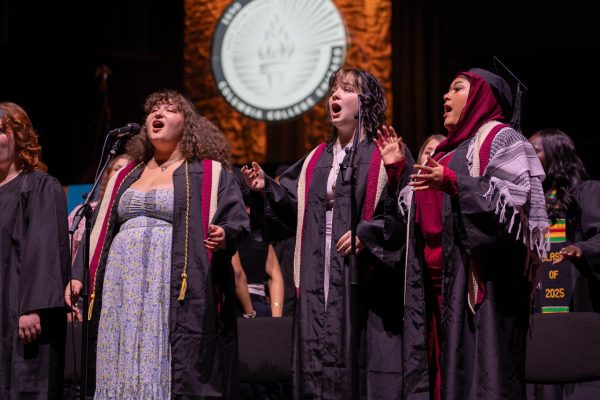
Columbia’s graduation regalia vendor Herff Jones offers two alternative gowns that are meant to be more eco-friendly.
The Renew “keeper” gown is made from 100% recycled polyester, which the company claims saves the equivalent of approximately 29 plastic water bottles from the landfill.
Fowlkes said that although a gown made with recycled materials would be an improvement, it is a product of greenwashing, because without a way to repurpose the gowns after use, the non-biodegradable polyester will still end up in landfills.
Herff Jones also recently released a rental option called EarthGrad that is made from high-quality sustainable fabrics, and known as the “first of its kind in the industry,” according to the company’s website.
Fowlkes said this is the best option in terms of sustainability, as many students do not feel the need to keep their gowns anyways.
She also said that, while gowns made from natural fibers, like cotton or linen, would be a more expensive up front cost, the college would get more wear out of them.
In March, University of California, Berkeley announced a 10-year partnership with Herff Jones to purchase custom EarthGrad gowns starting with the Spring 2026 commencement. The transition to these gowns raised the purchase cost for students by five times, but the college intends to establish a rental-based program in the coming years that would drop that fee back down to about $50.
At Columbia, the cost of graduation caps and gowns are included as a part of the student fees in tuition. Bachelor regalia currently costs approximately $45 per student, and graduate regalia costs about $78 per student.
Assistant Dean of Student Affairs Operations and Communications Connie Stanley said the college has reached out to Herff Jones to inquire about their more sustainable regalia options, such as EarthGrad, for future ceremonies.
“At this time, we do not have an anticipated timeline or information on potential pricing differences,” Stanley said.
Stanley added that if students are concerned about the environmental impact of the current regalia, they are “more than welcome” to wear an alternative gown as long as it aligns with the college’s standard ceremony color guidelines, which is black for undergraduate students and gray for graduate students.
“We are continually evaluating ways to improve the commencement experience, including exploring more sustainable practices,” Stanley said. “As we look ahead, sustainability remains an important consideration in our planning and vendor partnerships.”

Senior acting for stage and screen student Matthew Glasper said he would not consider paying additional fees for a more sustainable option, as he does not mind the material the regalia is made of now.
“I’m probably just going to stick with whatever gown they give me,” said Glasper.
Lucy Conway, a senior fashion design major, said that, while she understands why polyester is currently used, reusable regalia would be a good option for Columbia students to integrate more eco-friendly habits.
“If you’re using the same gowns every year, it can cut the cost over a long period of time, and it’s not adding any more garments into the waste of the world,” she said, adding that she is considering posting her gown on Facebook after commencement to offer to a rising senior for reuse.
Pham said that if any additional cost for new gowns were included in tuition, he would not have a problem with the shift.
“Honestly, it would be great to have a recyclable cap and gown program,” said Pham. “I think a lot of students would choose that option especially because there’s nothing unique about Columbia’s cap and gown, students don’t necessarily feel the most connected to it.”
Pham suggested that if the college were to invest in reusable gowns, there is an opportunity to customize the regalia to better suit Columbia’s creative identity.
“I mean, we go to an art school,” he said. “There’s so many students who would want to collaborate on a project like that.”
Fowlkes said that she would love to see a partnership between the School of Fashion and Herff Jones to design new regalia.
“I think that would be really interesting to see,” she said. “ We do so many upcycling projects and things like that, or maybe it’s a competition project to design a new graduation gown.”
Fowlkes said that if she were to craft a gown from natural fibers, she would consider affordability, modularity and fabric weight.
“It may look a bit less traditional,” she said, “but I think that’s part of the compromise and might even give the gowns a more stylish look.”
Copy Edited by Samantha Mosquera