Columbia will cap enrollment in most Big Chicago first-year course sections beginning this fall, part of an effort to help new students build stronger connections with peers and faculty during their first semester.
Most sections will have no more than 45 students, said Robin Whatley, associate dean of academic programming and director of the Honors Program. Class sizes ranged in the past from 45 to 200.
“Logistically, classes with fewer students makes it a little easier to navigate public transportation for field trips around the city,” Whatley said in an email to the Chronicle.
Big Chicago is Columbia’s required first-year seminar and the only remaining course in the Columbia College Chicago Experience, or CCCX, curriculum required for graduation. Introduced in 2015 to replace the college’s First-Year Seminar, the courses are designed to familiarize students with Chicago through interdisciplinary study, neighborhood field trips, and hands-on learning while helping new students build community during their first semester.
Courses in the fall include “Curiosity in the City: Monsters, Marvels and Museums,” “Chicago: The Global Metropolis” and “Haunted Chicago.”
Big Chicago originally was the first course in a required three-course Columbia Experience sequence, but the college eliminated the two upper-level CCCX requirements in 2023, leaving the seminar as the cornerstone of the first-year experience, which is designed to help students learn more about Chicago and the college’s urban and diverse community.
Each course has a different learning objective, ranging from topics like economic, ethnic, racial, cultural, social and political developments of the city, often including field trips to various locations around Chicago.
Solon Love, a junior interior architecture major, took a Big Chicago course as a first-year student in 2024. Although his class size was only about 35 students, he could not have imagined it being any larger.
“I don’t think those types of classes are suitable to have that many people,” he said.
The exception to the 45-student cap will be for courses that are co-taught.
Elizabeth Davis-Berg, a professor in the School of Design, is co-teaching “The Shapes of Chicago” in the fall with Christopher Shaw, associate professor in the School of Design. Their course cap is 105 students.
“We plan to have students work together in smaller groups so they can get to know each other and will vary the groups throughout the semester,” Berg said.
Berg said the only challenge will be transportation for field trips because the class will need to use several CTA buses to accommodate all of the students.
Last fall there were 14 sections of Big Chicago, and this fall there are 22 sections.
The change in course size was initiated through the Student Success Task Force, led by Greg Foster-Rice, associate provost for student success initiatives.
The deans of Academic Programming and Faculty Affairs, as well as other members of the Provost’s leadership team, worked with Big Chicago faculty to make sure their courses were intentionally designed and delivered in alignment with the program’s broader goals of student engagement, belonging and academic success, Whatley said.
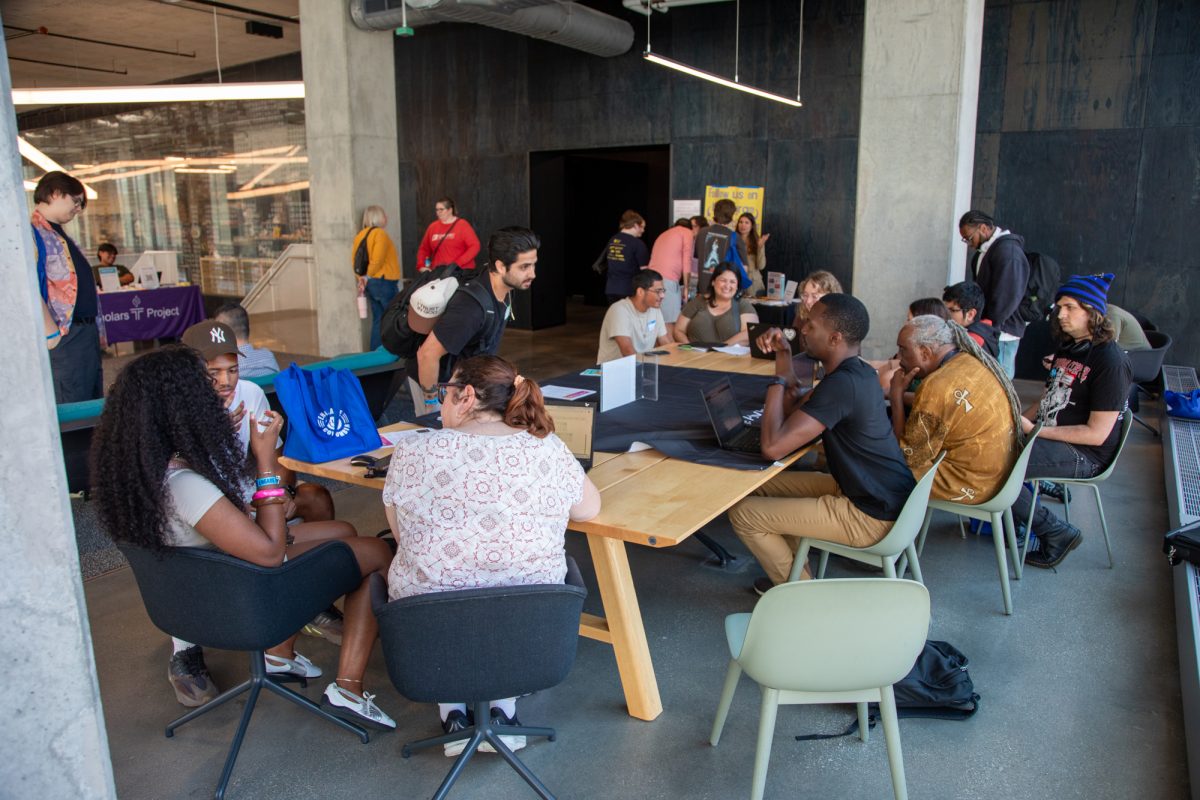
First-year photography major Mackenzie Bizub, who starts this fall, is taking the Big Chicago course “Everything is a Photograph,” which has a capacity of 48 students. Bizub said he was excited to learn about the history of Chicago and to connect with other students.
“I feel like a smaller class is better for community building because then you can connect with each person individually,” he told the Chronicle from New Student Orientation this week. “In a big class you can kind of connect with people like that, but it’s way easier when you’re in a smaller group.”
Shaw said one of the advantages of larger class sizes is that with more students there is an increase in the diversity of interest, experience, demographics and other affinities that students may identify with.
“For a student looking in their first semester to ‘find their people,’ a larger class casts a wider net,” Shaw said. “To me, the fact that ‘Big’ is in the title is a signal that it’s meant to be a large communal experience for the students.”
Additional reporting by Ava Simone Forster
Copy edited by Antonio Chaves