The Obama Presidential Center officially held its opening ceremony on Thursday, June 18, marking the culmination of nearly a decade of planning and creating a new civic and cultural destination on Chicago’s South Side.
It was a historic moment for both Chicago and the South Side neighborhoods that have been long tied to Barack Obama’s story.
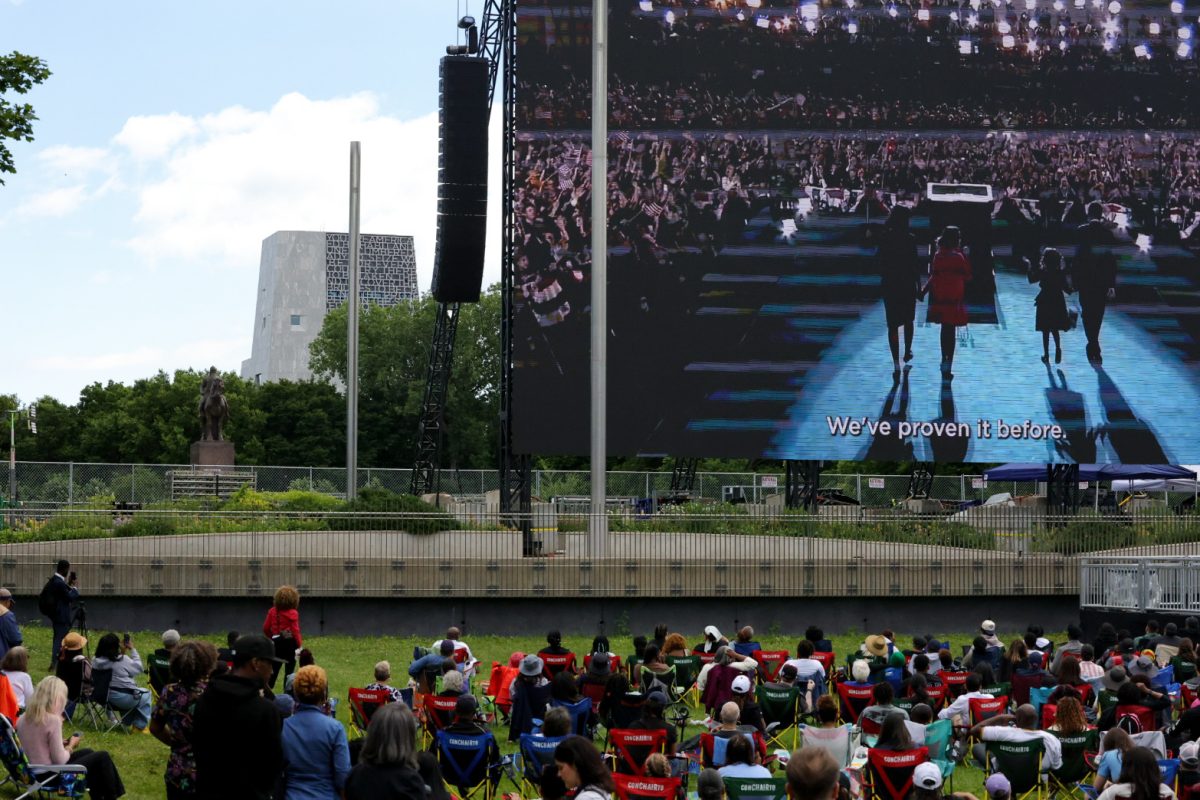
Thousands of people filled the Midway Plaisance at a watch party for the opening ceremony for a project nearly a decade in the making. The official ceremony took place at John Lewis Plaza, a central gathering space within the campus named after the late civil rights leader and congressman. Lewis maintained a close relationship with Obama and was among the earliest prominent political figures to endorse his 2008 presidential campaign.
“More than 40 years ago, on a late summer afternoon in 1985, I arrived here in Chicago, entering the city at the very spot where this center now stands,” Obama said in prepared remarks at the ceremony. “I found my purpose here, and I fortified my faith here. I found my community here, friendships that would last a lifetime. And I found a girl from the South Side, who has been my greatest blessing.”
Organizers expected 10,000 people to attend throughout the day’s festivities, and by the start of the ceremony, the grassy fields at Midway Plaisance were packed with Chicago residents swaying to music, dancing with one another and celebrating beneath the blue skies. Many wore Obama memorabilia.
“I think what he did is so phenomenal. He built a whole campus, and he made sure the community was involved,” said Cheryl Murray, a lifelong Chicago resident and member of the Obama Foundation who has followed the project since its earliest stages. “He was always a community worker, and he’s now showing just how much he loves Chicago, and that he made this possible.”
The presidential center, located in the Jackson Park neighborhood of Chicago, spans a 19.3-acre campus developed by the Obama Foundation, led by Chief Executive Officer Valerie Jarrett, a longtime advisor. Unlike traditional presidential libraries, the center was designed as a civic and cultural space that intends to foster community engagement and empowerment.
“This center is not a traditional museum, nor is today a traditional ribbon cutting. It’s a day for music, fun, and, this won’t surprise you, hope,” Jarrett said. “This is a campus for everybody, whether you live down the street or on the other side of the world, and we hope you’re gonna come back again and again.”
Joshua Skelton, a head coach with Step Ahead Chess, a nonprofit focused on youth leadership, said the center’s mission comes at an important time for the city.
“I think bringing this together and bringing together people on the South Side, the youth, and then also those who may be older and more experienced, to just come in as a collective to build more community is very important,” Skelton said. “And then also just build on the history of Black culture, especially coming from the Obamas themselves.”
The campus includes the Obama Presidential Museum, a branch of the Chicago Public Library, community gathering spaces, gardens, athletic facilities and public outdoor spaces. It is accessible from Columbia’s South Loop campus via CTA bus routes and Metra’s Metra Electric line.
“Barack and I have always said this center is grounded in our stories, but it has never been about us,” said former First Lady Michelle Obama. “It’s never been for us, and it’s gonna be here long after we’re gone. So what it becomes and how it’s preserved, that work has to be done by all of us. Just like our democracy.”
The Obama Presidential Center will become Illinois’ second presidential library site, joining the Abraham Lincoln Presidential Library and Museum in Springfield. Unlike traditional presidential libraries administered by the National Archives and Records Administration, the Obama Presidential Center will not house the former president’s official records. Those records are being preserved digitally through a partnership between the National Archives and the Obama Foundation.
Anna Horn, who grew up in Woodlawn across the street from where the center was built, said the project’s emphasis on accessibility and openness reflects the values many residents hope to see in public institutions.
“I think that’s what people should be. Honest and open. No hidden secrets because the more you hide, the more gets exposed,” Horn said from the Midway. “So, if you put it out there in the open there’s nothing to be gotcha on.”
She said the center’s opening represents a new chapter for a neighborhood that has often been overlooked.
“I think it’s good for the neighborhood and I think it’s good for the young people to see what they can be if they want to be,” Horn said.
The South Side location reflects Obama’s longstanding ties to Chicago, where he worked as a community organizer before entering public office. Obama later represented portions of Chicago’s South Side in the Illinois Senate from 1997 to 2004 before being elected to the U.S. Senate and eventually the presidency.
The Obama Foundation has said the center is intended to serve as a hub for civic engagement and community activity.
The Obamas announced plans for the center in 2015, and Jackson Park was selected after a yearlong site-selection process. Following years of planning, legal challenges and revisions, construction began in 2021.
The center is “an acknowledgment that so much of what I hold most dear, I owe to the people of this city and the people of these surrounding neighborhoods,” the former president said.
For many at the watch party on the Midway, the center’s opening was about more than celebrating a former president. It represented an investment in the future of the South Side and a lasting symbol of what communities can accomplish.
Joshua Skelton said seeing the center open in his hometown carries a deeply personal significance.
“So, to have something like this to come back to in my city, that’s like a staple for my community and it’s built by other Black people. And to see all these Black people interact with all the different community activities, this is a special place in my heart, and it will be a monument for the community to stand for a while,” Skelton said.
Additional reporting from Venus Tapang
Copy edited by Antonio Chaves