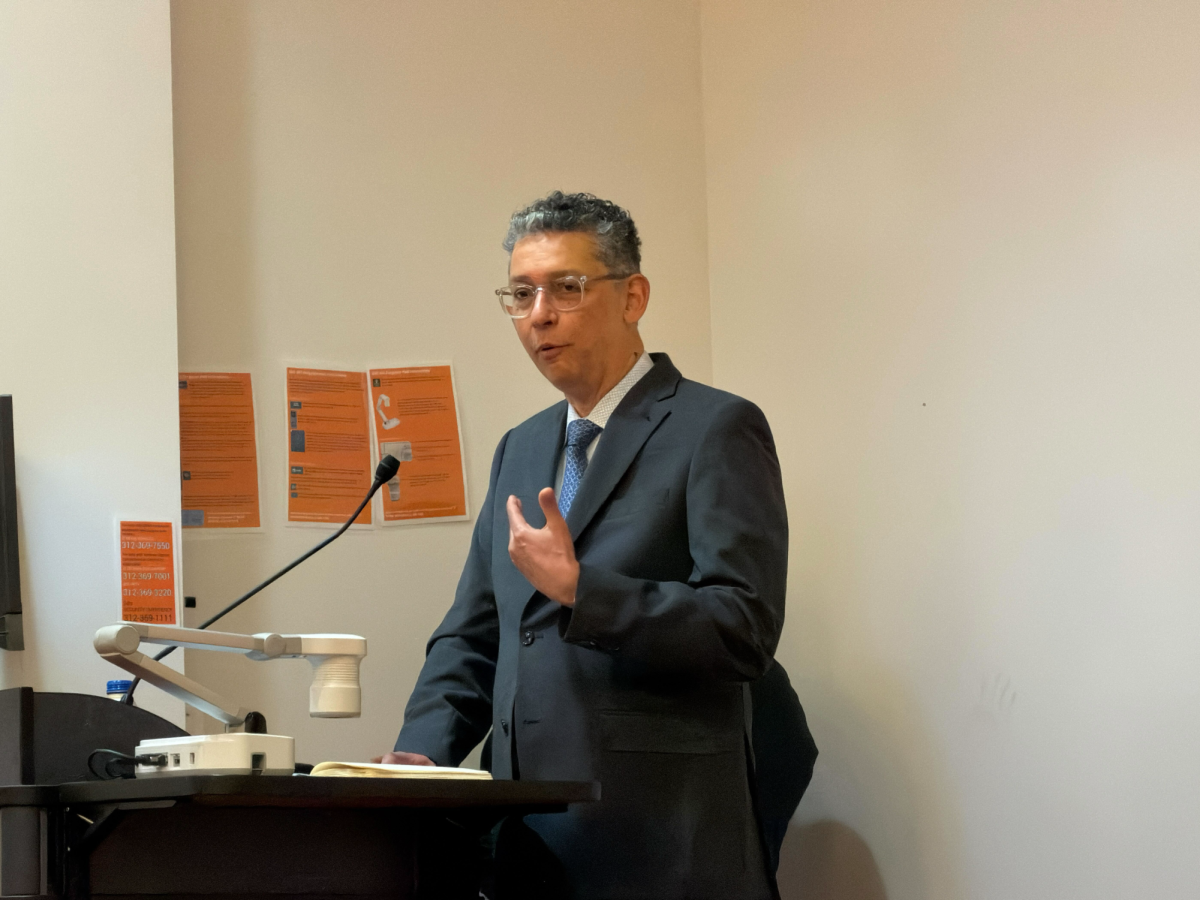
Michael Soto, the former provost and senior vice president of Academic Affairs at Point Park University in Pittsburgh, cast the college’s mission as an “ethical imperative” at a candidate forum on Tuesday, Feb. 24, saying he thinks the college has to get it right for first-generation and underrepresented students.
Soto said Columbia staff have been “working their tails” off to make sure students have a meaningful experience and that these experiences will go on to change their lives.
“If we have to get it right for anyone, let’s get it right for these students,” he said.
The college is hosting an open forum for each candidate to “present their vision for advancing academic excellence, strengthening support for students and faculty, and shaping the future of Columbia College Chicago,” according to an email sent on Friday, Feb. 20.
The next provost will help shape academic offerings in ways that support enrollment.
Soto was the second of the candidates to speak after Melissa Rands addressed the campus on Monday, Feb. 23.
Soto, who taught first-year writing at Harvard University for about 20 years, is one of the three remaining candidates selected by a search committee to find a replacement for Senior Vice President and Provost Marcella David, who stepped down on June 2 after six years at the college.
Suzanne McBride, the college’s dean of Faculty Affairs, has been serving as interim provost since June 3.
When asked how colleges should respond to the rapid development of artificial intelligence, Soto said Columbia must prepare students for professional lives that will look “radically different” in the coming years.
Rather than restrict AI use, he said faculty should integrate it into their disciplines in ways that reflect how industries are already changing.
During the open question portion of the forum, Senior Associate Provost Nathan Bakkum asked how Soto would balance urgency with shared governance. Soto said that he believes “structural injustices” definitely require immediate action, citing his time at Point Park University where he merged two departments that had been split to accommodate a personality conflict, a move he said harmed pre-tenure faculty.
He said he moved fast because allowing a situation like that to continue was “completely unacceptable.”
“I wasn’t going to wait around to allow what I saw as an injustice to linger,” he said. “It failed to live up to the boundaries that the university professed to live by.”
The college lost more than 1,000 students in Fall 2025, with enrollment dropping from 5,571 to 4,461. Enrollment is expected to be even lower this spring.
At the State of the College in October, President and CEO Shantay Bolton announced that in spite of cost-cutting efforts, Columbia’s budget deficit had climbed to about $40 million, attributing it in part to a smaller incoming class.
As faculty did with Rands, Soto was asked about morale and what immediate steps he would take to support faculty.
He acknowledged that the pandemic had taken a lasting toll and noted that national skepticism toward higher education has added to the strain.
“I don’t have a silver bullet answer,” he said.
Soto said he would prioritize bringing “clarity and equity” to faculty workload, identify resources to support faculty development and reduce administrative red tape that keeps faculty from focusing on students.
In the absence of a quick fix, he said he would commit to ongoing conversations.
“I am a strong believer in the power of a breakfast meeting,” he said. “If you are too, then let’s have breakfast and let’s talk about what we can do to improve faculty morale.”
The final candidate is Cristina Goletti, a professor and dean of the College of Performing and Visual Arts at the University of Northern Colorado. She will speak at 2 p.m. on Friday in the Ferguson Lecture Hall in the 600 S. Michigan Ave. building.
Eric Scholl, interim co-director of the School of Film and Television, said the forums help deepen his understanding of the candidates.
“I think I’ve got a good sense of who they are and how they feel about the importance of the Columbia community at this particular time,” Scholl said.
In an interview with the Chronicle after the forum, Soto reinforced earlier comments that he applied for the position because Columbia’s mission is important to him.
“Columbia’s mission of creating opportunities for students to thrive in artistic careers speaks to me,” he said.
Soto said he hopes that people see him as “genuinely a decent person who cares deeply about students.”
Asked about transparency and how he viewed the role of student media, Soto said he would connect with students weekly if his schedule permits. He said getting input before a final decision is crucial.
Tom Dowd, interim co-director for the School of Design, said being able to “access and weigh in” on who the future provost would be was a determining factor in him attending the event.
“Yes, in a practical sense they’re gonna be my boss, but they are also going to be setting the direction of our academic programs and organization for – one would hope – a good number of years after their hire,” he said.
Copy edited by Matt Brady