Though the usage of records peaked in the 20th century, they maintain a dedicated community that has kept them alive and well in the digital age.
For decades, records dominated as a listening medium. Since the introduction of compact audio formats and later, digital streaming, the usage of records declined overall, but still persevered through changing consumer and industry preferences.
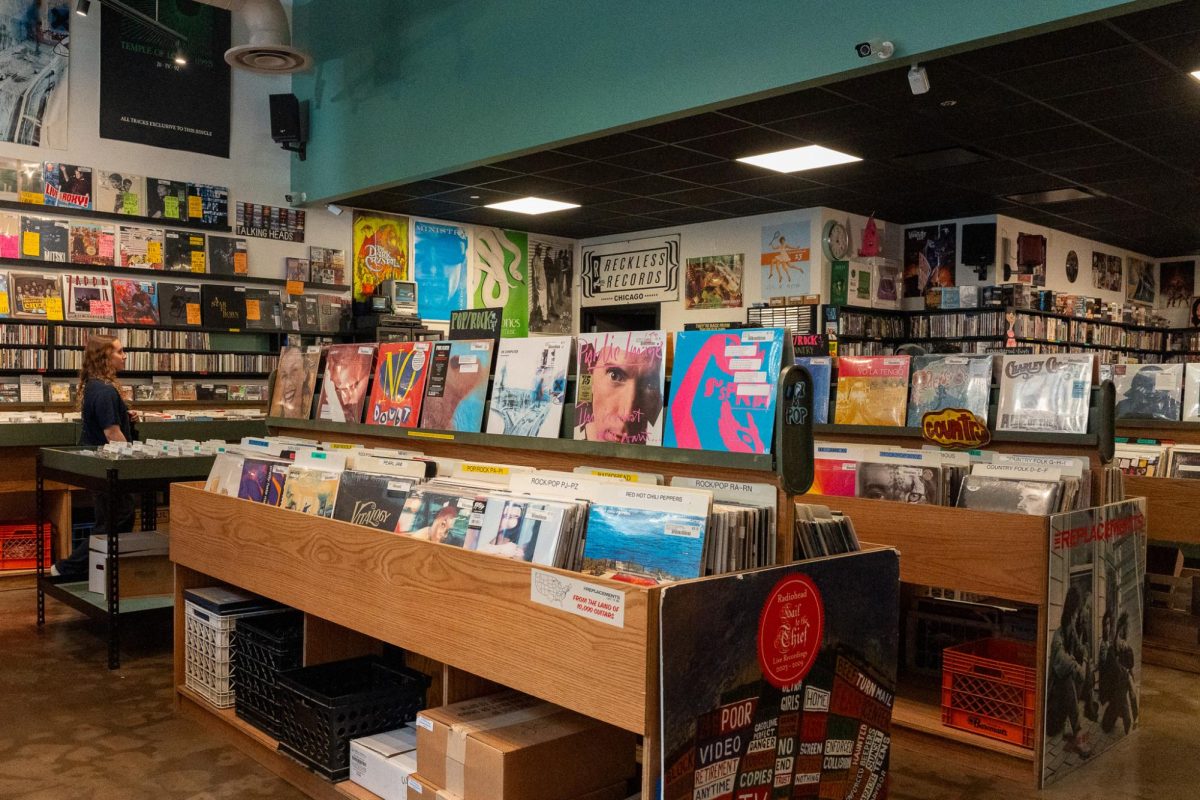
“Records never actually went away,” said Steven Rahman, a manager at Reckless Records in the Chicago Loop. “There was a time period where much fewer records were still being made, but they still provided a different experience that people still sought out.”
Despite the accessibility and convenience of other audio formats, some audiophiles sought out the distinctive quality and sonic texture of vinyl records, while others found the intentional nature of purchasing and listening to them appealing.
“When you buy a record or CD, you are physically buying the album,” said Amar Srivastava, a senior music production major. “In my experience, it makes you feel a little bit more connected to the music.”
Junior audio arts major Allesandro Kimbel inherited a collection of records from his grandfather. He said that he appreciates the “multigenerational bridge” analog formats have created. Without that collection, he would have never been exposed to bands such as the Eagles and ABBA.
“Listening to vinyl and physical media, you pick out what you want to listen to front-to-back and commit to doing something,” Kimbel said. “I think that’s something lost within the digital realm of playlists rather than appreciating a work of art independently.”
While listeners subscribe to online services like Spotify and Apple Music to listen to a near-endless catalog of music on-demand, the songs are not owned by subscribers, and can be altered or taken down without notice.
In 2022, singer-songwriter Neil Young announced in a statement that he removed his music from Spotify because of the platform’s promotion of misinformation regarding COVID-19.
In 2025, other groups like Deerhoof, Xiu Xiu, and King Gizzard and the Lizard Wizard also left the platform as a part of a protest against Spotify CEO Daniel Ek’s investments in defense companies, as reported by the Rolling Stones.
“The mix can change, lyrics can be changed, things can be changed after the fact,” Rahman said. “Most people wouldn’t notice it, but by owning the thing you can actually have a version of it that is stuck and finished.”
Although annual vinyl record revenue from stores like Rahman’s declined since the rise of modern formats, it has experienced a resurgence in recent years driven by new cultural appreciation in addition to the establishment of events like Record Store Day.
According to data from the Recording Industry Association of America, annual U.S. vinyl record revenue has grown from $22.9 million in 2007 to more than $1.2 billion in 2022.
Since 2008, Record Store Day has celebrated the unique culture surrounding record stores and their role in the community. While some stores host festivities for the event, others have exclusive artist releases and promotions.
Matthew Cunningham, an associate professor of instruction in the radio program in the School of Communication and Culture, said the music industry values physical purchases over online streams, with the purchase of one album being equivalent to 3,750 free digital streams.
“The reason Taylor Swift is always number one is because of a couple things,” Cunningham said. “Sure, everyone’s going to stream her music, but she also does four different versions of her album. And if you are a ‘Swiftie’ you can’t just have one.”
Beyond industry metrics, physical media continues to carry cultural and personal significance for listeners.
Srivastava works at Mystery Street Recording Company, a studio that offers restoration and preservation of analog audio formats like vinyl records. For many of the company’s clients, they either lack the technology to play certain formats or come to restore important family recordings.
“When we do these projects, we’ll give people files on Dropbox or a flash drive,” Srivastava said. “But we also return their physical media because it’s a part of their history.”
Copy edited by Katie Peters