From intimate stories about identity to meditations on memory and grief, faculty are setting an example for their students of what it means to be working artists.
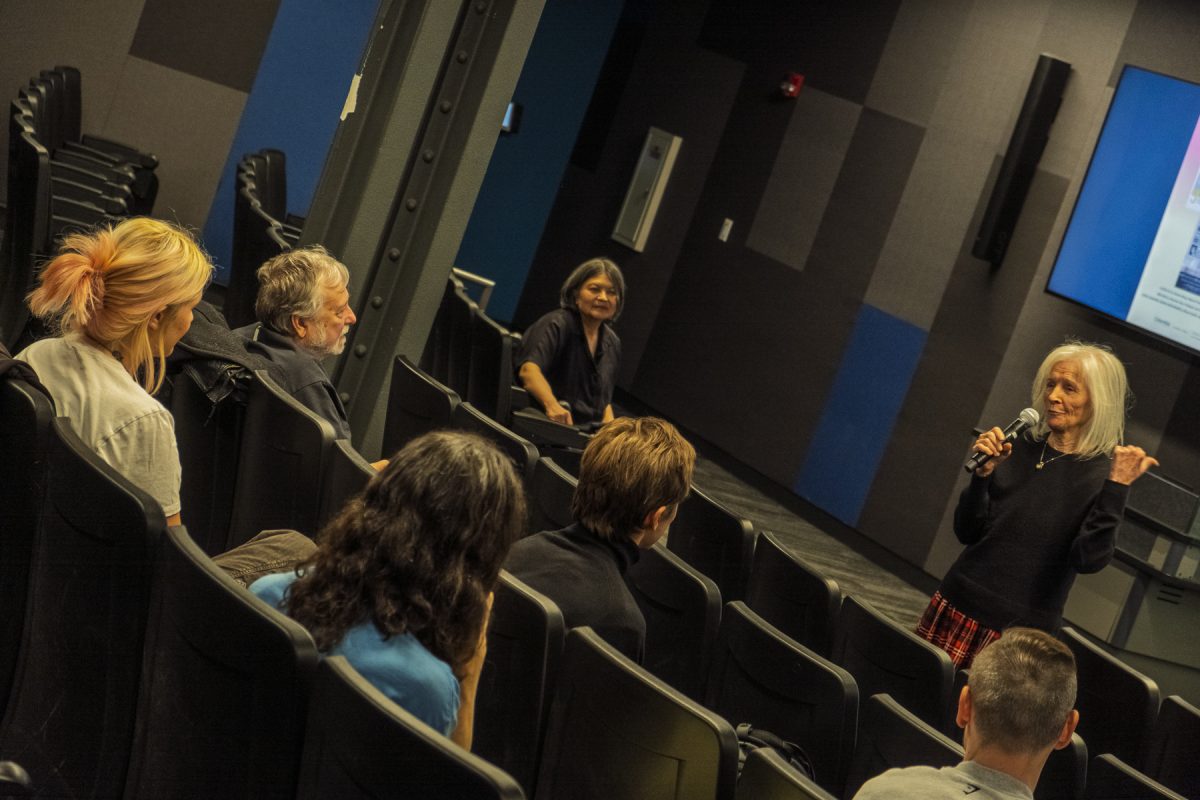
Throughout April, the School of Film and Television is hosting the Celebration of Faculty and Staff Creativity Film Screenings every Wednesday at 6:30 p.m. at Theater 310 in the 1104 S. Wabash Ave. building.
The screenings feature films spanning a range of cultures, genres and personal narratives. At the April 8 screening, Interim Co-Director of the School of Film and Television Wen-Hwa Ts’ao presented her short film “Red Rice,” which follows an Asian teen navigating identity, family expectations and sexuality.
The film centers on Japanese cultural practice in which rice is dyed red to signify a woman reaching adulthood. In the story, the ritual coincides with the main character, Jess, questioning her place in her family after kissing a female friend and facing bullying from her older brother.
Ts’ao said the film is an exploration of autonomy derived from her childhood.
“I grew up in Taiwan, and we are very much influenced by Japanese culture because we had a long Japanese occupation before World War II, and my grandmother’s Japanese and talked about how girls should behave,” she said.
Also featured was the trailer for part-time instructor Charles Borg’s feature film “Young Ali: those were the days,” co-written with director Amir Motlagh. The film follows a middle-aged Persian man who goes back home to reinvent himself after the COVID-19 pandemic.
Borg describes “Young Ali” as “slow cinema,” a subgenre that emphasizes stillness and reflection over fast-paced storytelling.
Borg said that slow cinema is having a comeback in Chicago as local production companies and independent theaters commit to the subgenre in their programming. He said as video content increases in speed through platforms like Instagram Reels, people are begging to slow down again.
“I think you’re hearing more conversations about how it changes your mode of thinking and kind of rewires your brain,” Borg said. “So, we deem our films as a kind of challenge in a good way.”
Borg urges students to tell stories in only a way they can, not concerning themselves too harshly with conventions and what’s been done before.
Maura Smith, a part-time instructor in the School of Film and Television, echoed that message after presenting her documentary “Steve Schapiro: Being Everywhere,” about her late husband, a renowned photographer.
“If you’re a film student, it is your moral obligation to make a film about a non-profit that could use some help. You know how to do this. Do it for free. Help somebody out,” she said.
The April 15 screening featured three short films centered on memory and personal history.
Assistant Professor of Instruction Johnson Cheng’s film, “Only the Moon Stands Still,” investigates three generations of Chinese women having to shut down their family’s ballroom dance studio.
Cheng said he chose the film to prompt students to consider the difficult balance between artistic ambition and family responsibility.
“There’s a distance and interiority in the character that might feel familiar. I thought students might recognize something of themselves in her complex situation choosing between her family and pursuing her art,” said Cheng.
Further exploring the nature of remembrance is Associate Professor and Associate Director of the School of Film and Television Carolina Posse’s film, “The Game Camera,” which she produced. The film, like Cheng’s, explores the connection between a physical space and memory, as a woman sees who she believes to be her passed husband in a camera installed in her horse’s corral.
The short was made by a mostly female crew in Kansas. It was important to Posse to not only explore how the setting could make for a more intriguing story, but also how it could open up new opportunities for future rural filmmakers.
“We lived on a farm for one month. Learned about the Kansas culture, like they don’t lock their doors, ever. Also, how isolated a lifestyle can be and the need for Sunday gatherings. Our lead actors are from Kansas: Kristen and Bree Elrod. They wanted to showcase their culture and beautiful landscape, also to plant seeds for future productions,” she said.
Like her fellow faculty, Posse hopes to show students it is not in the price tag and budget, but the artistic voice of a piece.
“Production value is not in the plastic but in the creative voices that come together to make one idea become a story. The performances, writing, editing, photography, design, score, etc., need to work in harmony.”
Assistant Professor of Instruction Mike Stanislawski presented the film “Chimera” for the screening, which he was the cinematographer for.
In line with the theme of memory, “Chimera” is a thriller about Alzheimer’s, which Stanislawski chose for the screening to not only show his students his chops as a filmmaker, but also as an example of how to make the most out of a low-budget production.
“‘Chimera’ presented us with plenty of challenges and roadblocks, but I’m very proud of the end result because it shows how years of experience and a level head can make up for so many perceived limitations in this industry,” he said.
Student turnout for the screenings has been low, which T’sao thinks is due to a lack of advertising. She also said that feature film previews tend to be more popular, noting a screening of the documentary “No One Cares About Crazy People” which had close to 250 people in attendance on Saturday April 11, according to T’sao.
Despite low turnout, T’sao thinks the event is a valuable resource for students to see their professor’s work and be able to understand how low budget film production operates.
“I think we get inspired by working with students,” T’sao said. “They finish a project, and hopefully they can look at our film and either say, ‘Oh, this is fantastic. I’m glad my professor continues to work,’ or they can say, ‘Gosh, you’re filming this? I can do that, too.’”
Sophomore film and television student Josie Baines said watching her professor’s work onscreen added a new dimension to what she hears in class. Baines is currently taking an editing course taught by Smith.
“She just is a personality,” Baines said. “She’s great, she has experienced so much and if you bring up something so random, she always has a story with it.”
Ts’ao said she wants students who attend the screenings to understand that she, like them, is an artist.
“I enjoy this art and I enjoy storytelling and I’m making films,” she said. “I want them to know that I am a working artist.”
The Celebration of Faculty and Staff Creativity Film Screenings will continue every Wednesday at 6:30 p.m. for the remainder of April at Theater 310 in the 1104 S. Wabash Ave. building.
Copy edited by Venus Tapang