Assistant Professor Ric Walker discusses Comedy Night and the importance of putting yourself out there
Transcript:
0:07: Welcome back to Conversations.
0:09: I’m your host, Levi Libson.
0:14: There’s a famous quote, pressure makes diamonds, but for comedy, that should be that it makes punchlines.
0:20: So, what happens when you hand off the mic and spotlight over to our own students?
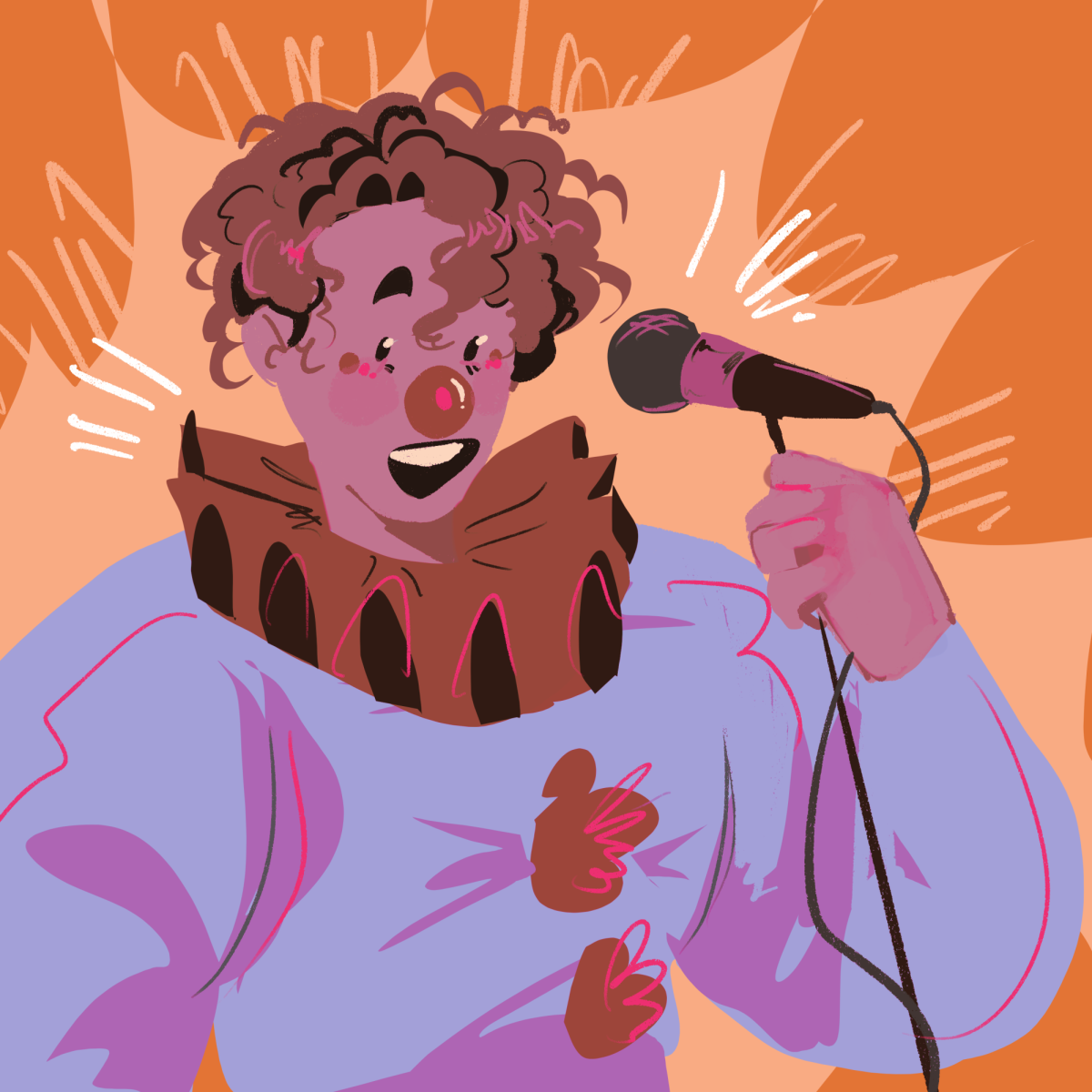
0:25: On today’s episode, we’re diving into comedy night, a three-day show highlighting creative comedic process as it unfolds live in front of you, written and performed by Columbia students.
0:35: Joining us is Assistant Professor of comedy writing and performance, Ric Walker.
0:39: I’m Rick Walker.
0:41: I teach in the comedy writing and performance area and the acting area in the theater department.
0:47: I got tenure last year, so I’ll be here for a while.
0:50: I’ve been here since 2015, and I helped produce the comedy nights.
0:58: Amazing.
0:59: So, what is comedy night for students who don’t know?
1:02: Comedy nights are student-driven, student-created, nights of comedy.
1:09: So there’s a, a wide variety of types.
1:12: it’s really, up to the pitch of the student or student groups.
1:18: So we have a range of comedy.
1:21: It could be variety show, could be sketch show, could be stand-up night. This time is some, a kind of a puppet show, which we’ve never done before.
1:33: So, it, there’s all kinds of different ways, to present comedy and we give, students an opportunity, a lab, if you will, to experiment with.
1:45: Their voice and their style.
1:47: How, how does an event like this really allow for more creative risks within students?
1:51: Oh, yeah, so it really is like a follow your own adventure kind of thing.
1:56: And I, I am as hands off as the students need or as hands on if they want.
2:02: So I’ll come in and give notes on, you know, my thoughts of where they are in the process or just show up on the night of the show.
2:11: Like this, this particular one, I’ve been very You know, hands off.
2:16: They’ve handled everything themselves, and I’ll see it on, on Friday.
2:20: And, you know, I’m sure it’ll be great.
2:23: I get, I try to give them the support that they need so that they’ll feel successful, but mostly it’s like, I have an idea and I don’t have a lot of guardrails if I don’t want them.
2:35: And so students can really kind of play to their own humor.
2:40: To some degree, it is curated because they do have to pitch the idea.
2:43: I want to make sure that they are thinking about it, thinking through it from, you know, just generation of idea, but also like, what are the steps you are going to need to take to accomplish this.
2:56: But it, it really is them experimenting.
2:58: It’s like I say, it’s a lab.
3:00: It’s a laboratory for them to play around.
3:02: What’s something about writing comedy that you think students always kind of underestimate?
3:07: You know, it’s a, it’s a job.
3:10: It’s like I, I heard a quote, I think Chappelle may have said it.
3:14: It’s like, it’s a job.
3:16: I’m fun.
3:17: It’s not a fun job, but it’s a, it’s a job and I’m fun.
3:20: So it’s like some people come into it thinking that, it’s just gonna be all fun, but it is like anything, it’s, it’s, it’s a job.
3:30: And the more you do it, and especially the more you do it for money.
3:34: the more of the labor part comes up and you know where it’s like.
3:39: You have to remember what it is that you love about this thing, because it’s always gonna be at least 20% work.
3:45: So since these shows are, are written and, and hosted by students, what’s something the audience should appreciate more, you think about student comedy?
3:54: that this is, that you’re seeing somebody at the beginning.
3:57: Of their excellence, you know, like, imagine if you got to see, you could look back and say, I, I saw, I saw Jimmy Kimmel when he did his first shows, or, I don’t know who I like, you know, if you think of like every famous, every great comedian or If you love somebody on Saturday Night Live right now, you know, that’s where, that’s the direction some of these students are going, you know, Saturday Night Live, a sitcom, movies.
4:28: So, you know, I think one thing is that, wow, I got to see somebody at the beginning of all of this.
4:37: another thing is, I get to see people my age risk and, take chances and play on stage.
4:46: I can do that too, in my field, you know.
4:50: So I think it should be somewhat inspirational to see your peers out there doing it and doing it at, you know, at a pretty high level.
4:57: If someone’s on the fence about coming to the show, what would you say to convince them?
5:02: The price is right.
5:03: It’s, you know, it’s like free show.
5:06: See more.
5:07: Free is good.
5:09: Free is the best price a college student can.
5:12: It’s also, you know, you can bring all your friends.
5:15: It’s just gonna be, it’s just gonna be like your peers there.
5:19: But it, I think, it’s, it should have like a party atmosphere, so you shouldn’t be reluctant to go there.
5:25: It’s like a great way to begin your Friday night.
5:28: There’s, there’s 6 of these every year.
5:31: They’re usually in the Sheldon in the basement of the theater building at 8 o’clock.
5:38: And, every one of them is different, different group of people putting them on, and, a different experience.
5:45: So see all 6 throughout the year.
5:51: Make sure to stay up to date with campus and Metro news at Columbia Chronicle.com.
5:55: I’m Levi Libson.
5:57: Thanks for listening.