Two weeks after the U.S. and Israel attacked Iran, members of Chicago’s Iranian diaspora say they are experiencing a mix of hope, fear and uncertainty about what comes next, especially as the violence spreads throughout the region.
Chicago is home to one of the largest Iranian communities in the Midwest, with estimates placing the population at up to about 30,000 people of Iranian descent in the metropolitan area. As the conflict intensifies, many in the community are closely watching developments, while weighing what political change in Iran could mean for family members and the country’s future.
University of Chicago professor Shiva Rahmani said the news of the reported death of Iran’s Supreme Leader Ayatollah Ali Khamenei during the initial strike in February initially brought a rush of conflicting emotions. His son, Mojtaba Khamenei, a hard-line cleric with close ties to Iran’s security establishment, has since taken his place.
“First, disbelief. Then a surge of excitement. Then disbelief again — as if my body could not process what my mind was hearing,” Rahmani said. “Ali Khamenei symbolized a system that governed through repression, imprisonment, censorship, executions and ideological enforcement. Hearing that he was gone felt like witnessing the closing of a historic chapter in real time.”
Rahmani said she views the strike on Iran as a “rescue mission” but that it’s only a temporary fix to a long-term issue
“The fall of one person does not mean the Islamic Republic disappears overnight,” said Rahmani. “The entire system must be dismantled for real change to occur. And that is what we are hoping will happen soon.”
Across Chicago, Iranian Americans are responding to the escalating conflict in different ways, reflecting deep divisions within the diaspora about the role of foreign intervention and what political change in Iran should look like.
“It takes me back to 1978, and, you know, the followers of Ruhollah Khomeini, when they were coming to power,” said Kaveh Ehsani, a professor at DePaul University who teaches International Studies and Islamic World Studies. “They were speaking with the same language of intolerance, absolutism and indoctrination.”
Ehsani said that people need to stop trying to speak for all Iranians because there are over 90 million people in the country, and not one voice speaks for all. He said just because one group is louder than another, it doesn’t dictate everyone’s beliefs.
“This is just beginning, and the fallout will be tremendous,” said Ehsani. “It’s a truly cynical and tragic situation, which ordinary Iranians are paying the price for.”
Rahmani was born in Iran. She said that being a 13-year-old girl is a time when you are full of curiosity, and being in a country that has strict laws on women’s rights wasn’t easy. As she grew older, she began to realize the structure of control.
“You grow up hearing stories that instill fear — that if a strand of your hair is seen by a man, you are responsible for his sin,” Rahmani said. “Over time, messaging can make many young women feel diminished, as though their value exists primarily in avoiding male temptation.”
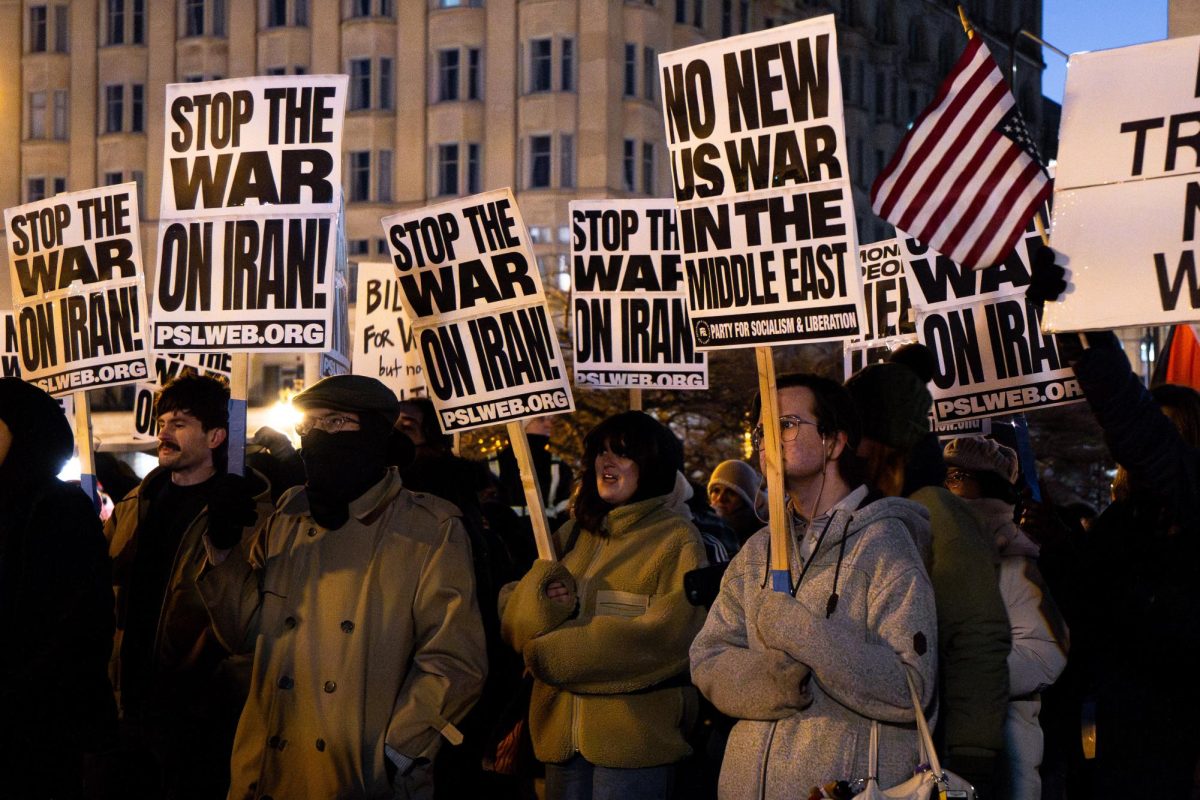
The divisions within Chicago’s Iranian diaspora have also played out publicly in recent weeks, including at anti-war protests downtown.
“Escalation of conflict in the Middle East is going to make us all unsafe,” said the twenty-fifth ward Alderman Byron Sigcho-Lopez, who was a speaker at the Stop The War On Iran protest in Congress Plaza on March 2.
Sigcho-Lopez said it is important for people to protest and come together to ensure that “terrorism” and “fascism” don’t become commonplace.
“The time to disrupt is now, the time to stop the distractions is now — before it’s too late,” said Sigcho-Lopez.
Chants rang throughout Congress Plaza as protesters waved their signs and flags at a protest in late February, saying “Not another penny, not another dollar, we won’t pay for our war and slaughter,” with undeniable unity among the crowd.
“Polls already show that a quarter of Americans, at least, do not support going to war with Iran, and yet the government continues to spend billions of dollars,” said Alithia Zamantakis, an activist at the protest.
Ariel Basora, a veteran who is also a member of the “About Face: Veterans Against the War” organization, spoke at the protest about events happening in Iran.
“To see these strikes in Iran leading to this disaster story, it just feels like we haven’t learned anything from over 20 years in Iraq and Afghanistan,” said Basora.
He said time in the Army gave him a unique perspective in comparison to other protestors.
“The entire institution was built to support these unlawful wars, and it has been unlawful for a long time,” said Basora. “It’s not just like a one-party, two-party thing.”
Copy edited by Venus Tapang