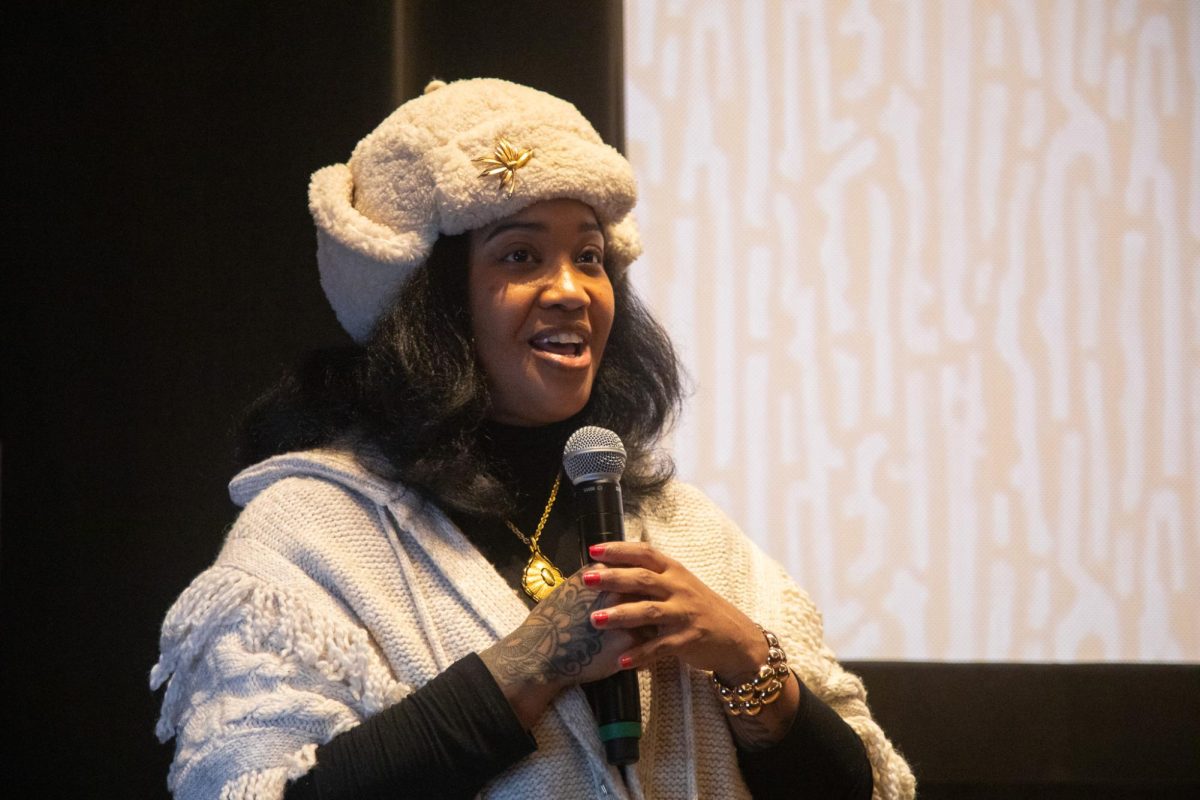
Nearly every person in the room raised their hand when 2025 MacArthur fellow and Columbia alum Tonika Lewis Johnson asked the audience if they had ever been told that the South Side of Chicago is “dangerous.”
On Wednesday, March 4, the School of Communication and Culture and the School of Film and Television hosted Johnson for a short film screening and conversation about her Folded Map Project in Film Row Cinema at 1104 S. Wabash Ave.
The project highlights segregation in Chicago through photos and interviews.
“Tonika is an alum that we could not be more proud of,” President and CEO Shantay Bolton said.
The event was part of “investiture week” ahead of Thursday’s ceremony, which will formally recognize the beginning of Bolton’s presidency.
Johnson grew up in Englewood, a predominantly Black neighborhood on the South Side.
While attending Lane Tech College Prep, a selective enrollment high school in Roscoe Village on the North Side, Johnson began to notice how the neighborhoods changed on her daily commute. The vacant lots and boarded-up homes she saw in her own neighborhood became less common in the white, North Side communities she passed through, even along the same streets.
Inspired by this realization, Johnson debuted the Folded Map Project years later in 2018.
The name of this investigation comes from the idea that if a map of Chicago was folded horizontally at State Street and Madison Street, or Chicago’s “zero-zero point,” Englewood would be touching the predominantly white North Side neighborhoods of Edgewater, Andersonville and Rogers Park.
This method of viewing neighborhoods in the context of their north-south counterpart showcases the city’s segregation, which has been brought on by a history of discriminatory housing practices and continued disinvestment of Black and Brown neighborhoods.
In fact, Chicago is more segregated between white and Black residents than any other city in the United States, according to data from Brown University.
Johnson began the project by photographing homes in Englewood and comparing them to homes with a corresponding address on the North Side. As the project evolved, she began introducing and interviewing residents from opposite north and south blocks of the same street, or “map twins.”
She interviewed the “map twins” together, asking questions like how they came to live in their neighborhoods, how much their homes cost and what is missing from their neighborhoods.
Answers varied greatly between residents of the north and south sides. For example, the South Side residents had significantly lower property values than their North Side counterparts.
Johnson said that while some of the questions and answers caused discomfort during the discussions, she believes that acknowledging the disparities and allowing the interviewees to talk through the awkward moments is important for understanding systemic racism and how it affects all people.
“Segregation worked, and we spent so much time trying to prove that we’re not impacted by it,” Johnson said in an interview with the Chronicle. “We need to accept that we were all impacted. And if we do, then we can move through these difficult conversations.”
Bringing people from different neighborhoods together to discuss their experiences gave Johnson the opportunity to experience the project in the same way an outside viewer would.
“I knew that was very special, to provide a model for the general public on how these conversations can go and how uncomfortable they can be, but how much you’ll be forever changed by having them,” she said.
The Folded Map Project led Johnson to co-author “Don’t Go: Stories of Segregation and How to Disrupt It” with sociologist Maria Krysan. The book, which was published in 2024, is a collection of stories from Chicagoans about how they have been affected by warnings to avoid the city’s south and west sides.
During the event, students volunteered to read excerpts aloud and were rewarded with their own copies of the book.
Sophomore journalism major Zoey Hill was among the students who volunteered. She said that she could personally relate to Johnson’s work.
Hill is from Chicago’s west suburbs. She grew up in Cicero and later moved to Oak Park, where she attended a private school.
Despite being neighboring towns, About 14.6% of Cicero residents live below the poverty line, compared to 7.4% in Oak Park, according to data from the United States Census Bureau.
Hill told the Chronicle that she was judged by her private school peers because of where she grew up.
“When people learned I was from Cicero, they called me ‘ghetto,’” she said.
Hill said that before starting college, she was “nervous” about having a similar experience at Columbia, but was glad to see how “incredibly diverse” the college is.
“Nobody is the same here, and it’s really incredible and powerful,” she said.
First-year fashion studies major Milagros Sanchez is from Louisville, Ky., where she grew up in trailer homes and apartments with predominantly Latino neighbors until her family bought a house in a suburban neighborhood that was predominantly white.
Sanchez said the event helped her better understand segregation in Chicago.
“It really helped me understand all these different perspectives that people could have, even from just one city alone,” she said.
After the students read excerpts from the book, Johnson asked all attendees to read a statement out loud together: a pledge to visit a grocery store in a neighborhood that is different from their own.
“See how simple it is to disrupt segregation?” Johnson asked the audience.
To address the problem on a systemic level, Johnson believes it is important to start with simple acts that prompt personal reflection. She said that the policymakers that created the conditions for segregation to endure were committed to their own values and didn’t work to expand their worldview.
“I want my work to be able to help people understand this, that they should have the same commitment to deepening the values that they have to improve this city, which starts with us and ourselves,” Johnson said.
Copy edited by Katie Peters