Cristina Guletti, a finalist for Columbia’s next senior vice president and provost, said the college must stabilize its finances and academic infrastructure before pursuing ambitious new initiatives.
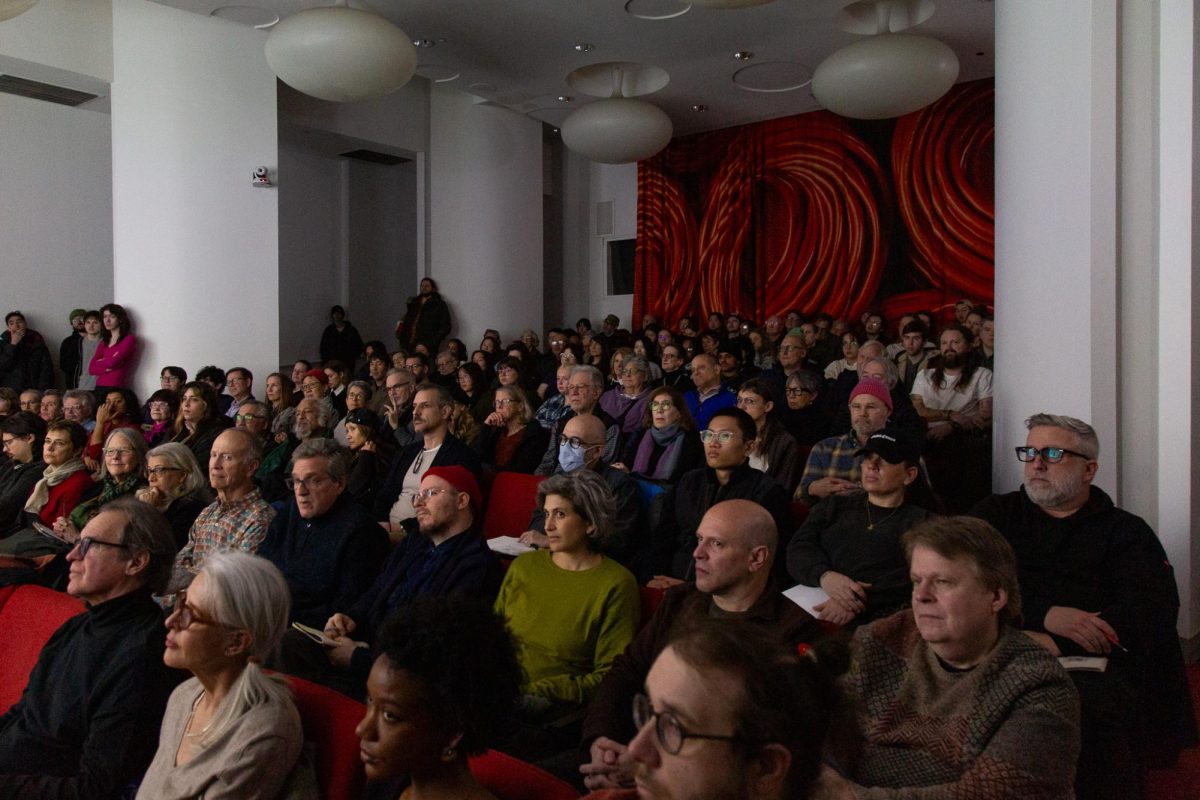
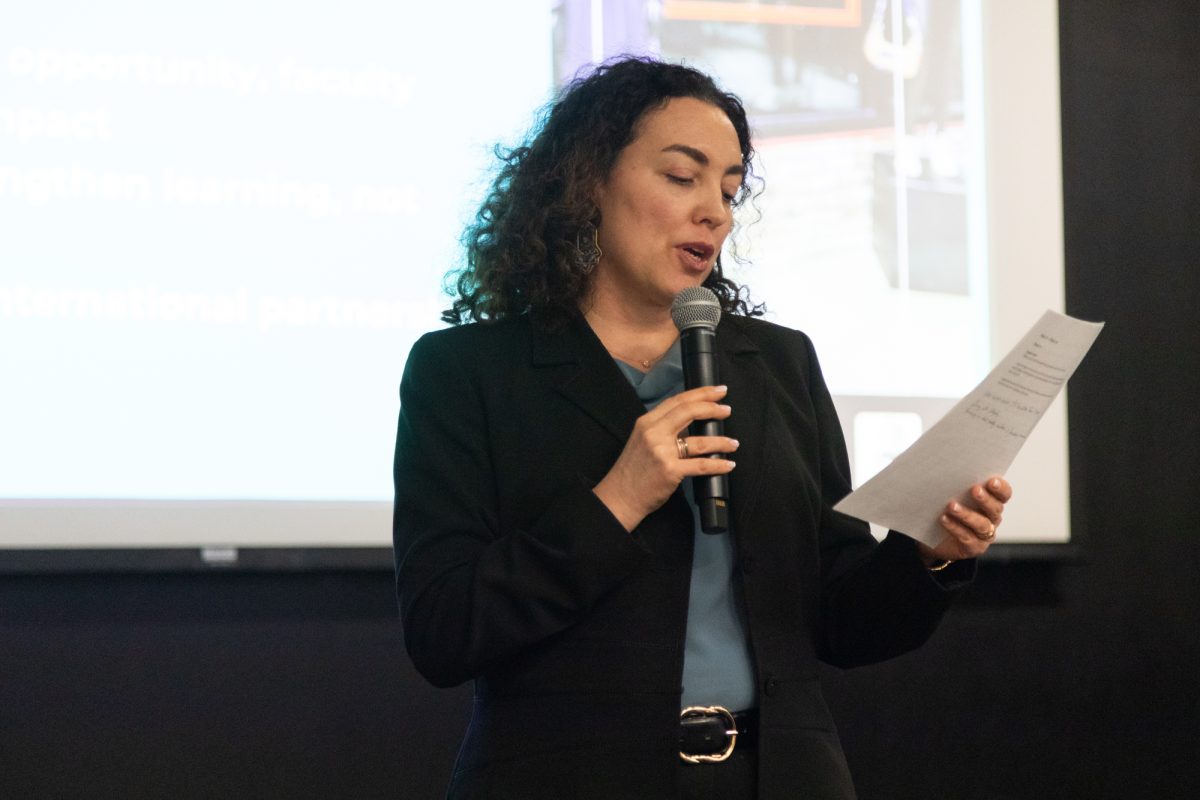
Guletti, who serves as dean of the College of Performing and Visual Arts at the University of Northern Colorado, told faculty, staff and students at an open forum on campus on Friday, Feb. 27, 2026. that strengthening internal systems would be her first step if selected.
“Before I can talk about any grand ideas we have to stabilize the institution,” she said.
Guletti, a first-generation college graduate, has been a dancer since childhood and involved in co-directing for events such as Performática, an international dance and performance festival that ran from 2008 to 2020 in Mexico.
This artistic experience was a key part of Guletti’s presentation. She said she seeks to align Columbia’s artistic identity with what courses are offered, and how they prepare students for a career after college.
“Creative work taught me that excellence depends on both vision and infrastructure. You can have a brilliant idea, but without time, coordination, support and shared commitment, and I argue a fabulous costume, it cannot fully come to life,” she said.
Guletti is one of the three candidates selected by a search committee to find a replacement for Senior Vice President and Provost Marcella David, who stepped down on June 2 after six years at the college.
Suzanne McBride, the college’s dean of Faculty Affairs, has been serving as interim provost since June 3.
The college hosted an open forum for each candidate to “present their vision for advancing academic excellence, strengthening support for students and faculty, and shaping the future of Columbia College Chicago,” according to an email sent to The Chronicle last week.
Guletti was the last of the candidates to speak to the college. Melissa Rands, who is currently the vice president of Academic Affairs and interim director of Foundation Studies at the Minneapolis College of Art and Design addressed faculty on Monday, Feb. 23. Michael Soto, the former provost and senior vice president of Academic Affairs at Point Park University in Pittsburgh, spoke on Tuesday, Feb. 24.
When asked about her position on the use of artificial intelligence in the classroom, Guletti said she wanted to give students the opportunity to make a personal, informed decision about their usage, talking about possibly implementing an AI literacy class where students can learn the history and impact of the technology.
“Once we all have a common understanding and a common language, and some people are going to be like ‘great, I want to really use this.’ Okay, then that’s great,” she said. “And then some people are going to be like, ‘I understand what it is. Thank you for the information. I’m choosing to continue to not use AI,’ and that’s totally okay.”
Guletti said her main priorities as provost would be to integrate AI into the curriculum, arts and wellness and building a relationship with Chicago Public Schools.
One example of working with CPS Guletti gave was through a proposed program, “Realize,” which would allow students to get hands-on arts experience through dual enrollment opportunities.
“Chicago Public School teachers that are in the arts need to complete 120 hours of professional development every five years, which is 24 hours a year. Basically, those can become stackable credentials,” she said.
Robin Whatley, the associate dean of Academic Operations and Programming and Professor in the School of Design, said she was happy with Guletti’s focus on infusing liberal arts and sciences at the college, potentially allowing students to ground their work in critical thinking skills.
“I went to an art school myself. And I came away feeling like I was missing that grounding in the liberal arts,” she said. “It adds a layer of understanding about, in my case, the natural world. If students have that layer of understanding, they’re going to come in contact with that and it informs what you can produce.”
Ted Hardin, an associate professor in the School of Film and Television, said he remains concerned about the limited alternatives for students to gain academic experience outside the traditional credit-hour model.
Hardin said none of the three provost candidates addressed options such as zero-credit courses, which would allow students to participate in academic work without it counting toward degree requirements.
“There are other ways of delivering educational expertise and offering experiences. Different time frames, different kinds of credit hour configurations,” he said. “We have some instances already at Columbia College. Theatre and dance have that model. In other words, it’s all about increasing joy, engagement and cultural expression.”
Guletti emphasized the importance of joy as a form of resistance — citing Bad Bunny’s Super Bowl performance as an example of bringing joy to people during continuing ICE operations.
She also referenced Chicago’s own history, having been an important part of jazz history, as well as the birthplace of house music, suggesting that her first action as provost would be to host a dance party.
“Let’s have a dance party,” she said. “I think it’s important to gather opportunities for joy. A lot of the arts that we’re doing right now are very preoccupied with the type of threats that we are facing as a country and in the world. And I think that there’s a really important place for that kind of art.”
Columbia’s enrollment has been steadily declining since 2019. In Fall 2025 the college lost more than 1,000 students, with total enrollment dropping from 5,571 to 4,461.
At President and CEO Shantay Bolton’s State of the College address in October, she announced that despite cost-cutting efforts, Columbia’s budget deficit had climbed to about $40 million, attributing it in part to a smaller incoming class.
Last year 48 full-time faculty were laid off, representing about 20% of all faculty.
Guletti acknowledged that the campus community has been worn down by its deficit and enrollment challenges but would implement a system that focuses on doing the best with less, and focusing on incorporating Columbia to Chicago’s larger cultural and economic landscape.
“Through what this institution is going through, it signals something to the larger society in the United States and beyond. Let’s bring back some of that hope or imagination. Chicago and Illinois remain a strong, significant opportunity market,” she said.
In an interview with The Chronicle after the forum, Guletti said she’d like for communication between students and faculty to be strong, citing town halls she holds every semester at her current university and a direct line of communication with student press.
“I would say maybe once every two weeks there is an open window so that you can come and talk to me, making sure that we share the same data. I think another thing that I’m thinking about is committing to a time of response. So if you ask me a question, I’ll commit to giving you a time frame where I can respond within 24 hours,” she said.
Guletti said she wants people to know that she’s an artist “first and foremost.”
“I think that I bring that deep rooted knowledge of artistic practice, and what a curriculum that can really prepare you for the 21st century creative career needs to have,” she said.
Copy edited by Samantha Mosquera