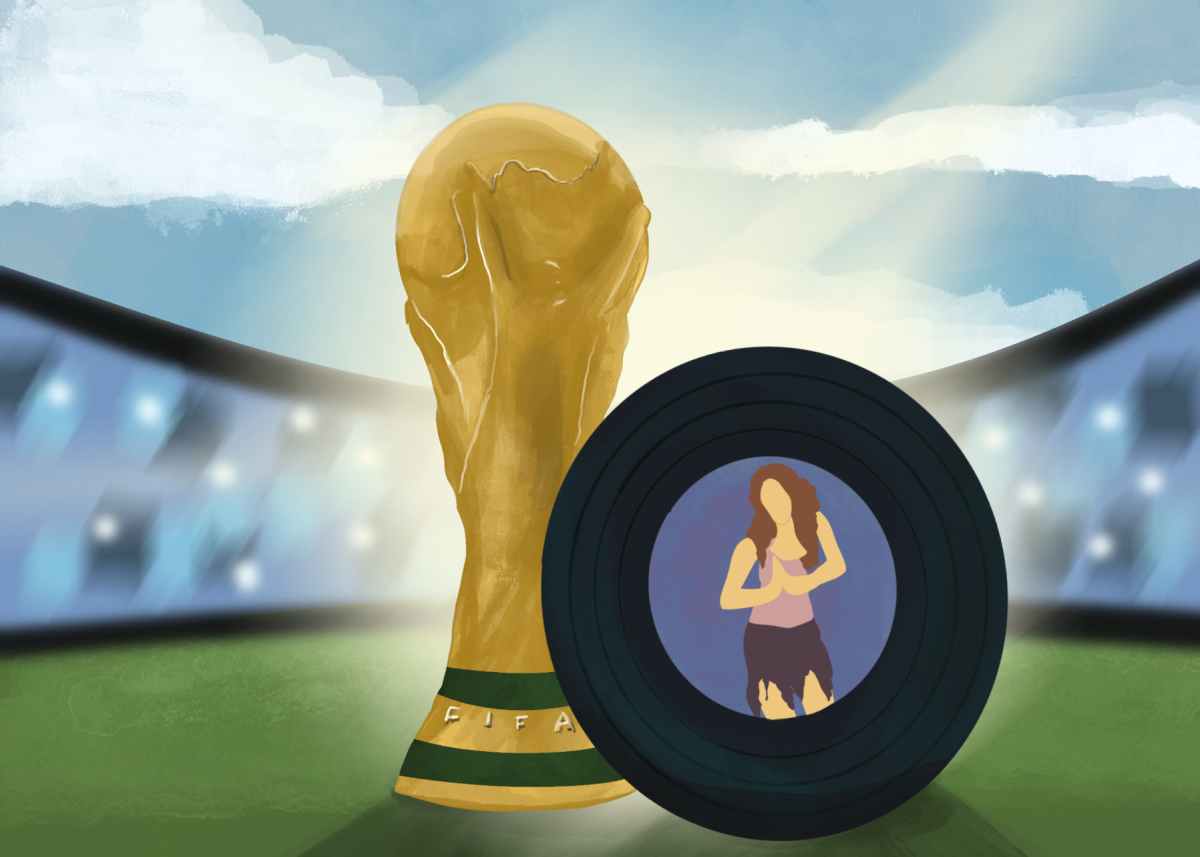
Sixteen years after Shakira’s “Waka Waka (This Time for Africa)” debuted as the anthem for the 2010 FIFA World Cup, many soccer fans can still sing the chorus from memory.
At a recent World Cup watch party at Michael’s Sport Lounge in the Brighton Park neighborhood, fans interviewed by the Chronicle immediately recognized “Waka Waka” and K’naan‘s “Wavin’ Flag,” another song closely associated with the 2010 tournament. But when asked about FIFA’s current soundtrack for the 2026 World Cup, several struggled to name a song.
The contrast raises a question as the World Cup unfolds across the United States, Canada and Mexico: Why do some World Cup songs become cultural touchstones while others fade quickly after the tournament ends?
The 2026 World Cup cycle has featured multiple songs and artists as part of a larger 18-track soundtrack project. The songs are succeeding on different platforms, but no single track has emerged as the defining anthem of the 2026 tournament.
Shakira and Burna Boy‘s “Dai Dai” debuted with approximately 1.77 million Spotify streams in a single day and has surpassed 100 million YouTube views, while “Goals” by LISA, Anitta and Rema has exceeded 7 million Spotify streams. The numbers suggest audiences are finding the music across different platforms and listening habits rather than rallying around a single song that defines the tournament.
One explanation may be the way audiences consume music today. Streaming services allow listeners to create personalized playlists rather than hearing the same songs through radio broadcasts, television coverage and advertising campaigns. The 2026 World Cup soundtrack also features 18 songs spanning multiple artists, countries and musical styles, potentially making it more difficult for a single anthem to emerge as the defining sound of the tournament.
“I don’t think there’s anything definitive that makes these songs make it or not,” said Howard Schlossberg, a former Columbia College journalism professor, longtime sports writer and radio DJ. “I think a lot of it is the artist and the popularity of the artist at that time.”
Schlossberg said sponsorships and marketing can play a major role in a song’s success.
“It’s always the money in sports,” he said. “If a sponsor can tie a song to a product, then there’s money to be made.”
AJ Lara, a Chicago soccer fan who was watching Argentina play Algeria in a group stage match at Michael’s, said the difference is how people consume music today.
“I don’t think the newer songs are necessarily worse,” Lara said. “I just think people discover music differently.”
Older World Cup songs benefited from an era when audiences were more likely to hear the same music through radio and television.
“Everyone’s playlists are just kind of different now,” Lara said. “Maybe they’re just not really into that.”
For many listeners, a lasting World Cup anthem is about more than chart performance. Fans said the songs that endure are those that become intertwined with the emotions, memories and cultural identity of a tournament.
For Dia Caldwell, a junior music business major, the first World Cup song that comes to mind is “Dreamers” by Jung Kook, which was released for the 2022 World Cup in Qatar.
“It stuck with me because it was the first time I really paid attention to the World Cup and watched it with my parents,” Caldwell said.
Caldwell said personal connections to artists often help songs stay memorable long after the tournament ends.
According to Caldwell, some World Cup songs become cultural phenomena due to advertising and the artist’s popularity.
“I always think about ‘Wavin’ Flag’ and how it was connected to Coca-Cola’s World Cup sponsorship,” Caldwell said. “When a song is used in advertisements and promotional campaigns, it becomes embedded in people’s minds.”
Addison Cage, a junior music business major, immediately thought of Shakira‘s “Waka Waka” when asked about memorable World Cup songs.
“It felt like a connection between different cultures where people could understand each other regardless of language,” Cage said.
Not all fans are convinced FIFA’s broader soundtrack approach is working. Several songs included on the tournament’s 18-track soundtrack have incorporated country influences with artists such as Jelly Roll, a shift that has generated debate among some fans accustomed to the Latin and international pop sounds associated with past World Cup anthems.
“Personally, I think they should have stuck with the regular Latina, Latino music type because I feel like it brought everyone together,” said Jacinta Mira, a student at the University of Illinois Chicago and longtime soccer fan who was watching the game at the sports bar.
Lara said World Cup songs play an important role in building excitement around the tournament.
“It’ll get you hyped,” Lara said. “You’re feeling the energy of the songs. It’s making you more intrigued and more into the game.”
Copy edited by Venus Tapang