
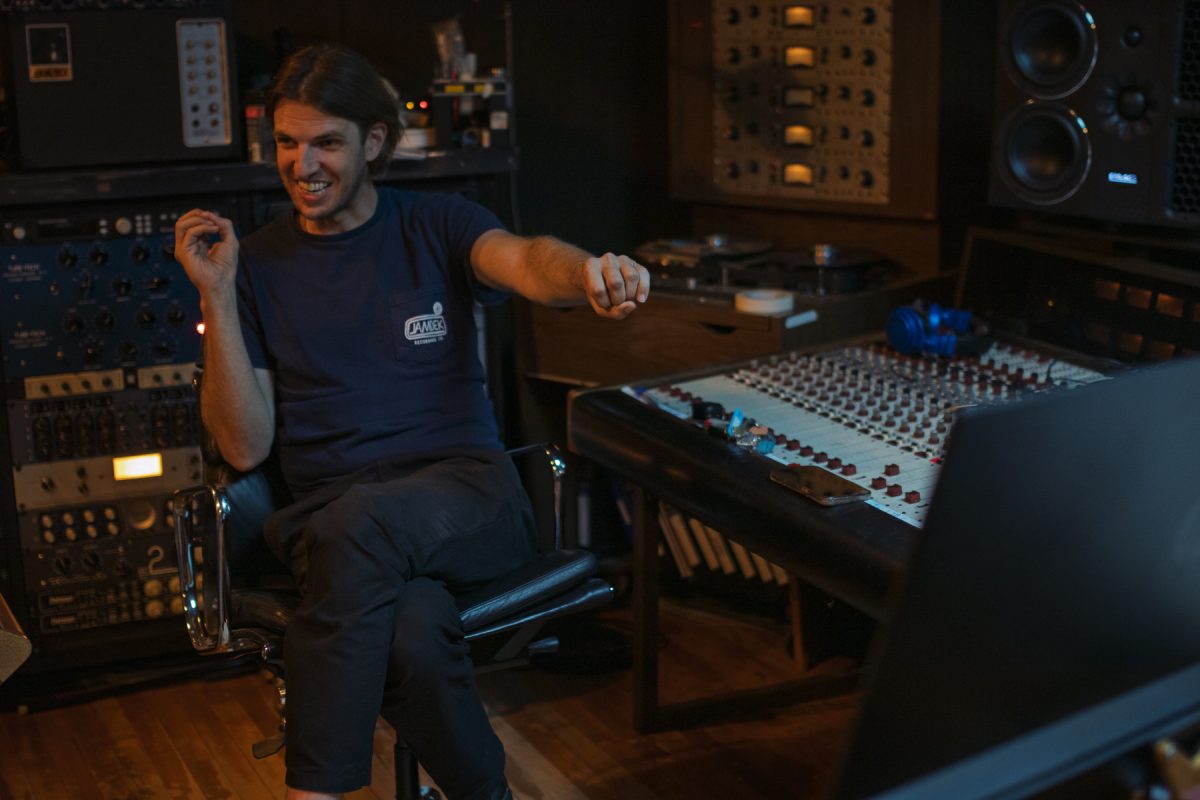
At Jamdek Recording Studio, the ambiance of the control room can be felt through the large, thick window that separates it from the live room where bands set up to play and record.
With dim lighting, worn panel wooden floors, stacks of analog recording gear and a massive mixing console that nearly fills the top width of the room, the aura is reminiscent of some place that Fleetwood Mac would have listened to songs they recorded for their “Rumors” album.
The studio was bare and quiet one recent summer day following a recording session with musician Lawrence Peters, who is known for working with Jason Molina of the alternative country group Songs: Ohia.
Though the bands were gone, Douglas Malone, the sole owner and lead engineer behind the day-to-day operations at Jamdek Recording Studio in Humboldt Park, was still present, walking around the studio with a big smile on his face, admiring all of the vintage instruments in the live room.
“It really was a dream come true,” Malone said. “I’d never in my wildest dreams would ever have imagined that.”
Malone graduated from Columbia in 2015 with a bachelor’s degree in music composition and has lived in the same neighborhood as his studio for 15 years.
Halfway through his program at Columbia, Malone realized that he had to confront the reality of making a living from working in music.
“They tell you how to paint the painting, but they don’t tell you how to make the money off the painting to feed yourself,” he said.
Malone would talk for hours with Nathan Bakkum, an associate professor in the School of Audio and Music, trying to figure out how to make his dreams come true.
Through Bakkum, who is now the college’s senior associate provost, Malone was introduced to Benjamin Balcom, Bakkum’s friend and the owner of Minbal recording studio.
“Benjamin definitely saw himself in Doug the same way I did, and he gave Doug great opportunities to dig deeper, expand his responsibilities and take on a larger role at Minbal,” Bakkum told the Chronicle.
Malone interned at Minbal and worked as a live sound engineer at the Empty Bottle, a staple bar venue in Ukrainian Village. He was committed to learning from professionals in the field and went in early three times a week before college classes to learn the ropes.
After graduation, he became studio manager at Minbal, facilitating the studio booking for musicians and handling other logistical work like looking over emails. Two years later, he bought the studio from Balcom.
“I kind of realized the whole time he was actually preparing for this,” Malone said. “We got together, we came up with a price that was suitable for both of us, I had to take out a big old loan and then I took over the business.”
Malone has worked with numerous artists and bands. Some of his favorites include Chicago acts Pixel Grip, Moontype, Spread Joy and Godstar Megamax, as well as out-of-state artists such as the alternative indie musician Moor Mother.
The legendary Steve Albini, a Chicago musician who founded the Avondale recording studio Electrical Audio and produced for albums such as Nirvana’s “In Utero,” Pixies’ “Surfer Rosa” and The Breeders’ “Pod,” even lent a helping hand to Malone during his early journey as a business owner.
“When I took over, he congratulated me and was like, ‘If you need anything, I got you,’” Malone said of Albini. “He’s great. He really helped me a lot.”
Music discovery in a small midwestern town
Malone grew up in Victoria, Illinois, a small town about an hour northwest of Peoria. In a farm town with fewer than 200 people and barely any neighbors or friends who lived nearby, he picked up the guitar at six “purely out of boredom.” As a result of the isolation, Malone relied on pre-internet means to find new music: the radio, mixtapes, the occasional hip college kid from the local community college and a crew of school friends who were into punk rock.
By junior high, Malone stumbled upon his first DIY show at the Rat House in Galesburg, a town southwest of Victoria. The setting was straight out of a scene in the 1981 documentary “The Decline of Western Civilization,” with a tiny garage that had a quarter pipe for skateboarders, punk bands reminiscent of Rancid and audience members clad in leather jackets and liberty spikes.
This experience, plus discovering bands such as Minor Threat and the Fugazi album “The Argument,” sent Malone down the path to the present. He continued to discover music and purchased a Marshall half-stack guitar amplifier at 12 years old with the money he made while selling cattle and detasseling corn.
Coupled with the Hamer Stratocaster guitar his parents bought him, the occasional drummer friend and an empty garage and endless farmland, Malone was able to play as loud as he wanted, sometimes even until three in the morning.
“My parents were totally cool with it because they were like, ‘Whatever. He’s not doing drugs,’” he said.
Malone began recording songs for bands he was in using Pro Tools, an audio recording software application, thanks to his bandmate, who had the software already. The two would often experiment with different techniques, remaining creative and curious at all times.
“There was no romantic, ‘I started out on a cassette deck,’ you know what I mean,” Malone said. “Even that’s too old for me.”
After traveling to perform in Peoria and the Quad Cities with his bands and attending three years at Carl Sandburg College in Galesburg, Illinois, Malone packed up his car, found a roommate on Craigslist and moved to Austin, Texas, in 2008 to “live a little bit” and experience something different from the small farm town he grew up in.
He performed in different bands for a couple of years while living there and spent time working in different studios. Due to rising rent and newfound interest in writing music, Malone decided to move back to Chicago and study music composition at Columbia.
A home for Chicago’s music community
The studio features hands-on recording gear for artists to use, from a reel-to-reel that was gifted from Isaac Brock of the Washington-based band Modest Mouse, to compression equalizers, reverb units, tape delays and a mixing console that all originate from different decades.
“He’s never done us wrong,” said Tyler Bixby, drummer for the Chicago-based femme-fronted art-punk band Spread Joy. “And in fact, on multiple occasions, he’s gone above and beyond. He’s just a treat to work with.”
John Cook, guitarist for the Chicago-based indie rock band Godstar Megamax, recorded their debut album “Nagamo, Piping Plover” in February 2024 at the studio. He said Malone was “super” honest and knowledgeable and worked quickly to get things done.
Cook reminisced about the times spent smoking cigarettes in the kitchen of Jamdek after 10 hours of recording and said Malone was able to “come down to the level of being in the band” through the recording process.
“He would call me a diva a lot,” Cook said about Malone when he was recording at Jamdek. “He’d be messing with me a little bit, and he’s like, ‘Why are you doing it again? You don’t need to do another take.’”
Malone said that through recording a band and getting the finished product, a musician creates an archive of a real thing.
“It’s fluid. It’s always in motion,” he said. “Yes, you’re changing the color of everything and you’re putting your sound and everyone’s working on it together, but you’re building relationships with people. You’re not just recording a band. It’s so much more than that.”
Copy edited by Vanessa Orozco