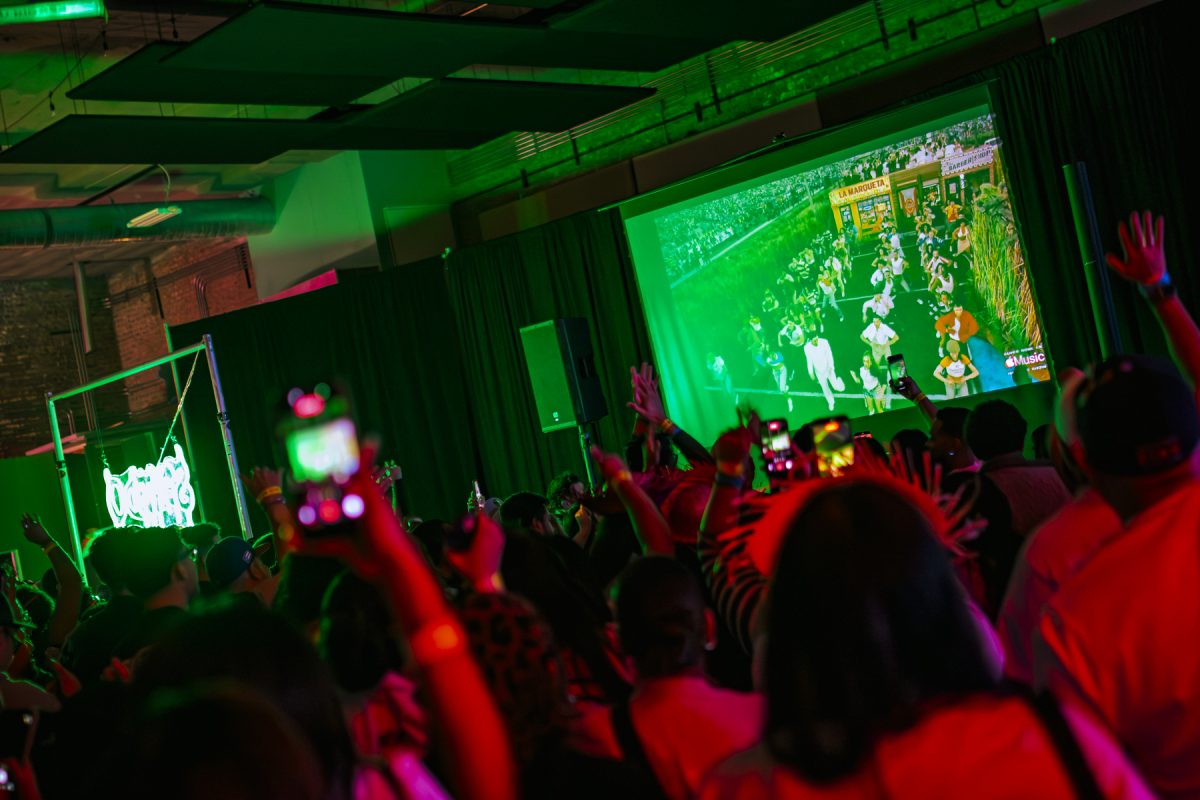
During the 60th annual Super Bowl halftime show, Bad Bunny made history as the first Latino artist to perform primarily in Spanish, a moment that resonated deeply with many Latino students at Columbia.
The performance opened with Bad Bunny singing “Tití Me Preguntó” in the middle of a sugarcane field, surrounded by dancers dressed as field laborers. As he moved across multiple stages, the show featured street vendors, nail technicians and construction workers, creating a block party atmosphere rooted in everyday life. Throughout the performance, Bad Bunny interacted closely with dancers dressed as workers, highlighting their presence rather than relegating them to the background.
Adilene Vega, senior art history major with a minor in Latino and Latin American studies, said she was anticipating the message Bad Bunny would convey through the performance.
“We’re all united by spirit and struggle,” Vega said. “There’s been a lot of division between identities, even within the Latin American communities, in the lives we live and problems we face. Coming back together is really what he’s trying to push.”
Bad Bunny’s performance aired amid ongoing national debates over immigration, language and Latino representation in mainstream media, at a moment when Spanish-language culture is both widely consumed and politically contested in the United States. While Latino artists have appeared in Super Bowl halftime shows before, the NFL’s decision to feature a performance primarily in Spanish marked a departure from past productions that often blended languages or minimized cultural specificity.
Details such as a small Puerto Rican taco stand, boxing imagery and piragua, a traditional shaved ice dessert, added to the block party feel of the performance, allowing viewers to follow Bad Bunny through familiar aspects of Puerto Rican culture.
For Vega, seeing Bad Bunny stand as a witness in the marriage between Eleisa Aparico and Thomas Wolter, a couple who had originally invited the global super star to their wedding, was a poignant example of this.
“In a time where Latinos in the US are being dehumanized and crazy agendas are being pushed trying to frame us as criminals, for him to celebrate a love story — I think it was very powerful,” she said.
Marcelo Sabatés, a professor in the School of Communication and Culture, said the performance’s political and historical context elevated its significance, pointing to Bad Bunny’s inclusion of references to nearly all Latin American countries.
“If you look at the show, you see unity with flags and everything,” Sabatés said. “But then, you also see inclusion, gender, gender identity, sex orientation, ethnicities within the Latino community represented. That was just plain fabulous.”
Sabatés said Bad Bunny used the halftime show to present Latino culture on its own terms, challenging stereotypes and asserting control over how it is represented.
“This idea of our culture is not for sale,” he said. “Of course, we can make profit with it, but it’s going to be on our terms and with the message we want to convey. And that was extremely well done.”
Milo Ramirez, a sophomore creative writing major, said the performance brought back memories of growing up immersed in Mexican culture. Ramirez laughed at a moment showing a young boy asleep in a chair while others danced around him, saying it felt deeply familiar..
“A part of me felt seen,” they said. “Seeing pieces of memories of what every Hispanic has grown up with, like a little market or a barber shop, it felt cool. It felt uplifting.”
Ramirez said hearing Bad Bunny speak about dedication and perseverance reminded them of conversations they’ve had with their parents. Ramirez’s mother immigrated to the United States without knowing English or having a support system beyond her husband, an experience that has long motivated Ramirez.
Seeing Bad Bunny hand an award to a young boy watching the broadcast on a box television stood out to Ramirez as a symbolic passing of opportunity.
“Everything starts with a dream,” Ramirez said. “That kid represents all of us, and I dare say our parents. They’re the ones who came to this country with nothing but dreams.”
Growing up, Ramirez didn’t see many examples of Hispanic representation in television or film. Being able to witness a variety of colors in people and flags celebrating together meant everything to Ramirez.
“He fuels hope. He fuels a lot of little kids’ hopes. I wish I had that representation growing up,” they said.
Representation and unity emerged as common themes among students reflecting on the halftime show.
Brianna Manzo, senior communications major, said she felt proud to watch and share the halftime show with her family. Its message of unity in the Latino community reminded Manzo of rapper Kendrick Lamar’s halftime show from the previous year.
“They were both powerful performances representing the diversity and culture around us,” said Manzo.
For Manzo, seeing multiple cultures represented together reinforced her belief that shared identity does not erase difference.
“We’re all Americans,” she said.
Manzo said her takeaway from the performance was that confidence in self-identity, paired with hope, can lead to opportunity.
“It doesn’t matter what you look like or your background,” Manzo said. “It’s about believing in yourself and in us as human beings.”
Copy edited by Katie Peters