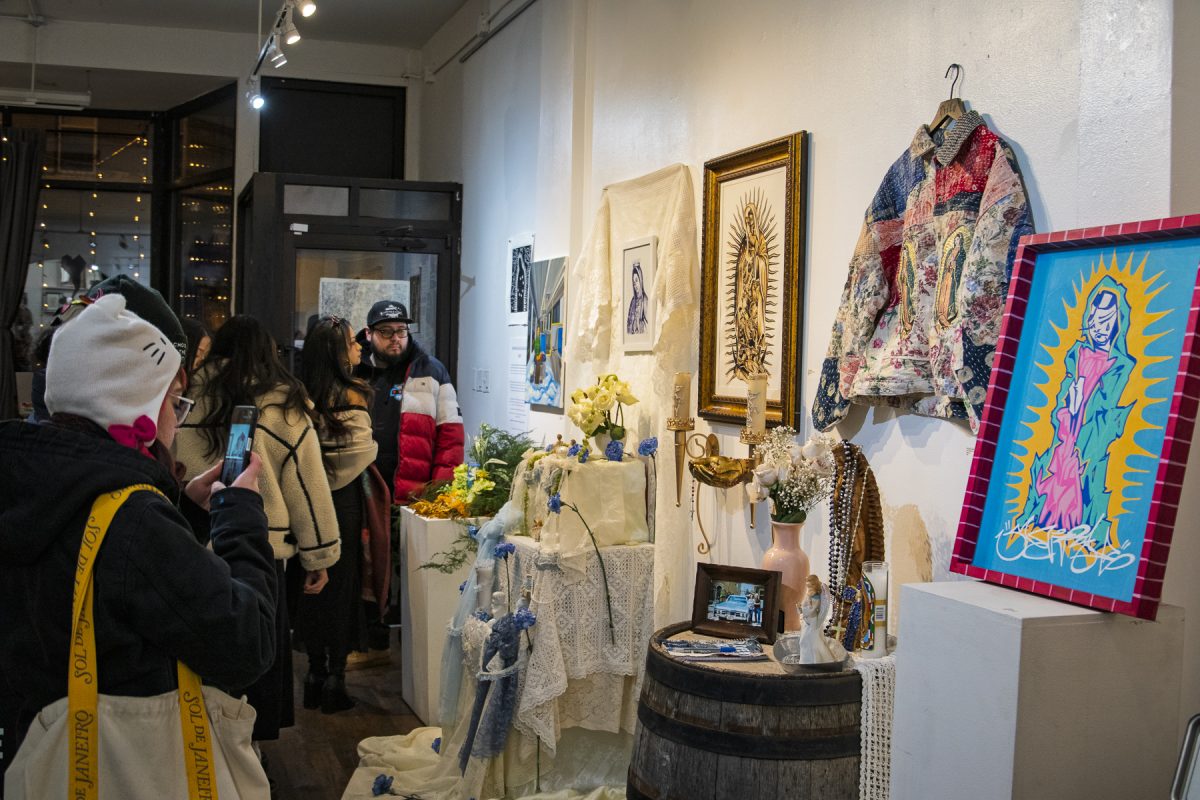
As a bitter cold settled over the Pilsen neighborhood, visitors stepped into Pilsen Arts & Community House to find its walls filled with images of the Virgin of Guadalupe depicted through paint, fabric and graphic design, each reflecting a different story of migration, protection and resistance. The gathering marked the fourth annual “Visiones de Guadalupe” exhibition, held for the second year in a row at the community space.
Curated and founded by sisters Stephanie “Soli” Herrera and Jessica Herrera, “Visiones de Guadalupe” is a group art show in which artists reinterpret the Virgin through their own lived experiences. This year’s exhibition titled “La Virgen Migrante,” centered on immigration and the fear many Latinos and immigrant families have faced throughout the year.
“We have been going through this real time persecution of Latinos, all Mexicanos, and of immigrants,” Herrera said, adding that the exhibition’s name was intended “to really invoke and give the show to the art immigrant community.”
For Herrera, the Virgin of Guadalupe represents more than religion. Even for those who do not consider themselves religious, she said the Virgin functions as a symbol of protection, hope and resilience during moments of uncertainty.
“I am an activist, I’m an artist, and combining those two things [to be] there for the community, and finding ways that the community could find hope is a way that I merged these two ideas,” Herrera said.
In Catholic tradition, the Virgin of Guadalupe is the mother of Jesus Christ and is believed to have appeared in Mexico to an Indigenous man, Juan Diego, during the period of Spanish colonization. Her image has since become a powerful religious and cultural symbol for many Mexicans and Latinos.
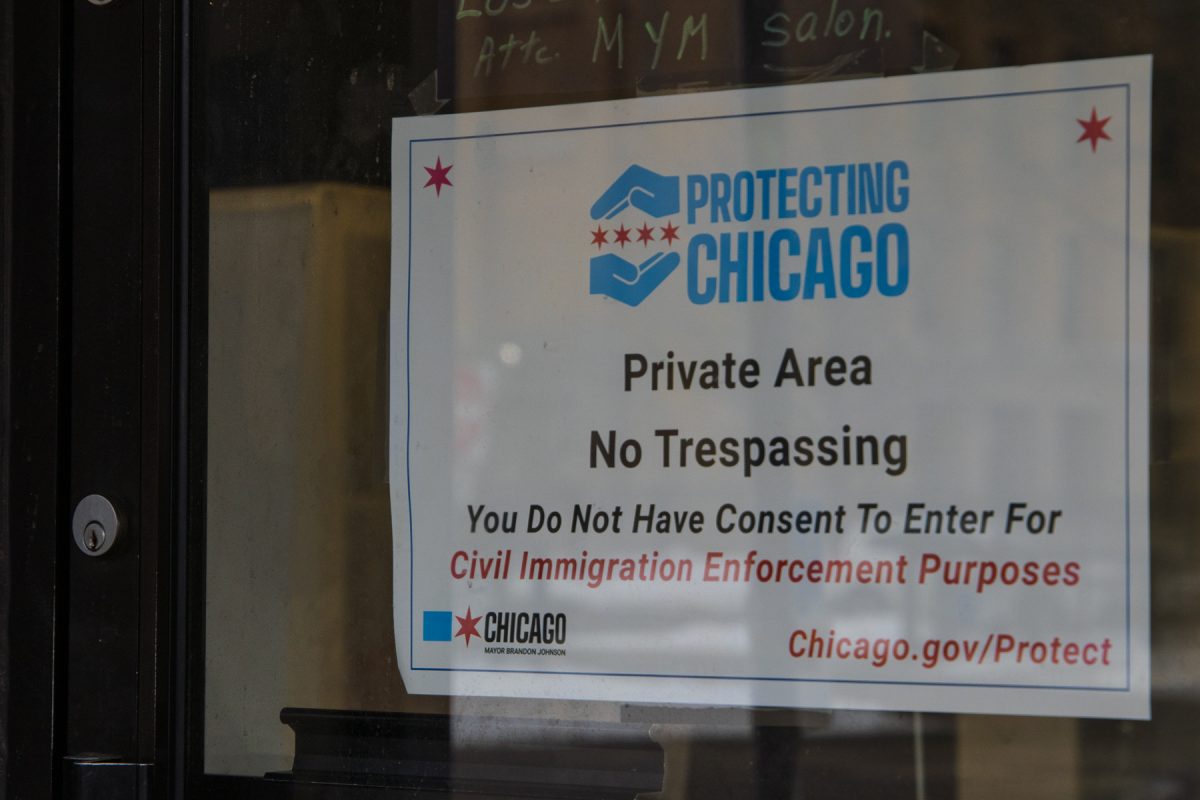
This year’s exhibition took on added significance amid ongoing immigration enforcement and ICE activity.
“We have been going through this real time persecution of Latinos, all Mexicanos, and of immigrants. I named [the exhibition] Visiones De Guadalupe: La Virgen Migrante, to really invoke and give the show to the art immigrant community,” Herrera said, “I saw La Virgen Migrante and a big banner of resistance under her in a protest, I was so deeply inspired, emotional, and I just saw the people walking at the protest believing and having that faith and resistance.”
For Herrera and many others, the Virgin of Guadalupe represents more than a religious symbol. Even those who do not consider themselves religious, she said, still feel a sense of protection and connection.
“I saw my community in need of hope, and there’s no better way and no better person and symbol than the Virgin of Guadalupe,” Herrera said, “I myself had to be reverent and surrender myself to her and ask her for help. My dad is an immigrant and I was scared every day.”
Columbia student Jorge Aviles, a sophomore graphic design major, participated for the second year in a row. Aviles grew up in the Little Village neighborhood and said he was surrounded by gang graffiti, an influence he incorporates into his work by reimagining it through color and community.
“What it means to me is being closer to my roots. I feel like growing up, I didn’t really get to experience what the culture really was. So anything like this really makes me feel closer to the culture, to the people, to Mexico in general,” Aviles said.
Herrera welcomed more students to be part of the community.
“What better way to get educated, not only through school, but through community lessons, you need to experience communities so you can really learn it,” Herrera said, “I would encourage Columbia students to come to the community centers to make themselves available, have an open mind, and not be afraid to reach out. I was a student once and I remember what it’s like to be scared, but your best friends are here waiting for you.”
The selection process of this year’s exhibition was intentional as in other previous years; it was an open call to all artists at any level.
“I wanted to be a bit more intentional because of the curation scope which was for immigration. Each artist has done and is a community active person, whether they’re an activist, whether they’re an artist that always speaks about political things, about political instances. They are people that have really had a long trajectory with doing this work and sharing these messages [of] resistance, hope, Latinidad, Mexicanidad,” Herrera said.
Alexander Cahue, is a fashion designer and has a brand called “Hilo de Cahue.” For a second year in a row, Cahue participated in Visions of Guadalupe. “I got the opportunity because someone recommended me. I felt like it resonated with who I am” as a product of immigrants, Cahue said. “The Virgin is so ingrained into our culture that it just felt right to try to express my love towards her through art and my main way to create it is through fashion and through fabric, It’s something that you don’t really see in art galleries so to bring a different view made me want to like challenge myself to bring that to life.”
For Cahue, his work represented something deeper. Earlier this year, his mother was diagnosed with stage three stomach cancer. “I wanted this piece to be more of a dedication towards her. The jacket itself is inspired by boro stitching, which is a Japanese way of mending old garments. I’m hand stitching each piece together and that’s why the piece is called the Mil Puntadas de Esperanza, just because I found myself while working on the piece either praying or just hoping that everything gets resolved,” Cahue said.
Herrera said the event is not only about resistance but also about preparing for what is to come.
With a year filled with oppression and uncertainty, many prayed to the Virgin of Guadalupe for protection against all harm. ”The roses are beautiful and her face is soft, but the thorns also protect her, and they protect us, too,” Herrera said.
The exhibition will be open through the first week of February at Pilsen Arts & Community House located at 1637 W 18th St. in Chicago.
Copy edited by Brandon Anaya