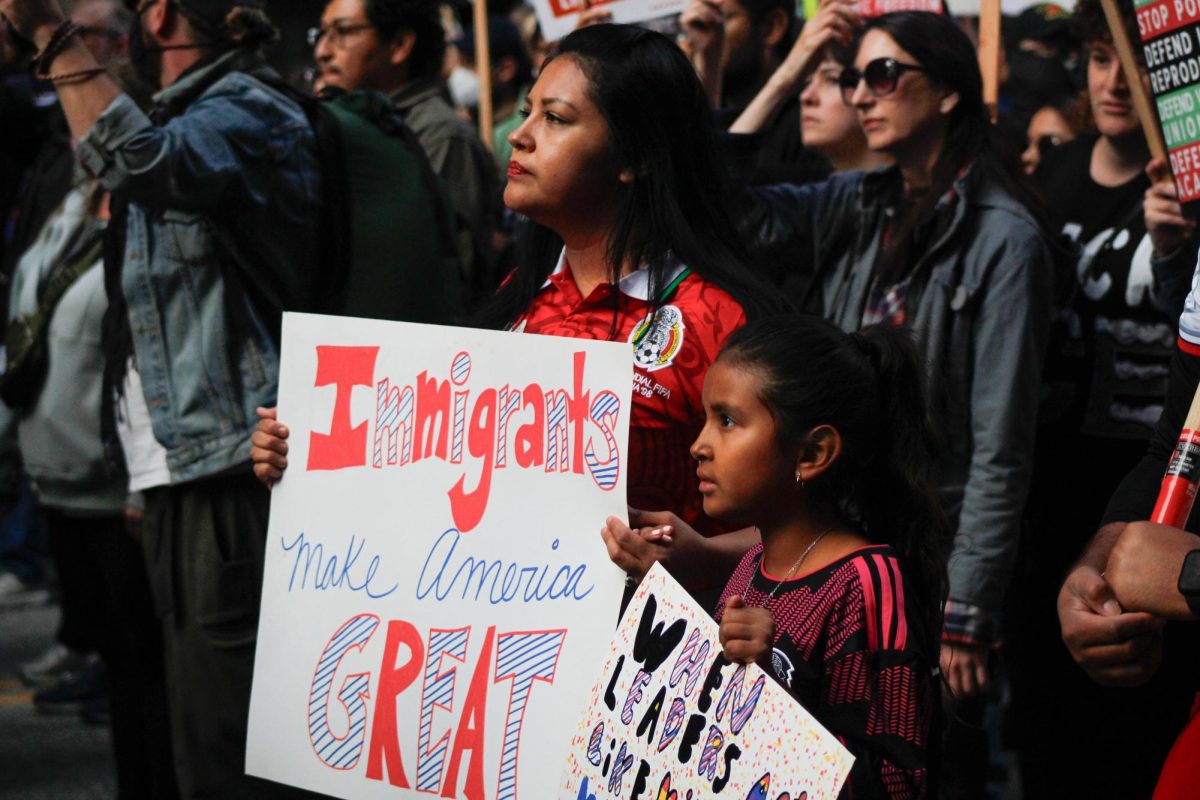
Just steps from Columbia’s campus, thousands of people flooded the intersection of Ida B. Wells Drive and Michigan Avenue on Saturday night, Sept. 6 to rally against President Trump’s threats to send the National Guard into the city and crack down on immigration.
The protest, led by the Coalition Against the Trump Agenda and the Illinois Coalition for Immigrant and Refugee Rights, comes ahead of an expected surge in Chicago-area Immigration and Customs Enforcement operations.
The diverse crowd of young and old marched through the streets chanting “Chicago isn’t lickin’ boots” and “Power to the people, no human is illegal.” The protestors stopped in front of the ICE Chicago Field Office, located at 101 W. Ida B. Wells Dr. and the Dirksen Federal Building at 219 S. Dearborn St., which was fenced off.
“You can’t mess with Chicago, and we stand together for our community in solidarity with one another,” said Lincoln Square resident Sarah Bauer. “I’m really interested in protecting my neighbors and making sure my neighbors are safe.”
President Trump signed his 200th executive order on Friday, Sept. 5, renaming the Department of Defense as the Department of War. Hours later, he escalated tensions with Chicago, posting on Truth Social that he was ready to “unleash the Department of War” on the city. The post, echoing a line from the 1979 Vietnam War film “Apocalypse Now,” added: “I love the smell of deportations in the morning.”
Illinois Gov. JB Pritzker fired back on X, calling the rhetoric unprecedented. “The President of the United States is threatening to go to war with an American city,” Pritzker wrote. “This is not a joke. This is not normal. Donald Trump isn’t a strongman, he’s a scared man. Illinois won’t be intimidated by a wannabe dictator.”
Chicago Mayor Brandon Johnson also shot back on X. “The president’s threats are beneath the honor of our nation, but the reality is that he wants to occupy our city and break our Constitution,” he wrote. “We must defend our democracy from this authoritarianism by protecting each other and protecting Chicago from Donald Trump.”
The exchange followed a week of speculation about the possible deployment of the National Guard and federal immigration raids in Illinois as part of a broader response to undocumented immigration, homelessness and crime in Chicago. Earlier this week at a press conference, President Trump even referred to the city as a “hellhole” and claimed that it is the “murder capital of the world,” which is statistically inaccurate.
The mayor’s office reports that violent crime is down 24% compared to last year, countering Trump’s claim that Chicago is a hot spot for crime. Trump has also called the city the “worst and most dangerous in the world,” which is not true. According to the latest FBI statistics, the city’s violence crime rate isn’t even in the Top 20, a list that includes St. Louis, Cleveland and Cincinnati, Memphis, Tennessee, Indianapolis, and Birmingham, Alabama, all cities in red states with Republican governors.
The Pentagon has authorized Naval Station Great Lakes, about 35 miles north of the city, as a staging site for ICE operations. The Trump administration has described the campaign as a six-week crackdown in Chicago, with ICE and Homeland Security using the naval facility as a logistical hub.
Pritzker had warned that operations were likely to intensify this weekend ahead of Mexican Independence Day, a major cultural celebration in Chicago’s Latino neighborhoods.
Latino neighborhoods have already postponed cultural events, including the annual El Grito festival in Grant Park, citing fears of disruption and heightened surveillance. But in Pilsen on Saturday, a parade to celebrate Mexican Independence Day went on as scheduled.
Federal Plaza, long a rallying point for Chicago demonstrations, has been fortified with 12-foot metal fences in anticipation of larger protests this weekend. In June, the plaza was the site of mass rallies against federal actions in Los Angeles.
On Friday, about 200 protesters blocked access to an ICE processing center on the city’s West Side, the Sun-Times reported.
Illinois is home to one of the largest immigrant populations in the country. A recent Pew Research Center study ranked the state sixth nationwide in the number of residents living in the U.S. without legal authorization, part of a record 14 million nationally in 2023.
“We want to show our support and keep the city a safe place for everybody to live,” said Jeffery Gore, a senior lecturer in English at the University of Illinois Chicago. “Especially for us at UIC, we want our students to come to class and to feel safe and to do their homework and to be able to just do regular student things.”
Earlier this week, Columbia said campus operations will continue as normal while it monitors reports of National Guard and federal immigration agents in Chicago, as the Chronicle previously reported. The college urged students to stay alert and to use support resources.
Nearly 28% of students identified as Hispanic in 2024, according to the college’s Office of Institutional Effectiveness.
“I think it’s important that we stand for what we believe in and our values,” said Lili Burciaga, a daughter of immigrants. “To me, it’s important that all human beings are valued and that we stand up when there’s injustice.”
Burciaga said she was worried about families being separated, children getting harmed and the “lack of process” for those being deported.
Although the Trump administration initially said it was going over criminals in its mass deportation effort, that has not been the case, the Cato Institute found. Through the end of July, one in five ICE arrests were Latinos on the street with no criminal past or removal order.
A report from the UC Berkeley Deportation Data Project found that the majority of arrests in Washington, D.C., where Trump sent National Guard troops last month, involved people with no criminal record.
Gore, the UIC lecturer, was concerned about this as well. “It’s horrible to imagine that somebody is following the law, doing their job, going to work, and that suddenly they could be picked up for doing normal human things,” he said. “We have people that are very law-abiding immigrants that are doing what they’ve been ordered to do and they are detained for that.”
Burciaga said that despite this uncertainty, she feels proud that people from diverse backgrounds showed up to support a cause that may not directly affect them as it does her.
At one point during the march, the protesters chanted in Spanish, “¡Se ve, se oye, estamos en la lucha! ¡Se ve, se siente, el pueblo está presente!,” which translated into English is, “It’s seen, it’s heard, we are in the fight! It’s seen, it’s felt, the people are present!”
Burciaga said it was empowering to be surrounded by others willing to take a stand. “When we come together, we are stronger,” she said.
Additional reporting from Carlos Alanis-Avila and Sofia Oyarzún.
Copy edited by Matt Brady and Brandon Anaya
Resumen En Español
Miles de personas protestaron en la noche de Septiembre 6 en la intersección de Ida B. Wells Drive y Michigan Avenue.
Esto fue en respuesta a las amenazas hechas por el Presidente Trump de mandar la Guardia Nacional a la ciudad por sus pólizas contra immigracion.
Algunos vecindarios latinos han pospuesto eventos culturales por la preocupación de la llegada de ICE, cual sus operaciones están temporalmente situadas en la Naval Station Great Lakes, 35 millas norte de la ciudad.
El Gobernador JB Pritzker ha advertido sobre la probabilidad de que las operaciones de ICE se iban a intensificar este fin de semana antes de la celebración de la Independencia Mexicana.
Las personas que participaron en el protesto de hoy marcharon alrededor del vecindario y pararon en frente del ICE Chicago Field Office al igual que el edificio Dirksen Federal.
“¡Se ve, se oye, estamos en la lucha! ¡Se ve, se siente, el pueblo está presente!,” fueron dos de los cantos hechos por los protestantes hoy.
Resumen escrito por Uriel Reyes
Resumen editado por Brandon Anaya