Rev. Jesse Jackson, who died last week at the age of 84, lay in repose in an open casket at Rainbow PUSH headquarters in Chicago as hundreds of mourners lined several blocks to pay their respects.
The civil rights icon and two-time Democratic presidential candidate was mentored by Martin Luther King Jr. during the civil rights movement and was with him when he was assassinated in 1968. Jackson later became known for decades of civil rights leadership, nonviolent activism and high-profile negotiations to free Americans held abroad.
A weeklong celebration will take Jackson’s body from Chicago to Washington, D.C. and then to South Carolina before returning to Chicago for the burial on March 7.
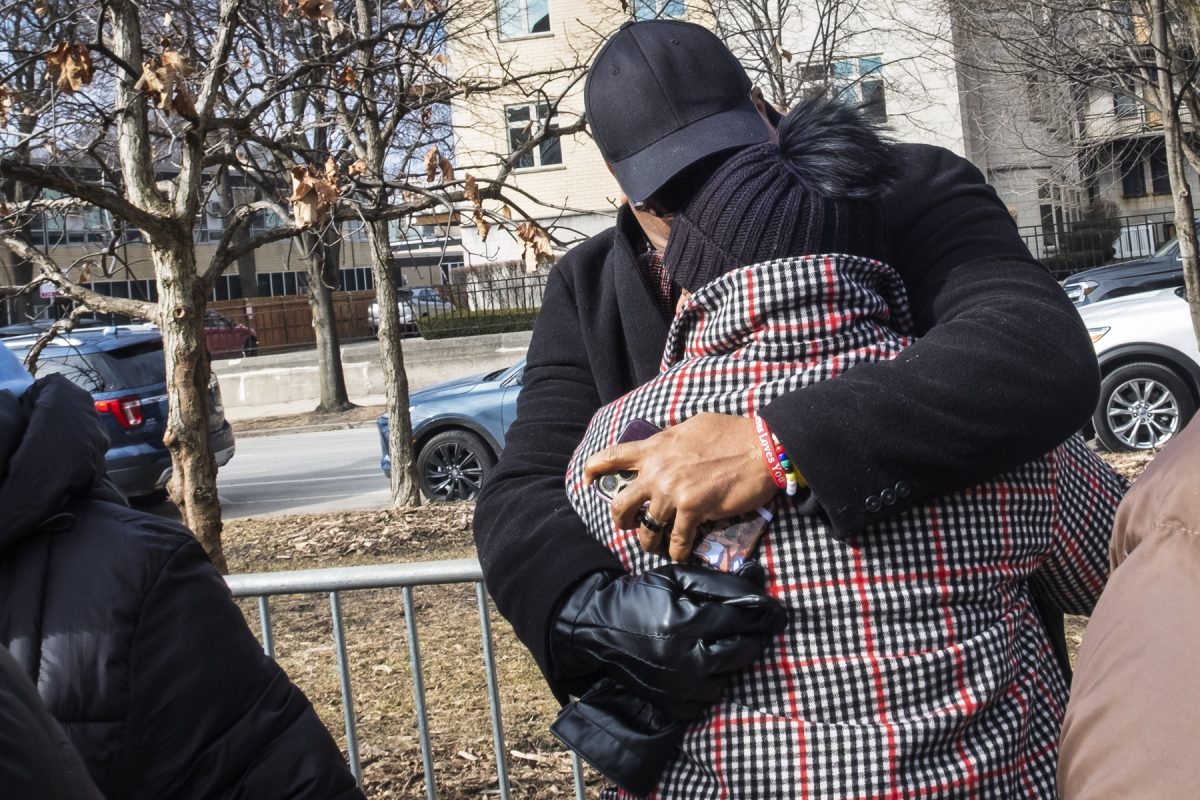
A chill breeze and cold morning air greeted mourners who began lining up at the Rainbow PUSH headquarters before a 10 a.m. service. The public chanted, “I am somebody” and “keep hope alive” upon entry.
Visitors received commemorative bookmarks at the entrance. Family members and close friends sat in the first three rows near the white casket. Family stood by the open casket, greeting mourners and thanking them for coming.
“We were really influenced by his influence,” said Camari Sire, a Columbia College Chicago alum who attended the visitation with her mother, Arnetta Sire.
Camari Sire said her grandmother worked closely with Jackson for years at Operation PUSH, the Chicago-based civil rights and economic empowerment organization that Jackson founded in 1971. The Rainbow PUSH Coalition was formed in 1996 when Operation PUSH merged with Jackson’s earlier political organization, the National Rainbow Coalition, which grew out of his 1984 and 1988 presidential campaigns.
Arnetta Sire said her mother was an advocate for the underserved and underprivileged, a commitment that mirrored Jackson’s life work.
“She’s a big advocate and motivational person, so we like to follow the people that are leading us in the right direction,” Arnetta Sire said.
Chicago Major Brandon Johnson, the Rev. Al Sharpton and former Congressman Bobby Rush also stood in a receiving line greeting members of the public.
To Johnson, the relationship was personal.
“To me, he was a friend and a mentor, someone who saw somebody in me, and encouraged me to continue to organize and push for liberation and justice.”
Jackson had received several high-level accolades for his civil rights work, including the NAACP Spingarn Medal in 1989, the Presidential Medal of Freedom in 2000 and France’s Commander of the National Order of the Legion of Honor in 2021.
Danielle Carter Tripp, from the Auburn neighborhood, said she was grateful for Jackson’s bravery.
“I’m thankful I’ve benefited from the fact that I can feel safer to go and ask for things that I should have an access to,” Tripp said. “So I’m thankful for Jesse Jackson that they made things available, possible for us to be able to work, work in positions that we were not traditionally having access to.”
Marsean Wilder, from the Calcolumet neighborhood, said Jackson was “just a good person.”
“I’m proud to be here to pay my respects to a great man that everybody loved, that he did his best to help not just black people, but everybody. Right? Everybody. He just was that kind of person,” Wilder said.
To the city’s mayor, Jackson was a “shining example” of collective action for others to live by, and his work through the Rainbow PUSH Coalition reflected that.
“He wanted everyone to be able to express their purpose,” Johnson said. “He lived his purpose so that we could live ours.”
Additional reporting by Liam Rieber
Copy edited by Katie Peters