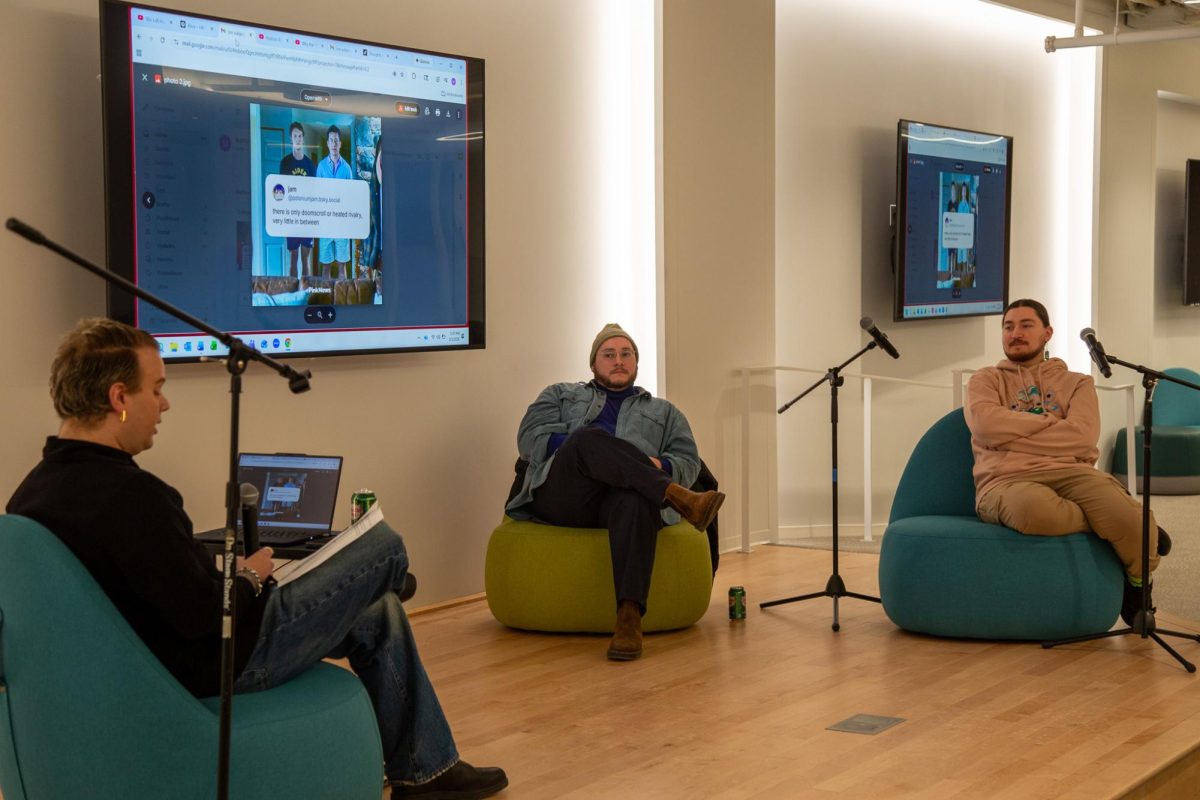
Columbia’s Office of Student Diversity and Inclusion brought students together to talk about identity, storytelling and representation through the lens of the hit series “Heated Rivalry.”
The show is a sports romance drama series based on the second installment Rachel Reid’s “Game Changers” series that gained rapid popularity after its debut in late 2025.
The show follows the rivalry of two professional hockey players Shane Hollander, played by Hudson Williams, and Ilya Rozanov, played by Connor Storrie, whose fierce competition on the ice masks a deep, secret romantic connection.
For Matthew Rillie, coordinator of education in SDI office and one of the panelists, the event was rooted in creating space for identity-centered conversations.
“One of our main goals is to really make space to talk about identity,” Rillie said. “It’s been really special to have a show right now where identity is kind of the forefront of conversation.”
The discussion focused on queer storytelling and expectations audiences bring to those narratives. Rillie said the show challenges what people have been conditioned to expect.
“What’s coming up when we are socialized to think that queer stories are not representative or they’re not happy or we can’t escape into them?” he said. “I really just wanted to spend some time seeing what we expected. And if it wasn’t what we expected, why was that?”
Senior ASL-English interpreting major John Reyes, who was also part of the panel, said the show’s storytelling style stood out to him the most.
“The thing that hit hardest for me for this show was its ability to show and not tell,” Reyes said. “There’s entire scenes where there’s zero dialogue. We’re having to use critical thinking skills to fill in the gap, and that ends up making it a lot more immersive.”
Reyes added that hearing other perspectives during the panel deepened his understanding of the show.
“I think that getting the opportunity to kind of dig deeper into what might have been a motivation for making certain choices,” he said. “It’s like I have a deeper understanding of how people feel about this show and how it has impacted other people differently than it impacted me.”
The panel also explored representation and parasocial relationships, the emotional bonds audiences form with fictional characters and actors. Rillie presented clips of the show to highlight themes represented in the show. Tiktoks were also used to show other people’s reaction to the show.
Reyes described how viewers often connect their own identity to characters in meaningful ways.
“When they can resonate with their own identity with that character, it kind of adds another layer of, ‘Oh, well, if they can do something, that means that I can do that too’,” he said.
Attendees also shared personal reflections during designated discussion moments. Students were able to share their thoughts on the actors, emotional impact, and behavior from the public towards the show and the breakout stars overall.
James Johnson, a sophomore animation major said he attended after recently finishing the series and wanted to hear different perspectives.
“I saw the flyer and I said, ‘Oh, I just finished that show’,” Johnson said. “I was just curious about what it would look like, especially in a college setting with maybe some people I didn’t know.”
Rillie emphasized that joy itself was a central theme of both the show and the conversation.
“I think one of the main messages of this show is that we deserve deep joy in our lives,” he said. “I really want to emphasize that joy is so much a part of our storytelling and so much a part of our world.”
Copy edited by Samantha Mosquera