A finalist for Columbia’s next provost said investing in faculty development, even if “something else maybe needs to go,” is critical if student success is to remain the college’s “North Star.”
Melissa Rands is one of the three remaining candidates selected by a search committee to find a replacement for Senior Vice President and Provost Marcella David, who stepped down on June 2 after six years at the college.
Suzanne McBride, the college’s Dean of Faculty Affairs, has been serving as Interim Provost since June 3.
Rands, who is currently the Vice President of Academic Affairs and Interim Director of Foundation Studies at the Minneapolis College of Art and Design, said that investing in faculty development is critical to student success.
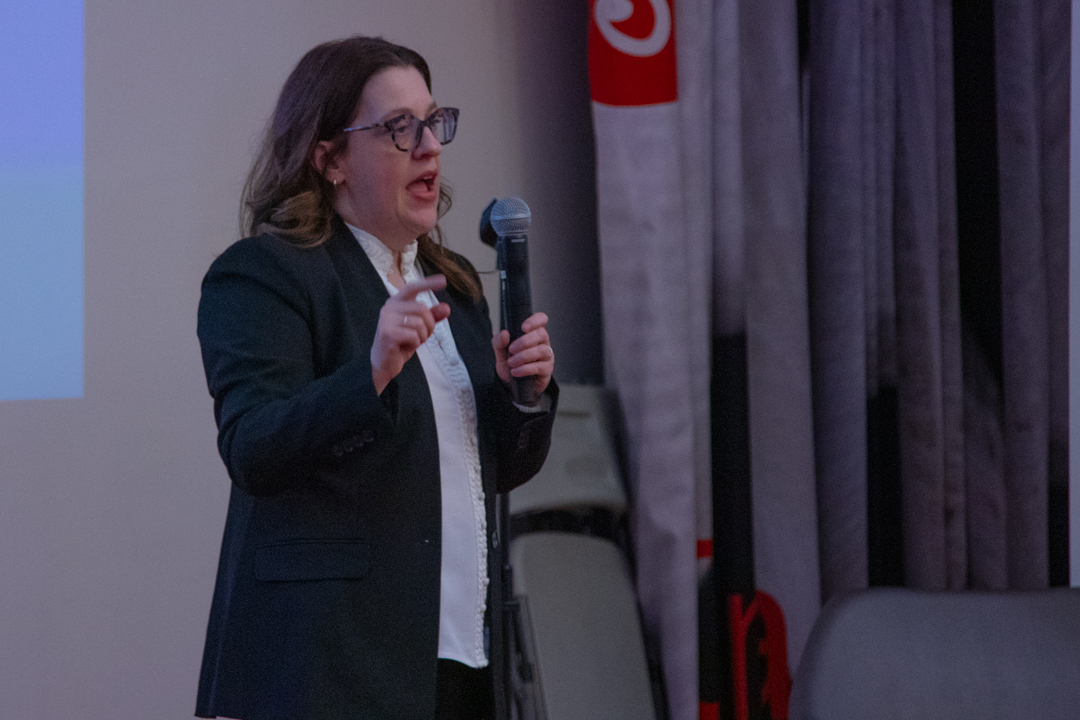
“However, I know it’s real, right, that budget cuts are real,” Rands said during a forum at Columbia on Monday, Feb. 23. “But I very strongly believe in this, so one of my priorities would be to raise some funding back for that.”
The college is hosting an open forum for each candidate to “present their vision for advancing academic excellence, strengthening support for students and faculty, and shaping the future of Columbia College Chicago,” according to an email sent on Friday, Feb. 20.
Rands was the first of the candidates to speak to the college. The two remaining forums will be held at 2 p.m. on Tuesday and Friday in the Ferguson Lecture Hall in the 600 S. Michigan Ave. building.
The other two candidates are Michael Soto, the former Provost and Senior Vice President of Academic Affairs at Point Park University in Pittsburgh, Pennsylvania, and Cristina Goletti, a professor and Dean of the College of Performing and Visual Arts at the University of Northern Colorado.
Madhurima Chakraborty, a member of the search committee and an associate professor in the School of Communication and Culture, said choosing a new Senior Vice President and Provost is a crucial decision for Columbia.
“It’s really important to get a sense of how people across the college community are responding to a candidate and what kind of questions are on their mind,” she said.
Ames Hawkins, Interim Director of the School of Communication and Culture, emphasized the importance of faculty and staff engagement in this process.
“It’s critical that the community participates in hearing from all the candidates and being allowed an opportunity to provide our feedback,” Hawkins told the Chronicle after the forum.
Rands began the forum with a 10-minute presentation with a brief introduction of her qualifications, then a list of ideals, priorities and goals for Columbia if she were to be selected for the role.
“A core value of mine is that institutional vision does not come from a singular person,” Rands started. “Institutions thrive when they clearly live their mission, find what distinguishes them and align that strategy to its identity. So that academic vision of Columbia must come from all of us — from our shared values, our care for students and our commitment to the community.”
Rands explained that her approach to this role would be to elevate the ideas that come from Columbia’s campus community, develop a strategy to accomplish those goals and take action to implement them.
However, she said that “a wish list is not a plan.”
Discipline and structure, Rands said, are the strategic key to making impactful change happen. She said that Columbia’s priorities must align and be willing to adjust to focus on a vision for the future of the college.
“All the things that make creative education special also cost a lot of money,” Rands said.
She acknowledged the reality that many colleges and universities are facing nationwide, including demographic shifts, affordability concerns, skepticism about the value of earning a degree and enrollment and financial pressures.
To cut costs, the college eliminated and consolidated nearly half of its programs in 2024.
Columbia’s enrollment has been steadily declining since 2019, but hit a new low in Fall 2025 when the college lost more than 1,000 students, with total enrollment dropping from 5,571 to 4,461.
At President and CEO Shantay Bolton’s State of the College address in October, she announced that despite cost-cutting efforts, Columbia’s budget deficit had climbed to about $40 million, attributing it in part to a smaller incoming class.
“Guiding an institution through change is not only about responding to pressure,” Rands said. “It’s about strengthening the creative core while ensuring students and faculty thrive.”
Hawkins said that an ideal candidate is “somebody who understands very much the kinds of programs that we offer — that’s No. 1 — and somebody who understands and can appreciate all the various challenges that there are.”
Chakraborty said she had a similar mindset while imagining someone to fill this role.
“Somebody who has a sense about the quirkiness of our college and loves us for it,” she said, “and is comfortable approaching all folks on our campus with respect.”
During the forum, several faculty questioned Rands about how she would raise morale at the college after 48 full-time faculty were laid off in 2025, representing about 20% of all faculty.
“I very strongly believe in faculty development because I know the research has shown the more you invest in your faculty and their development and their collective efficacy, the more it leads to student success,” Rands said. “It’s undeniable.”
In an interview with the Chronicle after the forum, Rands said her current institution holds regular town halls where “anyone is welcome to join the conversation.” She added that student government representatives regularly meet with administrators.
Rands did not directly respond to a question about her policy on engaging with student media.
Asked what she hoped faculty and staff took away from the forum, Rands said she wants them to view her as “a consultative, data-informed, collaborative leader.”
Copy edited by Katie Peters