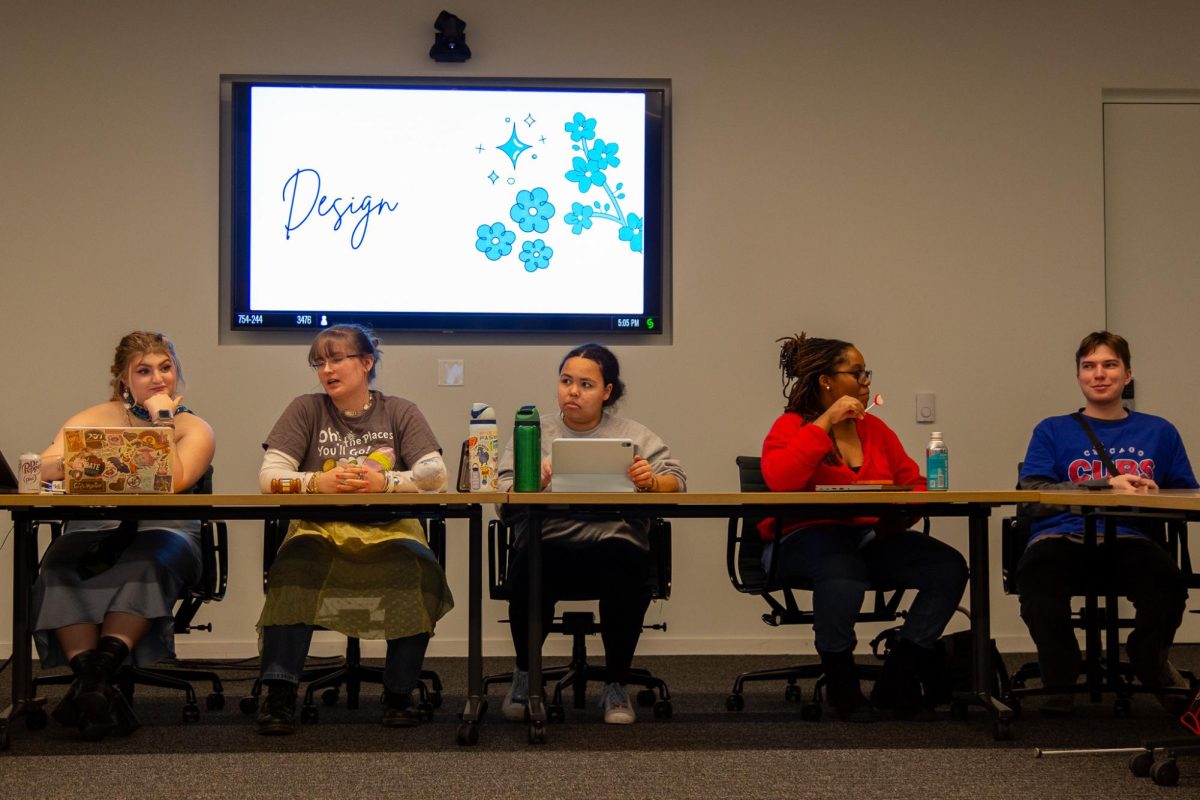
When the Student Government Association held its spring election this week, only one student stepped forward to fill a vacant senate seat, a result that reflects broader challenges facing student participation on campus.
Candidates had two minutes on Tuesday, Feb. 3 at the Student Center to address voting members. Sophomore musical theatre major Charlie Rush-Reese was the only student elected, filling the senate seat representing honors students.
Columbia’s overall enrollment has declined in recent years, shrinking the pool of eligible and willing students to take on leadership roles. Student leaders say that reality, combined with academic workload and scheduling challenges, has made filling senate seats increasingly difficult.
“The spring is harder to fill seats because everyone’s schedule is so packed,” said Jenna Davis, the President of the SGA and a senior fine arts major.
Rush-Reese, a sophomore musical theatre major, previously served in the LGBTQIA+ senator seat.
“I love academics, and it’s a huge part of my life,” said Rush-Reese. “I wanted to have at least somebody represent this community on campus.”
No senators were elected for positions to represent the schools of Design, Business and Entrepreneurship, and Audio and Music. The community senate seats representing on-campus, transfer, commuters, international students and student workers will also remain vacant.
“It’s important for students to run for senate positions during such a transitional time because they are the ones meeting with school directors and representing those communities’ voices,” Davis said. “There cannot be change if we don’t work together and we need someone from every community to do that.”
Senators represent the variety of student groups on campus, ranging from academic communities like the School of Visual Arts, to identity and experience-based groups like first-years and students with disabilities.
Students run for Senate seats in the fall and any remaining vacancies are typically filled through a spring election. During an election, candidates are given two minutes to convince present members why they should be chosen for a position. If a candidate runs unopposed, they must be chosen through a yes-majority.
Michael Kowalkowski, SGA’s vice president of finance, said the organization acts as a “liaison” between the students and Columbia’s administration.
“It’s always small things that come up within communities and departments and that’s what we really focus on,” said Kowalkowski, a junior fine arts major. “We’re students ourselves, we see those issues.”
Columbia’s overall enrollment has been on a steady decline since 2019, before the COVID-19 pandemic. The college’s fall enrollment fell by over 1,000 students, dropping to 4,461 from 5,571 last fall, as the Chronicle previously reported.
Lucy Nemec, a student representative for SGA, said she was “a little bit surprised” when so few students chose to run for a senator position.
“It was about the same as last semester,” said Nemec, a first-year music business major. “I thought that there might be more people coming today to apply to be a senator, so it was a little surprising when only one person did.”
Amelia Lutz, executive vice president for the Student Government Association, remains optimistic despite the low turnout.
“We always have a bit of a smaller turnout going into spring semester compared to the fall,” said Lutz, a junior film and television major. “The start of the semester is when we do our elections, and because they’re rolled into training we usually only have a few people show up for them.”
In addition to timing, Kowalkowski said it is also common for seats such as the transfer and international positions to remain vacant due to the difficulty of finding someone in a “niche and smaller” community.
“As an E-Board, we have to be more particular about how we plan a few events throughout the school year,” said Kowalkowski. “If there is a spot that is open, student reps always want to help in any way they can.”
Although SGA has no plans for a second round of elections, a special election may be held if students reach out with interest in filling the remaining seats.
“Even if only for one or two meetings, all student voices and input are valuable,” Lutz said.
Copy edited by Venus Tapang