
Columbia is hosting guided walking tours through the Wabash Arts Corridor in partnership with the Chicago Architecture Biennial for their 2025 theme of “Shift.” The tour explores murals surrounding the college’s campus and shows how street art becomes a catalyst for shifting attitudes and interactions with the city.
Led by two student guides from Columbia, the tours explore themes of disruption and community, encouraging participants to engage with what they see and maybe even reconsider their perspective on social and political topics.
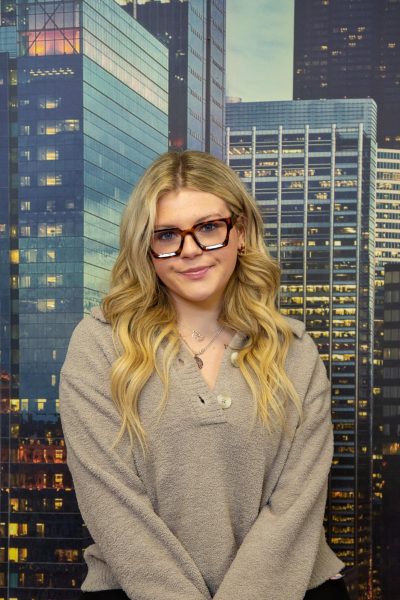
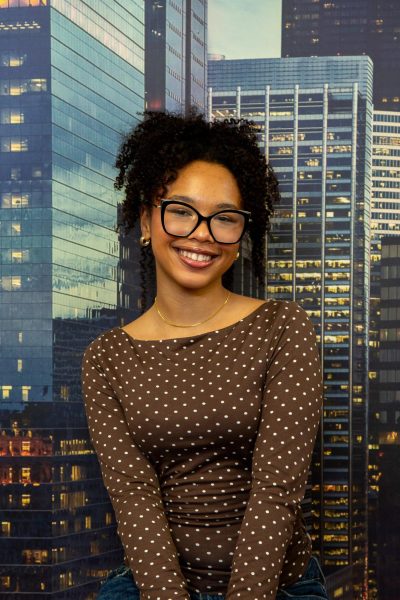
Madison Yager, a senior arts management and art history major, and Adilene Vega, a senior art history major, were asked by Greg Foster-Rice, associate provost for student retention initiatives, to lead and help arrange the tours.
Yager and Vega’s goal as tour guides is to teach the deeper meanings of these murals that people often walk by daily and don’t know the deeper meaning behind them.
“We’re really trying to activate campus and not only engage outside members of the community, but also students, because it’s so empowering to see these things around the city and say that Columbia has left a mark,” said Yager.
The Wabash Arts Corridor, founded in 2013 by Columbia faculty, has grown to be one of the most expansive, diverse and accessible public art programs in the country. The WAC is known for its especially deep representation of work by women artists and artists of color.
Some of the murals include a piece titled “Swamp” which spans the front of the 916 S. Wabash Ave. campus building painted by Cecilia Beaven, a part-time instructor at Columbia. Created just last fall, this work includes bright flowers, leafy greenery and vibrant reptiles.
“Moose Bubblegum Bubble,” a piece presented on the south wall of 33 E. Ida B. Wells Drive, was created by Columbia alum Jacob Watts who graduated in 2012. This work is one of the only photographic murals in Chicago and portrays a moose blowing bubblegum in front of a fence to challenge how one perceives humanity in contrast to animals.
Vega’s favorite mural on the tour is “On the Wings of Change,” located on the south side of 33 E. Ida B. Wells Drive building. This mural was created by Jasmina Cazacu, also known as Diosa, and pays a tribute to Ida B. Wells, and honors the unsung heroines of the suffragette and women’s rights movement.
“I have walked past this mural countless times in my three years at Columbia but never paused to fully take in its story. During my research in preparing a tour stop there, I have learned more about Ida B. Wells and her contribution to Chicago than all my time living here,” Vega said.
The tour took a historical dive into nine different murals, created by international artists and Columbia alumni and faculty, along Wabash Avenue from Ida B. Wells Drive to 11th Street.
Many of these murals challenged political ideals, one of the murals titled “Speak Up” by Dorian Sylvain, was originally supposed to be displayed at 524 S. Wabash Ave., but was denied by the owners for being too political. This mural features a quote from Kamala Harris with the words “I’m Speaking.” This piece is now featured on the side of 623 S. Wabash Ave.
Participant Fedor Adarichev said how impactful the walking tour was, especially as a Chicago native.
“It gave me so much more depth about not just Chicago but specifically this area, what it means for Columbia students and what it does for the women’s rights movement,” Adarichev said.
Adarichev’s favorite mural was “Curious Bunny” by Cheri Lee Charlton, an assistant professor in the School of Design, and is located on the side of the 754 S. Wabash Ave. building. He found it really impressive not only as the second biggest mural in Chicago, but also through different participants’ perspectives on the mural itself.
“Everyone brought up something different that they saw in that, and that got my mind thinking about a lot of different perspectives on the mural,” Adarichev said.
Vega said she hopes that these tours can inspire participants to begin thinking deeper about art that they see on their own, or even go out and create some. She added that “Regarding Columbia, I hope these tours spotlight the creativity within our campus community, but also how much we contribute to the city at large.”
The WAC will be doing four more walking tours in the coming weeks focusing on political disruption and encountering the community. These tours will take place on Oct. 25 and 26, and Nov. 1 and 2.
Copy edited by Mya DeJesus