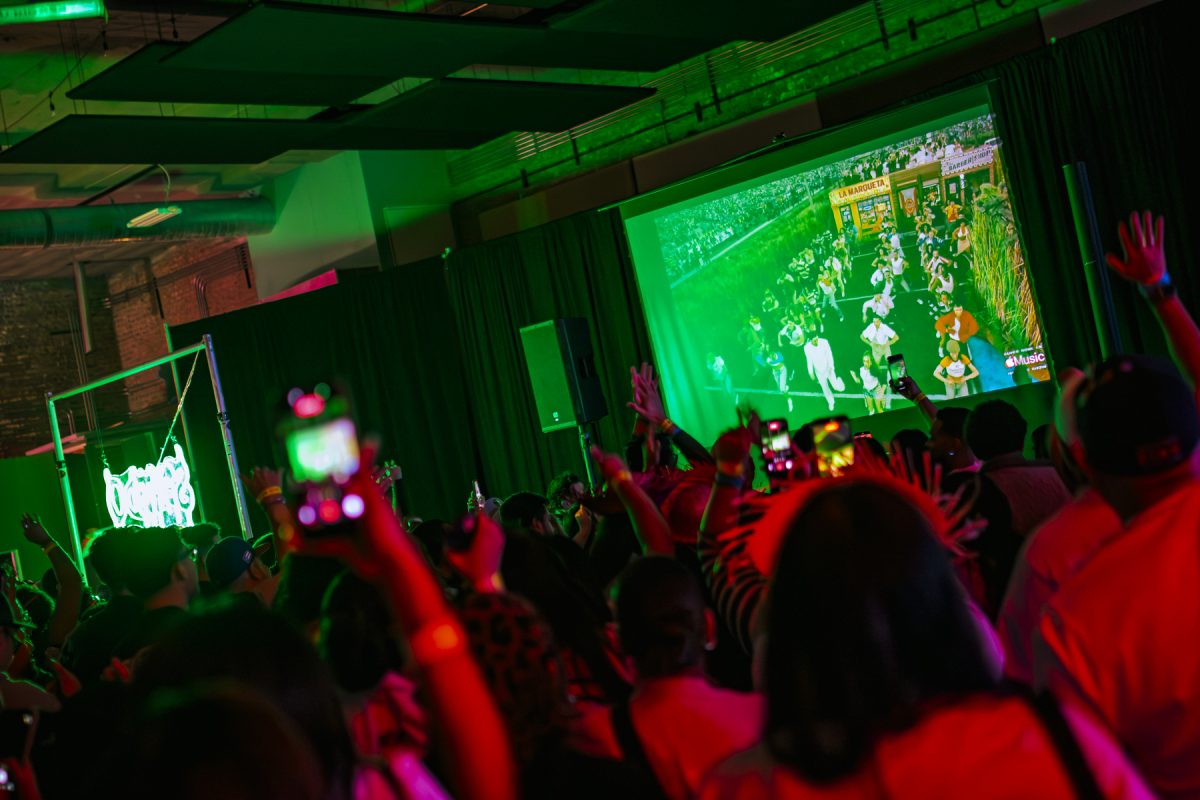

In a basement on Chicago’s North Side, the lights go down and the show begins. Movie screenings, drag shows, stand-up comedy, concerts and plays — performances that usually demand high ticket prices at major venues — are happening here for free, the work of a group of Columbia alumni determined to make art more accessible.
The space is called Big Foggy, and it’s tucked beneath the home of Biff Hartwell, who graduated in 2023 from Columbia with a bachelor’s in filmmaking. Hartwell and four friends now run the venue entirely out of his basement.
“Everything we do is going to be 100% free,” Hartwell said. “The moment you introduce money, it’s transactional. It’s not as connected of an experience as we want it to be.”
The separation of money from the creative process is important to Big Foggy. This sentiment is shared by Robin Boggs, who attended Columbia up until she dropped out in her sophomore year, and helped start Big Foggy after meeting Hartwell in a writing group.
“Money’s evil,” she said, “I like the people I’m working with to only want what they’re getting very directly out of it artistically. I want them to be able to come see it and not have to weigh its merits against what they put into it financially.”
“It’s good to have a space where people can be themselves in an expansive and free way,” Boggs said. “I don’t think that in itself is necessarily politically significant, except that it allows people to bring those feelings into other parts of their life. I think it’s good to be operating in a way that is counter to expectations and capitalism in as many parts of your life as possible.”
For Hartwell and his friends, accessible art is more than a mission. It’s a belief that young people, whether watching or performing, deserve the chance to discover what art can do.
“There’s so much that we grow up being told that, by the time we can think for ourselves, it’s just like a default,” Hartwell said, “So when I make art, I want it to be something that wakes people up and makes people feel really present in the moment and thinking about things in a new way.”
Chicago law permits venues with a capacity of less than 100 people and no admission fee to operate without a Public Place of Amusement license.
Big Foggy promotes its shows via its Instagram page, where its history of performances is archived, including the first production, an adaptation of the musical “Cats.”
“I think ‘Cats’ is an appealing show because it’s directed right at the audience. It’s kind of like a presentation for the audience where the audience is part of it,” said Hartwell. “I think it was the fun of taking a show that’s a huge spectacle and figuring out a creative way to make it that immersive and dazzling, but in such a small space.”
Audience participation is a big part of Big Foggy’s operation. What started with audience members singing along to Broadway tunes has since evolved into members of the crowd becoming the stars of drag shows, one of Hartwell’s favorite recurring events.
One such audience member is Mo Tardy, who graduated from Columbia in 2021 with a bachelor’s in public relations and did drag for the first time at Big Foggy.
“I felt safe to do that at Big Foggy because I know that my friends are also putting their asses on the lines creatively, they’re just as much in it as I am,” Tardy said, “Even the audience is so into it. It’s a really exciting way to perform. It feels very intimate.”
Intimacy is a key part of Big Foggy. The space seeks to promote comfort in creativity, allowing their performers to go as crazy as they want and express whatever they want.
“It’s transgressing what we know to be normal, I think that’s another thing that really draws me to Big Foggy,” Tardy said. “It makes me feel very loving towards all of the people that are performing there, because we are all working very hard to bring something weird to the table or something exciting, or something that makes you think something that’s true to our experiences.”
Queerness is a large part of Big Foggy’s artistic identity as well. Hartwell said that social norms around gender can limit a person’s ability to live and create.
“I think everybody is suffering under the enforcement of gender one way or another,” said Hartwell. “So we take a lot of care to not differentiate between people or separate. For the drag shows, anyone, no matter what someone identifies as for their gender or sexuality, they can perform, they can be there because subverting cultural expectations is a celebration of queerness, in our opinion.”
Big Foggy has more drag shows and film screenings planned through the rest of July, which Tardy will be attending.
“Keep putting them on, and I’ll keep coming back,” Tardy said, “We need as much weird shit as possible right now… I think it’s important that people see that it’s not just all of the terrible things that are happening right now. There’s also really beautiful queer and artistic communities that are creating things that are life affirming, and freak affirming.”
This story has been corrected.
Copy edited by Vanessa Orozco and Emma Jolly