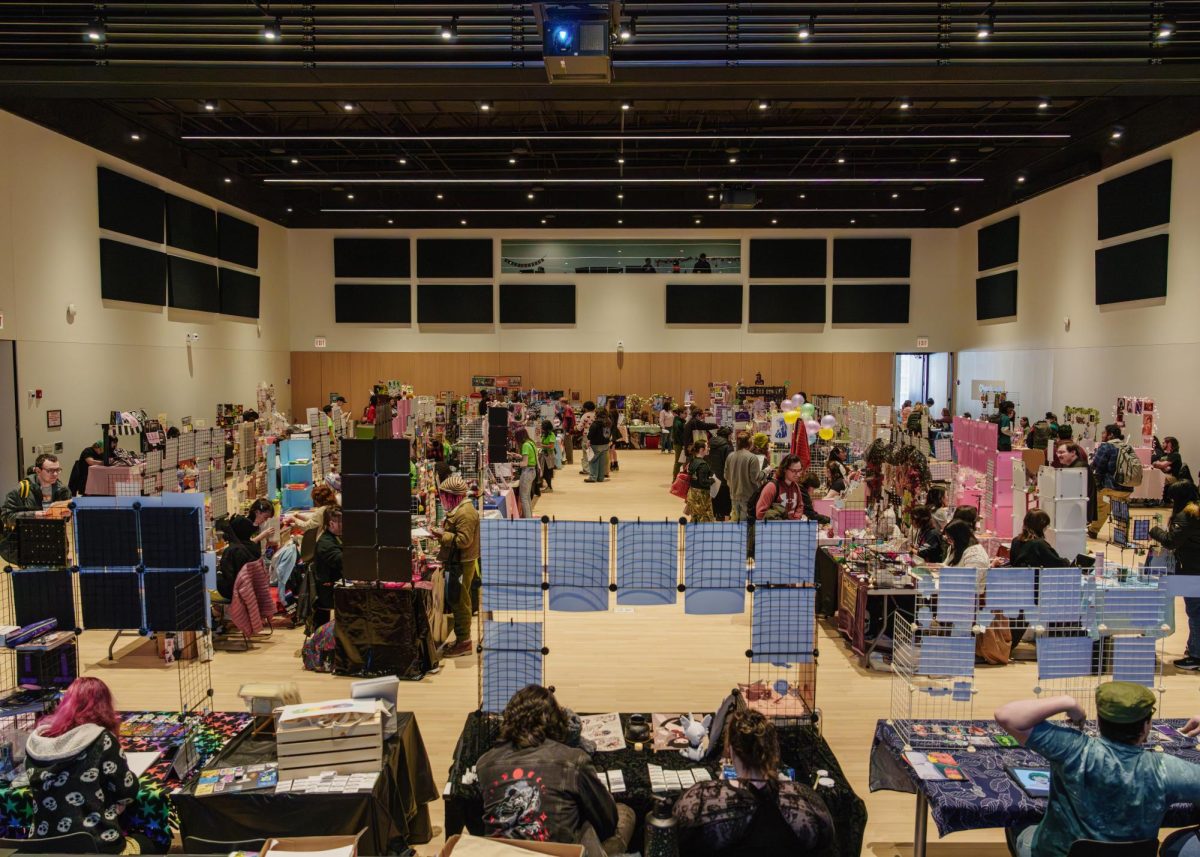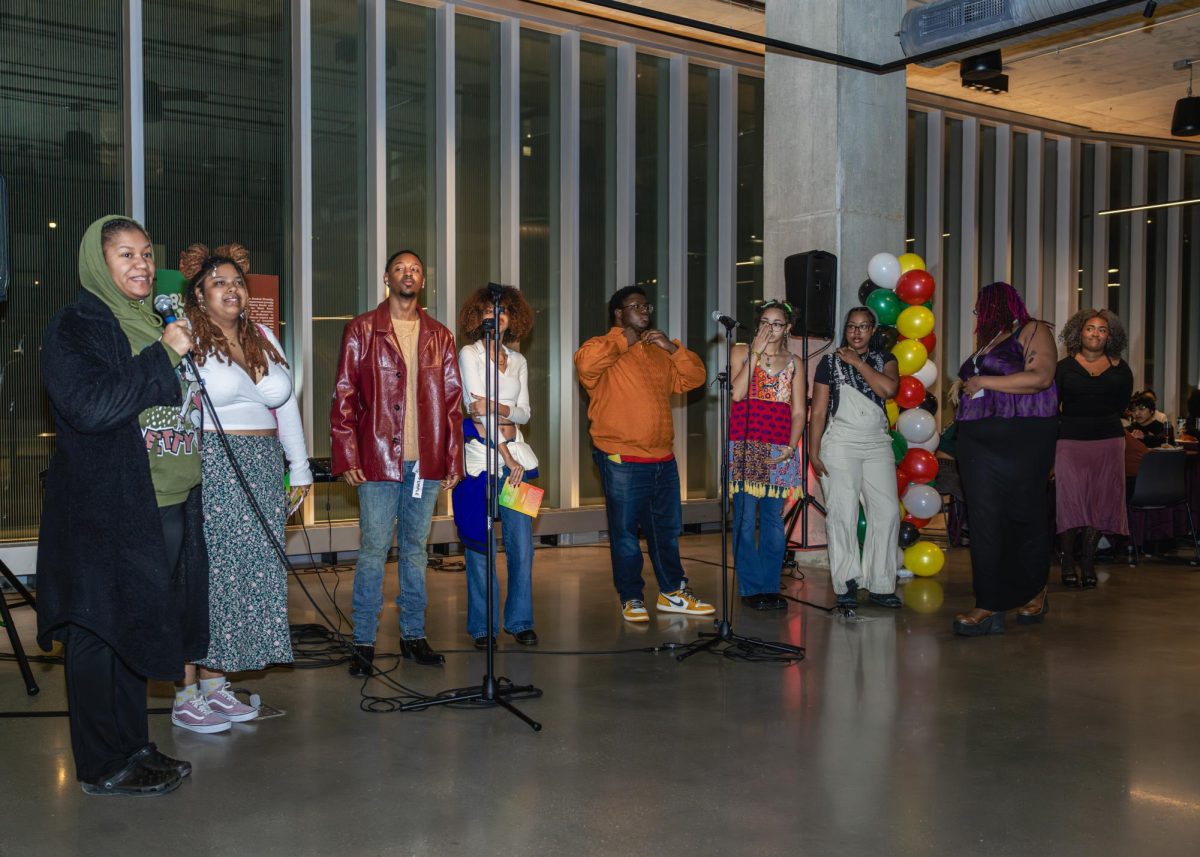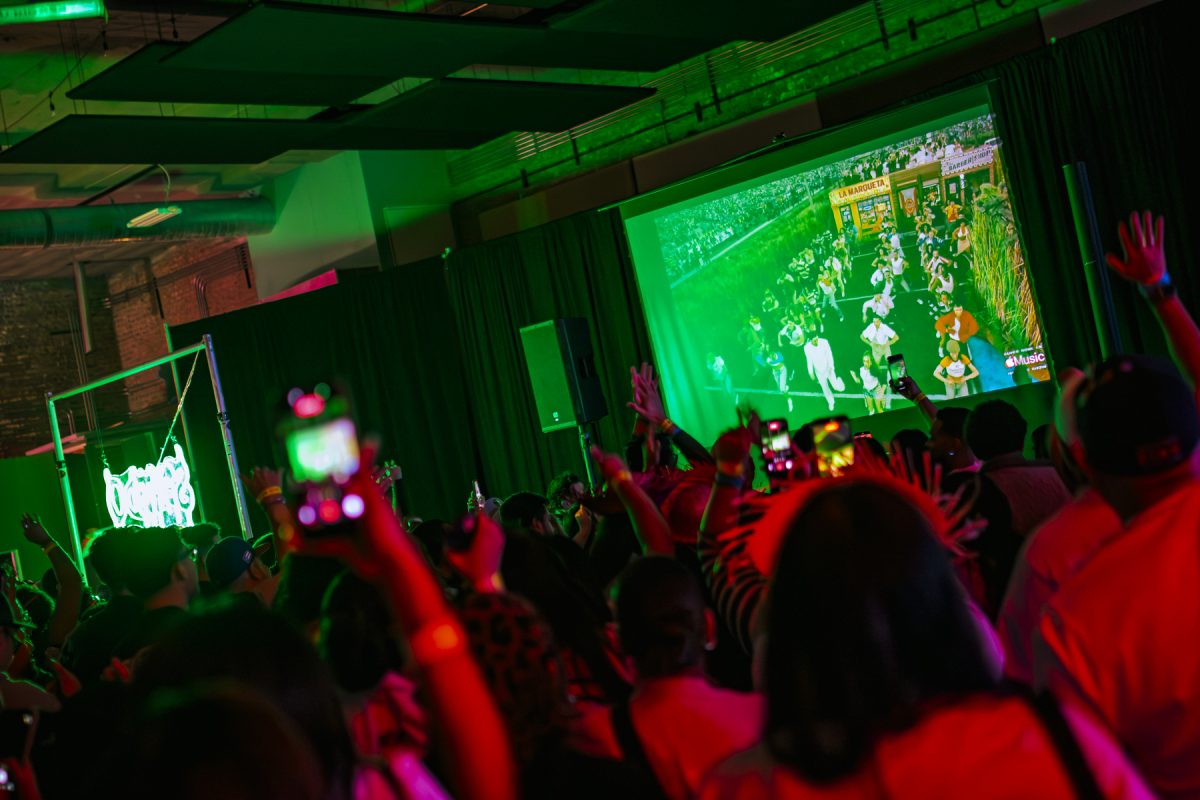

Nearly 100 people packed the fifth floor of Columbia College’s Student Center, raising their hands in applause instead of their voices.
They had come on Thursday night, Sept. 25, for the quarterly ASL Jam, an open mic hosted by Columbia’s ASL Club, even as the college moves to phase out its ASL-English Interpretation major.
The stage was filled with rhythm and expression as songs and stories unfolded. After every performance, the crowd cheered in American Sign Language, raising their hands and waving them in the air.
“The energy in the room was really fun and receptive,” said Riley Malcomson, a junior ASL-English Interpretation major who was one of the hosts of the event. For her, it was important to “get people together,” and to “do something for the Deaf community.”
Hyacinth Rodriguez, a junior ASL-English Interpretation student, performed their own interpretation of the pop song “Holding Out For a Hero,” by Bonnie Tyler.
“ASL has really been that thing of connecting my love of music, my love of performance, and my love of helping people,” said Rodriguez.
Ramina Daood, a senior ASL-English Interpretation major who has been to previous events, chose to perform Linkin Park and JAY-Z’s “Dirt Off Your Shoulder,” a song that contrasted with other choices.
“I enjoy seeing all these performances, but I also like to see variety,” said Daood. “So I decided to do a genre that I enjoy which is metal and another genre that I enjoy which is hip-hop and started to perform that.”
While some students performed songs, others decided to use the stage to tell stories instead.
Cicely Boggan, a Deaf high school teacher at Charles A. Prosser Career Academy, signed her own version of “The Boy Who Cried Wolf,” where she told it through the perspective of a person who is Deaf.
“I wanted to change those stories to be accessible for all Deaf people,” said Boggan, speaking through an interpreter in American Sign Language. She wanted to show the “perspective of a Deaf person in that story in a fun way.”
Victoria Cornelson, a senior ASL-English Interpretation major, told a story that she wrote a year before the event. Cornelson is also a creative writing minor and tries to incorporate the two often, so she translated the story into ASL to perform at the event.
However, she said that events like this have felt “different” since Columbia’s decision to sunset the interpreting program, even though the college will continue to support an ASL Studies minor.
“Realizing that we’re one of the last graduating classes from Columbia,” she said, “it’s definitely going to be a loss for the Deaf community.”
Enrollment in the ASL-English Interpretation program has been declining since 2020. In Fall 2020, there were 94 students. By Fall 2024, the number had dropped to 66, according to the Office of Institutional Effectiveness. The college cited the cost of the major in its decision to cut it, the Chronicle previously reported.
Mehg Solamillo, the student representative of the ASL Club and a sophomore ASL-English Interpretation major, believes that future events may not be as “extravagant” since there may be fewer students.
“I’m a little sad, but I’m hopeful that it’ll still continue at least in some form,” Solamillo said, adding that those who are pursuing the minor usually only reach conversation level, not fluency in ASL.
Kayleigh McReynolds, president of the ASL Club and a senior ASL-English Interpretation major, said that since it’s her last year, she wants the club to “do our best to make a good experience for everyone.”
“Jam is a way to express yourself and perform,” Solamillo said. “It’s a nice way to bring people together and to celebrate ASL.”
An interpreter was used in this story.
Copy edited by Vanessa Orozco